Facts
The petitioner, Ghanshyam Dansena, challenged the order dated 25 April 2023 passed by the Chhattisgarh State Information Commission in Second Appeal Case No. C/1140/2021/Raigarh.
Source reference: para. 1By that order, the Commission imposed a penalty of ₹25,000 upon the petitioner under Section 20(1) of the Right to Information Act, 2005, for failure to furnish information within the prescribed period.
Source reference: para. 1The petitioner consequently sought quashing of the Commission’s order.
Source reference: para. 2The petitioner contended that any delay in supplying the information was neither deliberate nor mala fide and was not attributable to intentional misconduct.
Source reference: para. 3The State Information Commission opposed the petition, relying on the requirement under Section 7(1) of the Act to provide information within thirty days.
Source reference: para. 4Issues
1. Whether the State Information Commission was justified in imposing a penalty under Section 20(1) of the Right to Information Act, 2005, without recording a finding that the petitioner’s failure to provide information was deliberate and mala fide?
Source reference: paras. 3, 6–72. Whether mere failure to furnish information within the thirty-day period prescribed under Section 7(1) of the Act was sufficient, by itself, to sustain the penalty?
Source reference: para. 4; paras. 6–7Law Applied
Section 7(1) of the Right to Information Act, 2005 requires the Public Information Officer to provide the requested information within thirty days.
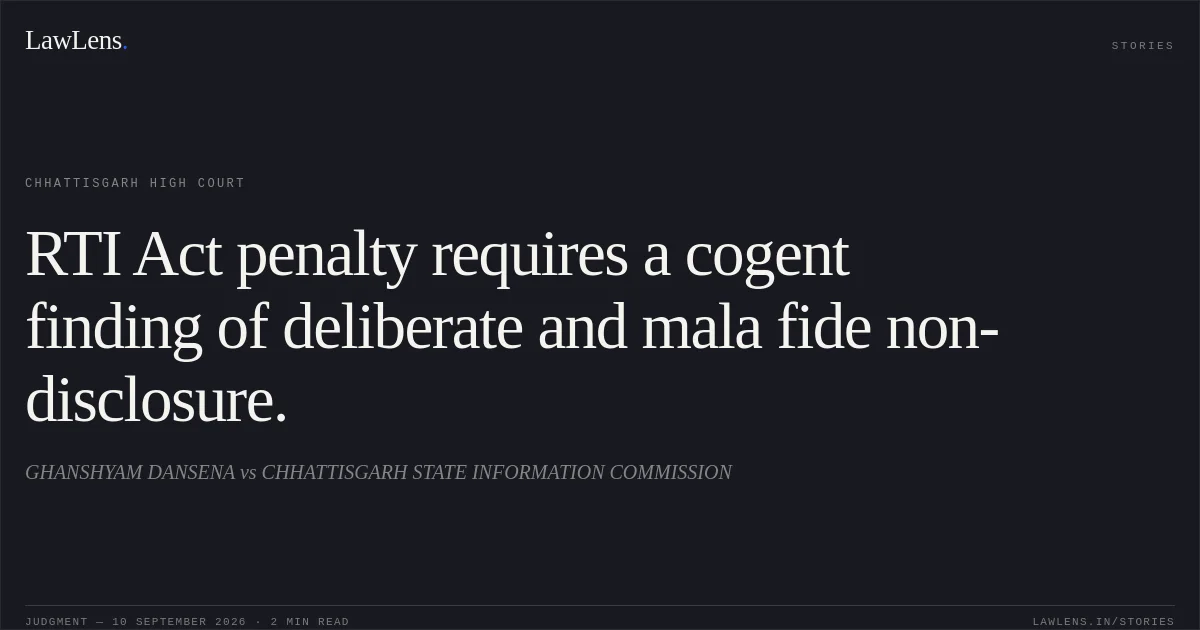
Source reference: para. 4However, penalty under Section 20(1) requires a categorical and reasoned finding that the information was withheld, or the statutory obligation was breached, through deliberate and mala fide conduct; in the absence of such a finding supported by cogent material, the penalty is unsustainable.
Source reference: para. 6The Court relied on Manohar S/o Manikrao Anchule v. State of Maharashtra, (2012) 13 SCC 14, for the principle that mala fide intent and deliberate non-compliance must be firmly established before imposing penalty under the RTI Act.
Source reference: para. 7Reasoning
The Court accepted that the petitioner had not furnished the information within the period contemplated by Section 7(1), but held that such delay, by itself, did not establish the intentional or mala fide conduct necessary for imposing penalty under Section 20(1).
Source reference: paras. 4, 6The Commission’s order did not record any finding that the petitioner deliberately withheld the information or acted with mala fide intent, nor did it identify material demonstrating that the delay was intentional.
Source reference: para. 6Applying the principle in Manohar S/o Manikrao Anchule, the Court concluded that the statutory preconditions for penalty had not been established.
Source reference: para. 7Holding
The Court held that the penalty imposed under Section 20(1) of the Right to Information Act, 2005 could not be sustained in the absence of a specific finding and supporting material establishing deliberate and mala fide non-compliance by the petitioner.
The writ petition was allowed, and the State Information Commission’s order dated 25 April 2023 imposing a penalty of ₹25,000 upon the petitioner was set aside.
Source reference: para. 8Acts & Sections Cited
2 provisions across 1 statute referred to in this judgment. Each provision opens on LawLens.
Right to Information Act, 20052
Original Court PDF
GHANSHYAM DANSENAvsCHHATTISGARH STATE INFORMATION COMMISSION
Click to open original judgment
Original judgment, available to read, download and summarize on LawLens.in