Facts
The petitioner, an Assistant Director/Public Information Officer in the Public Instruction Department, received an RTI application from Respondent No. 3 on 03.12.2018 seeking information concerning an enquiry against the Secretary of the Chhattisgarh State Open School.
Source reference: para. 1–2Since the information was not available in the petitioner’s office, he forwarded the request to Respondent No. 2, who informed him on 19.12.2018 that the enquiry was pending and the information could not then be supplied.
Source reference: para. 1–2Respondent No. 3 subsequently sought copies of the enquiry note-sheets and statements and filed first and second appeals.
Source reference: para. 1–2After completion of the enquiry, Respondent No. 2 supplied the information to the petitioner on 06.07.2020, and the petitioner forwarded it to Respondent No. 3 on 07.07.2020.
Source reference: para. 1–2The Chhattisgarh State Information Commission imposed a penalty of ₹25,000 on the petitioner under Section 20(1) of the Right to Information Act, 2005, for delay in furnishing the information.
Source reference: para. 2–3Issues
Whether the petitioner’s conduct amounted to failure to furnish information without reasonable cause so as to justify imposition of penalty under Section 20(1) of the Right to Information Act, 2005?
Source reference: para. 7–10Whether the State Information Commission’s penalty order was vitiated by non-consideration of the petitioner’s explanation and the material showing that he had promptly forwarded the information after receiving it?
Source reference: para. 9–11Law Applied
The Court applied Section 20(1) of the Right to Information Act, 2005, under which a Public Information Officer may be penalised for refusal, delay, or failure to furnish information where such failure is without reasonable cause.
Source reference: para. 7–8The Court held that mere delay, viewed in isolation, is insufficient; the authority must examine the explanation offered by the Public Information Officer and the steps taken in discharge of statutory duties.
Source reference: para. 7–8The Court also applied the principles of reasonableness, due consideration of relevant material, and procedural fairness, holding that the adjudicating authority must properly consider the officer’s reply before imposing a penalty.
Source reference: para. 9–11Reasoning
The Court found that the petitioner had not remained inactive after receiving the RTI application. He promptly forwarded the request to the authority possessing the information, namely Respondent No. 2.
Source reference: para. 5–6The information was ultimately supplied to him only on 06.07.2020, and he forwarded it to the applicant on the very next day, 07.07.2020.
Source reference: para. 6Since the delay principally occurred while the petitioner was awaiting information from the concerned authority, and since he acted immediately upon receiving it, the Court held that the delay could not be attributed to deliberate, unreasonable, or mala fide conduct on his part.
Source reference: para. 7–10The Commission failed to adequately consider these material facts and the petitioner’s explanation before imposing the penalty.
Source reference: para. 9–11Holding
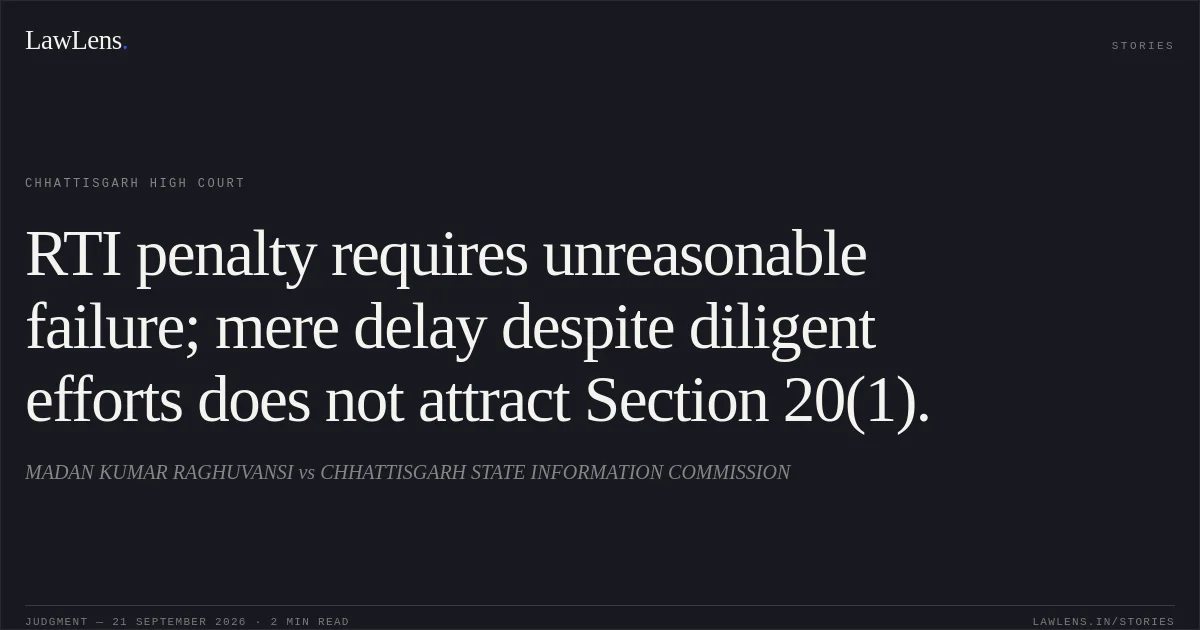
The Court held that the petitioner had demonstrated reasonable cause and diligence, and that the delay did not warrant penalty under Section 20(1) of the Right to Information Act, 2005.
The penalty order dated 05.05.2022 imposing ₹25,000 on the petitioner was held unsustainable for non-consideration of material facts and his explanation.
Source reference: para. 11–12The writ petition was accordingly allowed, and the impugned order was quashed and set aside.
Source reference: para. 11–12Acts & Sections Cited
1 provisions across 1 statute referred to in this judgment. Each provision opens on LawLens.
Right to Information Act, 20051
Original Court PDF
MADAN KUMAR RAGHUVANSIvsCHHATTISGARH STATE INFORMATION COMMISSION
Click to open original judgment
Original judgment, available to read, download and summarize on LawLens.in