Facts
The petitioners manufacture pan masala using Form Fill and Seal (FFS) machines. In March 2026, they installed three additional machines which became operational on 20.03.2026
Source reference: para 2.1-2.5The Assistant Commissioner levied cess for the entire month of March for these machines under Rule 12(4) of the Health Security National Security Cess Rules, 2026
Source reference: para 2.6The petitioners sought a proportionate abatement of ₹4,70,70,967 for the 19 days prior to installation when the machines did not exist in the factory
Source reference: para 2.7Their application was rejected on 22.04.2026 on the grounds that abatement under Rule 15 applies only to the temporary closure of already installed machines, and Rule 12(4) mandates calculating cess based on the maximum number of machines installed on any day during the month
Source reference: para 2.9Issues
1. Whether Rule 12(4) of the Health Security National Security Cess Rules, 2026, is ultra vires Sections 4, 5, and 35 of the Cess Act, 2025, and Articles 14 and 19(1)(g) of the Constitution
Source reference: p.1, para 52. Whether a taxable person is entitled to proportionate abatement of cess for the period of a month prior to the actual installation and operation of a new machine
Source reference: p.17-18, para 14Law Applied
Section 4 of the Cess Act, 2025, which levies cess on "machines installed" for production
Source reference: p.11Section 5 prescribes the computation of cess based on machine speed and product weight as specified in Schedule II
Source reference: p.12Section 5(7) permits proportionate abatement only when a machine remains "inoperative" for a continuous period of 15 days or more
Source reference: p.13Rule 12(4) of the Cess Rules, 2026, stipulates that for adding or removing machines, the monthly cess is calculated based on the "maximum number of machines installed on any day during the month"
Source reference: p.15The Court followed the principles from State of Tamil Nadu v. P. Krishnamurthy, establishing that subordinate legislation is presumed valid unless it lacks legislative competence, violates fundamental rights, or is directly inconsistent with the parent Act
Source reference: p.19-20Reasoning
The Court held that Rule 12(4) must be read in conjunction with Section 5 and Schedule II, which link cess to the production capacity of installed machines rather than just the duration of their presence
Source reference: para 12-13The Court reasoned that the statutory scheme intends to charge cess based on the total production capacity available in a given month
Source reference: para 16The Court rejected the petitioners’ argument that machines not yet installed are "inoperative" under Section 5(7), clarifying that "inoperative" refers to machines that exist but are not functioning
Source reference: para 14To allow proportionate deduction for mid-month installations would bypass the "maximum number of machines" rule designated by the legislature
Source reference: para 14The Court found no manifest arbitrariness or inconsistency between Rule 12(4) and the parent Act, noting that the Rule serves the Act’s objective of capacity-basded taxation
Source reference: para 16Holding
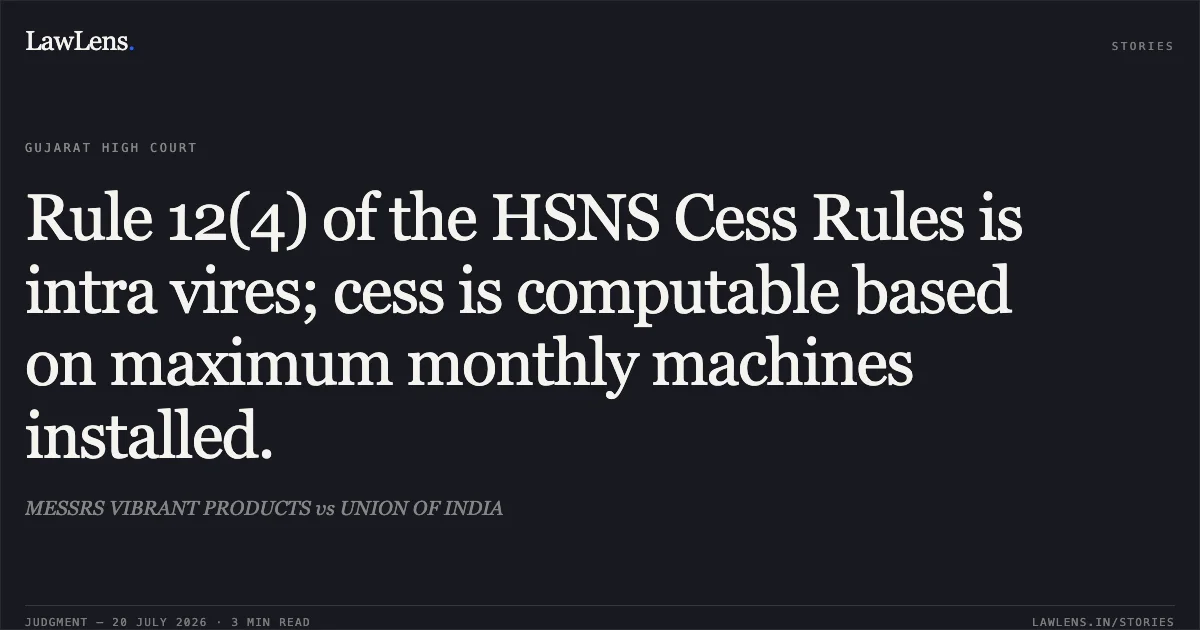
The High Court dismissed the petition, holding that Rule 12(4) of the Rules is intra vires the Cess Act, 2025, and the Constitution
The Court ruled that cess is payable for the full month if a machine is installed and operational at any point during that month, provided it does not meet the 15-day "inoperative" threshold for abatement
Source reference: para 14Regarding the challenge to the adjudication order dated 22.04.2026, the Court directed the petitioners to the alternative remedy of filing an appeal under Rule 29
Source reference: para 17Acts & Sections Cited
4 provisions across 1 statute referred to in this judgment. Linked provisions open on LawLens.
Health Security Se National Security Cess Act, 20254
Original Court PDF
MESSRS VIBRANT PRODUCTSvsUNION OF INDIA
Click to open original judgment
Original judgment, available to read, download and summarize on LawLens.in


