Facts
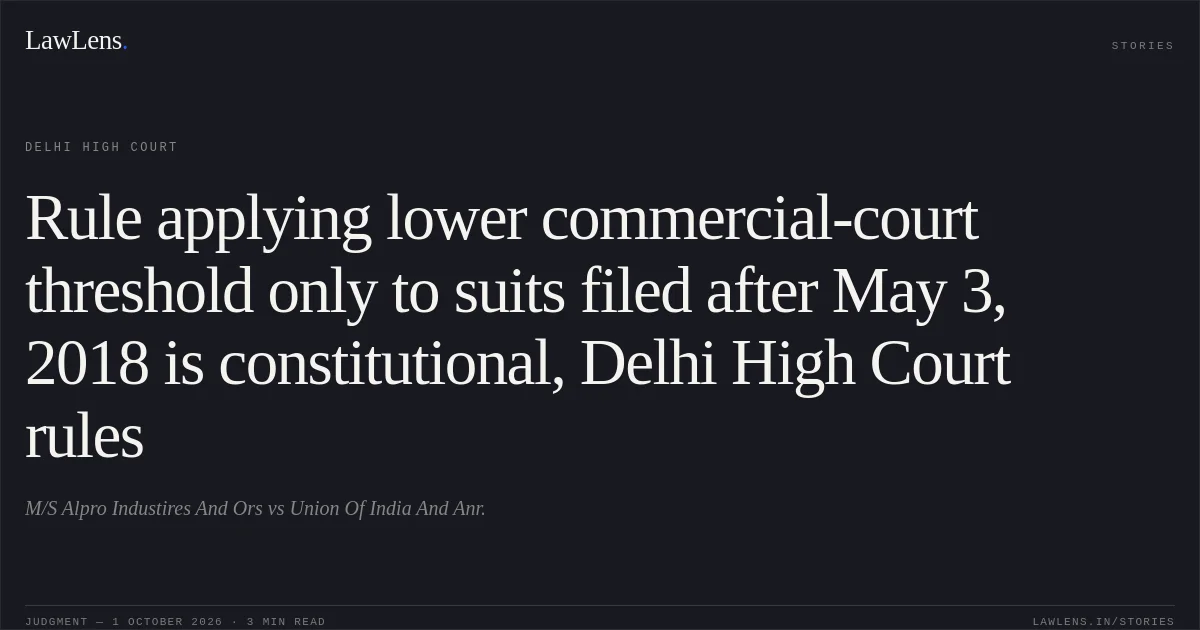
Respondent No. 2 instituted a recovery suit in 2016 for ₹35,50,000, alleging that ₹27,92,467 remained due for supplied aluminium products.
Source reference: paras. 2–3, pp. 2–3At that time, the specified-value threshold under the Commercial Courts Act, 2015 was ₹1 crore, and the suit proceeded as an ordinary civil suit.
Source reference: paras. 2–3, pp. 2–3The 2018 Amendment reduced the threshold to ₹3 lakh with effect from 3 May 2018.
Source reference: para. 4, p. 2In 2025, when the suit was at the evidence stage, the Petitioners applied under Order VII Rule 11 CPC for rejection of the plaint, arguing that the dispute should have been transferred to a Commercial Court under Section 15 of the 2015 Act.
Source reference: paras. 5–8, pp. 3–4The Trial Court dismissed that application, holding that the Amendment applied only to suits instituted on or after 3 May 2018; the Revision Petition was also dismissed.
Source reference: paras. 5–8, pp. 3–4The Petitioners then challenged the constitutionality of Section 19 of the Amendment Act under Article 226.
Source reference: paras. 1, 7–9, pp. 1, 3–4Issues
1. Whether Section 19 of the 2018 Amendment Act, which limits the Amendment’s application to cases instituted on or after 3 May 2018, violates Article 14 of the Constitution
Source reference: paras. 1, 10.3–10.4, pp. 1, 42. Whether the reduced specified-value threshold and Section 15 of the 2015 Act required pending suits instituted before 3 May 2018 to be transferred to Commercial Courts, notwithstanding Section 19
Source reference: paras. 10.1–10.2, p. 4Law Applied
Article 14 permits legislative classification where it rests on an intelligible differentia and that differentia has a rational nexus with the statute’s object.
Source reference: para. 17, p. 7A legislative cut-off date is ordinarily within the Legislature’s policy discretion; prospective operation alone does not render a provision unconstitutional, unless the cut-off produces a blatantly capricious or outrageous result.
Source reference: para. 20, p. 8Section 19 of the Commercial Courts, Commercial Division and Commercial Appellate Division of High Courts (Amendment) Act, 2018 provides that, save as otherwise provided, the Amendment applies only to cases relating to commercial disputes filed on or after its commencement.
Source reference: para. 14, p. 6Section 15 of the 2015 Act provides for transfer of pending suits and applications relating to commercial disputes of the specified value to the competent Commercial Court or Commercial Division.
Source reference: para. 13, p. 6In Satyanarain Khandelwal v. Prem Arora, 2022 SCC OnLine Del 2142, the Delhi High Court held that Section 19 confines the Amendment to cases instituted on or after 3 May 2018 and rejected a retrospective construction.
Source reference: para. 19, p. 8Reasoning
The Court treated the date of institution as an ascertainable basis for distinguishing cases governed by the amended threshold from earlier cases.
Source reference: para. 17, p. 7It found that applying the amended regime to pending suits could unsettle proceedings at different stages of trial, disrupt applicable procedure and timelines, and cause administrative and practical difficulties; limiting the Amendment prospectively therefore served the orderly implementation of the commercial-court regime.
Source reference: paras. 18–20, pp. 7–8The Petitioners did not establish that this temporal classification lacked an intelligible criterion or a rational connection to the Amendment’s purpose.
Source reference: paras. 21–22, p. 9The Court also held that Namita Gupta v. Suraj Holdings Ltd., 2024 SCC OnLine Del 143, did not determine the applicability of the Amendment to suits instituted before 3 May 2018.
Source reference: para. 23, p. 9Holding
The Court held that Section 19 is founded on an intelligible differentia bearing a rational nexus to the Amendment’s object and does not violate Article 14.
It dismissed the writ petition challenging Section 19 and disposed of any pending applications.
Source reference: para. 27, p. 10Acts & Sections Cited
1 provisions across 1 statute referred to in this judgment. Each provision opens on LawLens.
Code of Civil Procedure, 19081
Original Court PDF
M/S Alpro Industires And OrsvsUnion Of India And Anr.
Click to open original judgment
Original judgment, available to read, download and summarize on LawLens.in