Facts
The petitioners, a group of GST-registered traders and manufacturers, are engaged in businesses such as cattle feed production, Gudakhu (tobacco product) manufacturing, and poultry feed, all of which utilize molasses as a primary raw material
Source reference: para 6, 8Molasses is a by-product of the sugar industry and, in its raw form, is neither potable nor an intoxicant
Source reference: para 8Historically, molasses was regulated by the Central Government under the Molasses Control Order, 1961, until its decontrol in 1993
Source reference: para 8Currently, molasses is subject to Goods and Services Tax (GST)
Source reference: para 8, 19In 2022, the State of Chhattisgarh framed the Chhattisgarh Molasses Control and Regulation Rules, 2022 ("Rules of 2022"), purportedly under Sections 8 and 62 of the Chhattisgarh Excise Act, 1915
Source reference: para 5These Rules sought to regulate the possession, sale, and transport of molasses for all purposes—including non-intoxicant industrial and agricultural uses—and imposed excise duties and licensing requirements
Source reference: para 29, 37, 44The petitioners challenged the Rules as ultra vires the parent Act and the Constitution, arguing that the Excise Department lacked jurisdiction over non-intoxicant commercial trade
Source reference: para 5-7Issues
1. Whether the Chhattisgarh Molasses Control and Regulation Rules, 2022, are ultra vires the Constitution of India and beyond the legislative competence of the State under Entries 8 and 51 of List II
Source reference: para 4, 72. Whether molasses, in its raw form for non-intoxicant use, falls within the definition of "intoxicant," "liquor," or "excisable article" under the Chhattisgarh Excise Act, 1915
Source reference: para 4, 10, 333. Whether the rule-making power of the State under Section 62 of the Excise Act allows for the regulation of a substance that is not an "excisable article" as defined by the parent statute
Source reference: para 36, 44Law Applied
The Court applied the definitions under the Chhattisgarh Excise Act, 1915, specifically Section 2(6) for "excisable article," 2(11-a) for "intoxicant," and 2(13) for "liquor," noting that these are restricted to alcoholic liquors for human consumption or intoxicating drugs
Source reference: para 32-33It relied on the "Generality vs. Enumeration" principle regarding rule-making power under Section 62, which stipulates that subordinate legislation must strictly "carry out the purposes of the Act" and cannot extend its substantive scope
Source reference: para 41-42The Court also referenced Constitutional Entries 8 (regulation of intoxicating liquors) and 51 (excise duty on alcoholic liquors for human consumption) of List II, Seventh Schedule
Source reference: para 28, 39Precedents such as Synthetics & Chemicals Ltd. v. State of U.P. and State of Uttar Pradesh v. Lalta Prasad Vaish were cited to distinguish between the State's power over potable alcohol and the Union’s power over industrial/non-potable substances.
Source reference: para 40, 43Reasoning
The Court observed that the Preamble of the Chhattisgarh Excise Act, 1915, explicitly limits its application to "intoxicating liquor" and "intoxicating drugs"
Source reference: para 34Upon reviewing Section 2, the Court found that molasses is not listed as an "excisable article," "intoxicant," or "liquor"
Source reference: para 33, 44While the State argued that Section 8(c) allows control of "any other base" used for liquor manufacture, the Court held that raw molasses cannot be categorized as such because it requires a complex industrial fermentation process to become alcohol; treating every fermentable substance as an intoxicant would grant the State limitless, unauthorized power
Source reference: para 35, 44The Court further reasoned that the Rules of 2022 impermissibly divided molasses use into two categories: distillation and "other uses" (scientific, agricultural, etc.)
Source reference: para 30While the former might fall under excise jurisdiction, the latter does not
Source reference: para 30Consequently, the Rules of 2022 attempted to create substantive obligations and disabilities for ordinary traders that were never contemplated by the parent Act
Source reference: para 44-45Subordinate legislation cannot travel beyond the object for which the parent statute was framed
Source reference: Head Note, para 41-42Holding
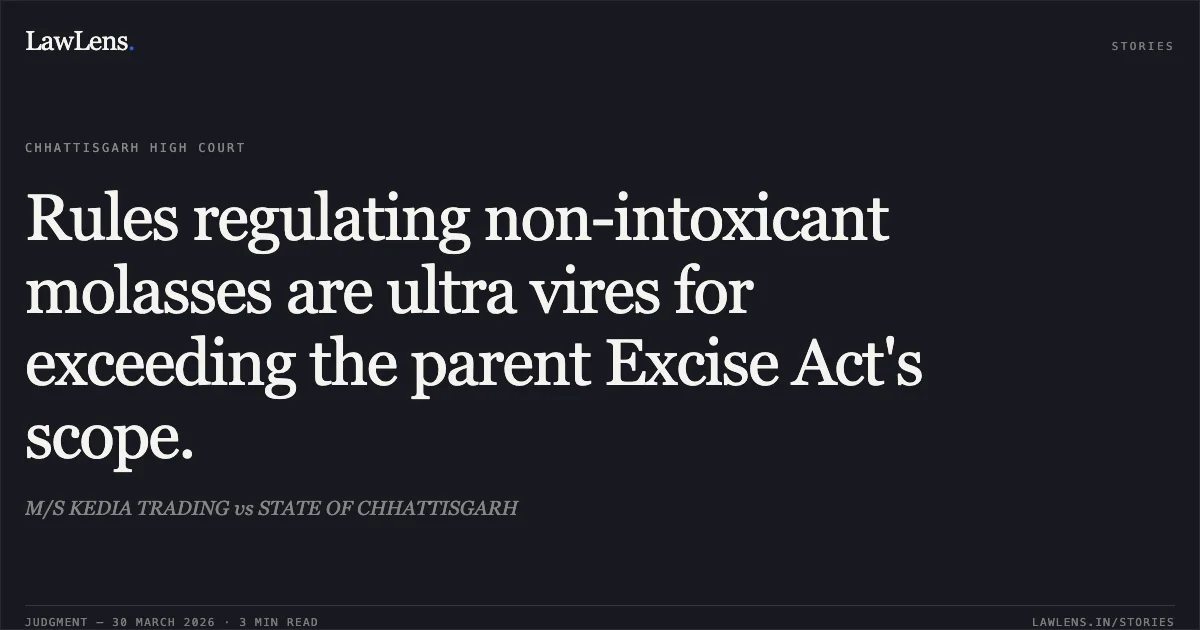
The Court held that the Chhattisgarh Molasses Control and Regulation Rules, 2022, are ultra vires the parent Chhattisgarh Excise Act, 1915, and the Constitution of India
The Court declared that the State cannot compel traders dealing in molasses for non-intoxicant purposes to obtain excise licenses or pay excise duties, as molasses is not an "excisable article" under the Act
Source reference: para 33, 44All writ petitions were allowed, and the petitioners were granted consequential relief, including the setting aside of demands or coercive measures initiated under the impugned Rules
Source reference: para 46No order as to costs was made
Source reference: para 47Acts & Sections Cited
5 provisions across 3 statutes referred to in this judgment. Each provision opens on LawLens.
Industries (Development and Regulation) Act, 19512
Central Goods and Services Tax Act, 20172
Narcotic Drugs and Psychotropic Substances Act, 19851
Original Court PDF
M/S KEDIA TRADINGvsSTATE OF CHHATTISGARH
Click to open original judgment
Original judgment, available to read, download and summarize on LawLens.in


