Facts
The appellant, a trader in plastic granules, imported goods under four Bills of Entry in March 2009 and paid 4% Special Additional Duty of Customs (SAD).
Source reference: pp. 1–4; paras. 1–4It filed a refund claim of ₹5,02,579 under Notification No. 102/2007-Cus. dated 14.09.2007, supported by Bills of Entry, sale invoices, VAT/CST payment records, a reconciliation statement, and a Chartered Accountant’s certificate.
Source reference: pp. 1–4; paras. 1–4The original authority sanctioned the refund by Order-in-Original No. 11318/2010 dated 10.03.2010.
Source reference: pp. 1–4; paras. 1–4The Department’s appeal was initially rejected, but the Tribunal remanded the matter for de novo consideration.
Source reference: pp. 1–4; paras. 1–4On remand, the Commissioner (Appeals) set aside the refund and ordered recovery, principally because the sale invoices described the goods generically as “plastic granules” rather than mentioning the specific imported grades, and because some sales were made through consignment agents.
Source reference: pp. 1–4; paras. 1–4Issues
Whether the Department’s appeal against the original refund-sanctioning order was barred by limitation or otherwise not maintainable because it was numbered in 2012, although allegedly filed earlier.
Source reference: p. 5; paras. 7–8Whether the appellant fulfilled the substantive conditions of Notification No. 102/2007-Cus. for refund of SAD, despite the generic description of the goods in the domestic sale invoices and the sales conducted through consignment agents.
Source reference: p. 5; paras. 9–17Law Applied
Notification No. 102/2007-Cus. permits refund of SAD where the imported goods are subsequently sold, appropriate VAT/CST or sales tax is paid, and the prescribed documentary evidence establishes the correlation between the imported goods and the subsequent sales.
Source reference: pp. 6–8, 15Section 129D of the Customs Act, 1962 governs departmental appeals and limitation; an appeal filed within time is not rendered time-barred merely because it is later renumbered after being recalled from the call book.
Source reference: pp. 5–6; paras. 7–8CBEC Circular No. 16/2008-Cus. recognises sales through authorised consignment agents or stockists, provided the sale, tax payment, and correlation with the imported goods are properly certified.
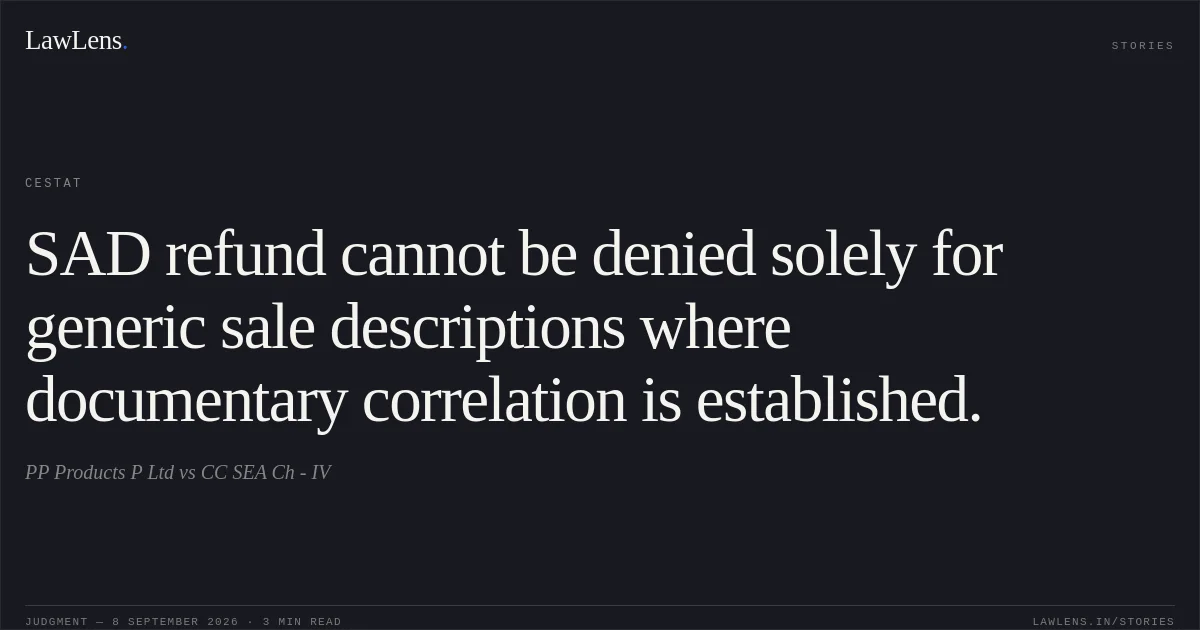
Source reference: pp. 10–11; paras. 15–17Relying on P.P. Products Ltd. v. Commissioner of Customs, 2019 (367) E.L.T. 707 (Mad.), and Kamadhenu Polymers Pvt. Ltd. v. Commissioner of Customs (Exports), Chennai, Final Order No. 41112/2024, the Tribunal held that a refund cannot be denied merely because the specific grade or code in the Bills of Entry is not reproduced in the sale invoices, absent evidence that different goods were sold.
Source reference: pp. 8–10; paras. 12–14The principle in Hemraj Gordhandas v. H.H. Dave, 1978 (2) E.L.T. J350 (S.C.), requires exemption or refund benefits to be determined by the express conditions of the notification, without importing additional requirements.
Source reference: pp. 11–12; para. 18Reasoning
The Tribunal accepted the Department’s contention on limitation because the record showed that the appeal had originally been filed in 2010 and was only renumbered in 2012 after recall from the call book; therefore, the date of renumbering could not be treated as the date of institution.
Source reference: pp. 5–6; paras. 7–8On merits, the Tribunal found that the original authority had examined the Bills of Entry, sale invoices, VAT/CST records, quantity reconciliation, and Chartered Accountant’s certificate and had recorded satisfaction regarding payment of SAD, subsequent sale, and tax payment.
Source reference: pp. 6–8; paras. 10–11The mere use of the generic expression “plastic granules” in the sale invoices did not prove that the goods sold were different from the imported HDPE, LDPE, or other grades.
Source reference: pp. 7–10; paras. 11–14The Revenue produced no independent evidence disproving the correlation or showing that the Chartered Accountant’s certificate was incorrect.
Source reference: pp. 7–10; paras. 11–14Likewise, sales through consignment agents were not prohibited by the notification or Circular No. 16/2008-Cus.; they constituted a valid mode of sale where the required authorisation, tax payment, and correlation were established.
Source reference: pp. 10–11; paras. 15–17The Tribunal also held that reliance on Wikipedia to distinguish polymer grades could not displace the contemporaneous statutory and accounting records.
Source reference: pp. 12–13; para. 19Holding
The Tribunal held that the Department’s appeal was not barred by limitation, but that the Department failed on merits to establish any breach of Notification No. 102/2007-Cus.
The generic description in the sale invoices and the use of consignment agents did not, by themselves, negate correlation between the imported and sold goods.
Source reference: pp. 14–16; paras. 22–25The impugned Order-in-Appeal dated 08.03.2017 was set aside, the original refund sanction of ₹5,02,579 was restored, and the appeal was allowed with consequential relief in accordance with law.
Source reference: pp. 14–16; paras. 22–25Acts & Sections Cited
1 provisions across 1 statute referred to in this judgment. Linked provisions open on LawLens.
Customs Act, 19621
Original Court PDF
PP Products P LtdvsCC SEA Ch - IV
Click to open original judgment
Original judgment, available to read, download and summarize on LawLens.in