Facts
Seven Gram Panchayats—Dabhora, Acauriya, Magdaura, Gedurha, Kota, Panwar and Latiyar—were merged and converted into Nagar Parishad Dabhora under Section 7 of the Madhya Pradesh Municipalities Act, 1967.
Source reference: para. 3A District Scrutiny Committee (“DSC”) was constituted under the Madhya Pradesh Municipal Services (Scale of Pay and Allowances) Rules, 1967 to scrutinise and recommend employees of the erstwhile Gram Panchayats for absorption.
Source reference: para. 4The DSC recommended absorption of 50 persons into the newly constituted Nagar Parishad.
Source reference: para. 4Following complaints of serious irregularities, the Commissioner constituted a four-member inquiry committee.
Source reference: para. 5Its report alleged that several persons had never worked for the Gram Panchayats and that members of the DSC had facilitated the absorption of their relatives and associates.
Source reference: para. 5The President-in-Council (“PIC”) of Nagar Parishad thereafter declined to grant appointments to the allegedly absorbed employees.
Source reference: para. 6The affected persons filed writ petitions challenging the inquiry findings, the PIC’s decision and, in some cases, seeking salary for the relevant period.
Source reference: para. 6The learned Single Judge allowed relief in the connected writ petitions, leading the Nagar Parishad and the Chief Municipal Officer to file the present appeals.
Source reference: no citationDuring the pendency of the appeals, the State Government passed an order dated 22 June 2026 quashing the proceedings, including the DSC’s recommendations.
Source reference: para. 8The affected employees challenged that order in separate pending writ petitions.
Source reference: para. 8Issues
Whether the PIC was bound by the DSC’s recommendations for absorption, or could independently reconsider and reject such recommendations in view of alleged irregularities.
Source reference: paras. 7–9Whether the legality of the State Government’s order dated 22 June 2026, which allegedly quashed the absorption proceedings, should be determined in the writ proceedings pending before the learned Single Judge rather than in the writ appeals.
Source reference: paras. 8, 11–12Whether the respondents were entitled to salary while the legality of their alleged absorption remained unresolved.
Source reference: para. 13Law Applied
Section 7 of the Madhya Pradesh Municipalities Act, 1967 and the statutory framework governing the merger and constitution of Nagar Parishads.
Source reference: para. 3The Madhya Pradesh Municipal Services (Scale of Pay and Allowances) Rules, 1967, including the procedure concerning scrutiny and absorption of employees of merged local bodies.
Source reference: paras. 4, 9The appellants relied on Section 94 of the relevant municipal legislation to contend that the process effectively involved fresh appointments, while the respondents argued that it was inapplicable because the matter concerned absorption rather than appointment.
Source reference: paras. 7, 9An appellate court should not adjudicate the merits of a dispute when a subsequent governmental order directly affecting the controversy is already under challenge in pending writ proceedings; all substantive grounds should therefore be considered by the writ court.
Source reference: paras. 11–12Reasoning
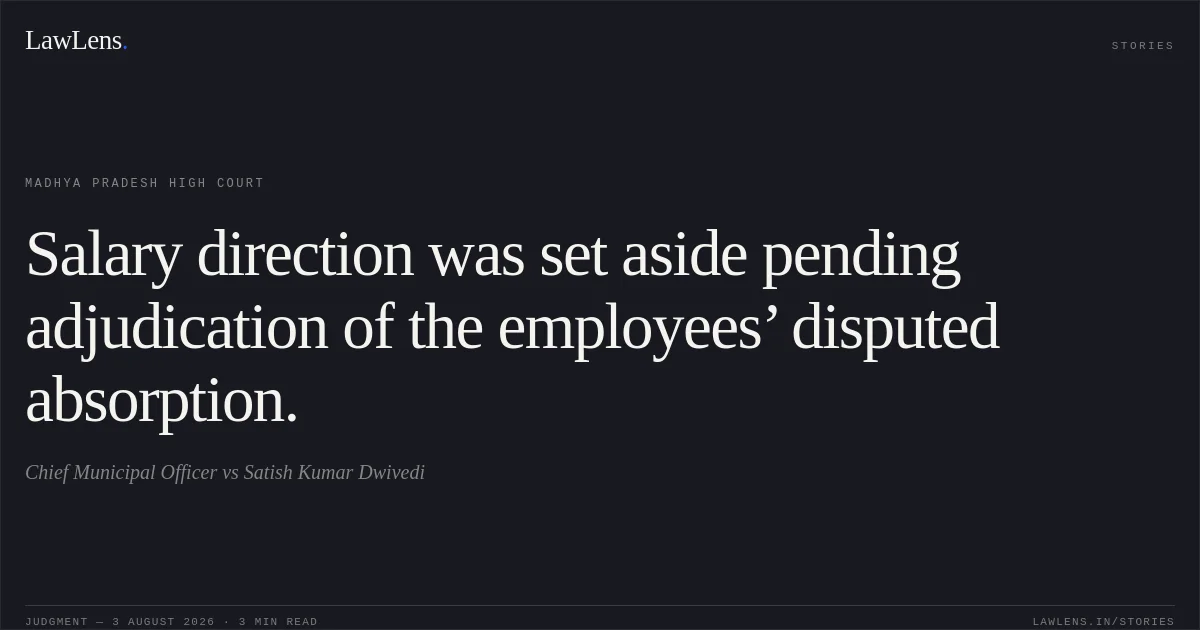
The Division Bench found that the State Government’s subsequent order dated 22 June 2026 materially altered the context of the appeals.
Source reference: paras. 8, 11Since the respondents had already challenged that order before the learned Single Judge, determining whether the DSC’s recommendations were valid, whether the PIC could reject them, and whether the absorption was lawful would overlap with issues pending before the writ court.
Source reference: paras. 8, 11The Court therefore declined to express any opinion on the rival contentions concerning the binding nature of the DSC’s recommendations, the PIC’s authority, alleged fraudulent or irregular appointments, or the applicability of Section 94.
Source reference: paras. 7–12Because the respondents’ entitlement to salary depended upon the validity of their absorption, the salary directions issued by the learned Single Judge could not be sustained at that stage; however, this did not amount to a finding that the respondents were ultimately disentitled to salary.
Source reference: para. 13Holding
The writ appeals were disposed of without deciding the merits of the absorption dispute.
The parties were granted liberty to raise all their contentions—including the validity of the State Government’s order, the legality of the absorption process and the claim for salary—before the learned Single Judge.
Source reference: para. 12The directions of the learned Single Judge relating to payment of salary were set aside because the validity of the underlying absorption remained in dispute, without prejudice to the respondents’ substantive entitlement to salary being determined objectively in the pending writ proceedings.
Source reference: para. 13Accordingly, the impugned order was set aside and the appeals were disposed of.
Source reference: paras. 14–15Acts & Sections Cited
2 provisions across 2 statutes referred to in this judgment. Linked provisions open on LawLens.
Criminal Law Amendments (Madhya Pradesh Amendment) Act, 19671
the Act of 1962 (alias, unresolved)1
Original Court PDF
Chief Municipal OfficervsSatish Kumar Dwivedi
Click to open original judgment
Original judgment, available to read, download and summarize on LawLens.in