Facts
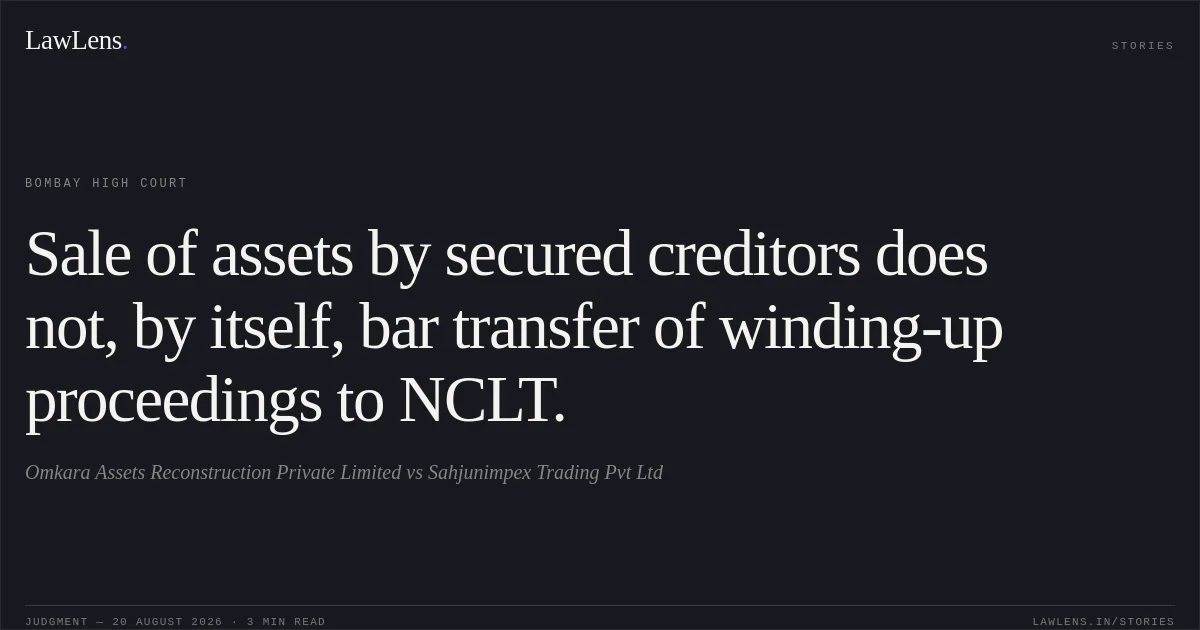
The appeal challenged the order dated 3 February 2026 by which the learned Single Judge directed transfer of the winding-up proceedings concerning Patheja Forging & Auto Parts Manufacturing Ltd. to the National Company Law Tribunal (“NCLT”) under Section 434(1)(c) of the Companies Act, 2013, to enable consideration of the company’s revival under the Insolvency and Bankruptcy Code, 2016 (“IBC”).
Source reference: para. 1Omkara Assets Reconstruction Pvt. Ltd. opposed the transfer, contending that the company had been in liquidation since 2008, its net worth had eroded by 1997, and BIFR had found it incapable of functioning as a going concern.
Source reference: paras. 2–3It further relied on sales of core industrial and factory assets at Aurangabad, Chakan, Bhosari and Pimpri through Debt Recovery Tribunal (“DRT”) proceedings, asserting that these sales were concluded and irreversible.
Source reference: para. 4The Respondent, an erstwhile financial creditor holding more than 50% of the company’s financial debt, supported the transfer and asserted that revival remained legally and commercially possible within the IBC framework.
Source reference: para. 6The record also showed that certain assets remained in the custody of the DRT receiver, while other assets remained with the Official Liquidator.
Source reference: para. 11Issues
Whether the winding-up proceedings had reached an irreversible stage, or “corporate death,” so as to justify refusal to transfer them to the NCLT under Section 434(1)(c) of the Companies Act, 2013.
Source reference: paras. 1–5, 9–11Whether sales of assets by secured creditors outside the winding-up proceedings, together with the steps taken by the Official Liquidator, constituted an irreversible step defeating the possibility of revival under the IBC.
Source reference: paras. 4–5, 9–11Whether an erstwhile financial creditor holding more than 50% of the company’s financial debt was entitled to seek transfer of the winding-up proceedings for revival of the company.
Source reference: para. 8Law Applied
The Court applied Section 434(1)(c) of the Companies Act, 2013, which permits transfer of pending winding-up proceedings to the NCLT, particularly where revival under the IBC remains possible.
Source reference: para. 1Relying on Action Ispat and Power Pvt. Ltd. v. Shyam Metalics and Energy Ltd., (2021) 2 SCC 641, the Court held that transfer must be assessed by examining whether the winding-up process has reached an irreversible stage; mere admission of a winding-up petition, appointment of a provisional liquidator, or even possession of assets by the liquidator does not automatically establish irreversibility.
Source reference: para. 9The Court also relied on A. Navinchandra Steels Pvt. Ltd. v. SREI Equipment Finance Ltd., (2021) 4 SCC 435, supporting a fact-based assessment of whether revival remains possible and recognising the primacy of the IBC’s rehabilitative framework.
Source reference: paras. 4, 10An erstwhile financial creditor is entitled to seek transfer where the application is made within the statutory framework and revival is sought in a time-bound manner.
Source reference: para. 8Reasoning
The Court rejected the Appellant’s contention that the company had effectively undergone “corporate death.” Although certain core assets had been sold through DRT proceedings, those sales occurred outside the winding-up proceedings and did not, by themselves, establish that revival under the IBC was impossible.
Source reference: para. 10The Court noted that assets remained at Thane, Bangalore and Pune in the custody of the DRT receiver, while other assets in Pune and Gujarat remained with the Official Liquidator.
Source reference: para. 11The Official Liquidator had taken only limited steps, which could not be characterised as irreversible.
Source reference: para. 11Since the possibility and desirability of revival were matters for the creditors and prospective investors to assess under the IBC, and the Respondent represented more than 50% of the financial debt, there was no sufficient basis to prevent transfer to the NCLT.
Source reference: paras. 8, 10–11Holding
The Court held that the winding-up proceedings had not reached an irreversible stage and that the sale of certain assets by secured creditors did not, in the circumstances, preclude revival under the IBC.
It therefore upheld the learned Single Judge’s order transferring the company petition to the NCLT and dismissed the appeal without costs.
Source reference: para. 12The connected Interim Application was disposed of as having become infructuous.
Source reference: para. 13Acts & Sections Cited
2 provisions across 2 statutes referred to in this judgment. Each provision opens on LawLens.
Securitisation and Reconstruction of Financial Assets and Enforcement of Security Interest Act, 20021
Companies Act, 20131
Original Court PDF
Omkara Assets Reconstruction Private LimitedvsSahjunimpex Trading Pvt Ltd
Click to open original judgment
Original judgment, available to read, download and summarize on LawLens.in