Facts
Nayara Energy Limited, formerly Essar Oil Limited, had acquired software licences and associated rights under an Assignment Agreement dated 22 June 2017, following the original 2004 EULA between SAP and Essar Steel.
Source reference: paras. 4–14The parties thereafter executed three Software License and Support Agreements/Order Forms in 2017 and 2020, governed by SAP’s General Terms and Conditions (“GTC”) and SAP Enterprise Support Schedule.
Source reference: paras. 4–14On 24 July 2025, SAP India suspended Nayara’s access to the SAP Marketplace and Online Service System, stating that Nayara was subject to an “export issue” and EU sanctions.
Source reference: paras. 15–18Nayara filed the present application under Order XXXIX Rules 1 and 2 read with Section 151 CPC seeking interim mandatory directions for restoration of access to the SAP Marketplace and OSS, issuance of hardware and software keys, reinstatement of technical support, and restraint against further interference with its use of SAP software and services.
Source reference: para. 1Issues
1. Whether the contractual relationship between the parties was governed by Indian law, and whether the contractual stipulation giving primacy to Indian law excluded reliance on foreign laws and regulations?
Source reference: paras. 119–1352. Whether SAP could rely upon EU sanctions and German export-control laws to justify suspension of contractual support services under contracts performed between Indian parties in India?
Source reference: paras. 136–1563. Whether the EU sanctions constituted a contractual contingency under Section 32, or otherwise rendered performance impossible or unlawful under Section 56 of the Indian Contract Act, 1872?
Source reference: paras. 157–1914. Whether the Order Forms, GTC, SAP Enterprise Support Schedule and Delivered Support Agreement were determinable or otherwise incapable of specific enforcement under Section 14 of the Specific Relief Act, 1963?
Source reference: paras. 192–2485. Whether the pendency of proceedings before the European Court of Justice amounted to suppression of material facts or barred the Indian proceedings?
Source reference: paras. 248–2516. Whether Nayara satisfied the higher threshold for grant of an interim mandatory injunction, namely, a strong prima facie case, irreparable injury and balance of convenience?
Source reference: paras. 252–256Law Applied
The Court applied the contractual choice-of-law principle recognised in National Thermal Power Corporation v. Singer Company, under which an express and bona fide choice of governing law ordinarily determines the proper law of the contract; here, Clauses 12.5 of the GTC and 13.6 of the Delivered Support Agreement selected Indian law and gave it precedence over conflicting foreign laws.
Source reference: paras. 124–135Under Sections 52(1) and 39 of the Bharatiya Sakshya Adhiniyam, 2023, Indian courts take judicial notice of Indian law but foreign law must be pleaded and proved through competent expert evidence; this principle was drawn from Hari Shanker Jain v. Sonia Gandhi, Rasmala Trade Finance Fund v. Raman Gupta, and State of H.P. v. Jai Lal.
Source reference: paras. 139–156Sections 32 and 56 of the Indian Contract Act distinguish between an expressly contemplated contingency and subsequent impossibility or unlawfulness, as explained in NAFED v. Alimenta S.A., Satyabrata Ghose v. Mugneeram Bangur & Co., and Energy Watchdog v. CERC.
Source reference: paras. 163–167, 184–191Section 14 of the Specific Relief Act bars enforcement of contracts that are inherently determinable or require continuous supervision, but K.S. Manjunath v. Moorasaviappa, DLF Home Developers Ltd. v. Shipra Estate Ltd., and Mahajan Imaging Pvt. Ltd. v. Pushpawati Singhania Research Institute establish that contracts terminable only for cause, or at defined contractual junctures, are not necessarily determinable in nature.
Source reference: paras. 200–224For interim mandatory injunctions, the Court applied Dorab Cawasji Warden v. Coomi Sorab Warden, Deoraj v. State of Maharashtra, and Hammad Ahmed v. Abdul Majeed, requiring a strong prima facie case, irreparable or serious injury, and a balance of convenience favouring the applicant.
Source reference: paras. 252–256Reasoning
The Court held that the Order Forms incorporated the GTC and SAP Enterprise Support Schedule, while the Delivered Support Agreement independently selected Indian law and Delhi jurisdiction.
Source reference: paras. 128–135Accordingly, Indian law governed the parties’ contractual rights, with Clause 12.5 of the GTC expressly providing that Indian law would prevail in case of conflict with foreign law or regulations.
Source reference: paras. 128–135SAP’s reliance on EU Regulation No. 269/2014 and German law could not be accepted at the interim stage because foreign law is a question of fact requiring proper pleading and proof through examined and cross-examined expert evidence.
Source reference: paras. 148–156The expert opinions filed by the parties lacked adequate qualifications, supporting material and evidentiary foundation, and therefore did not establish the legal effect or applicability of the EU sanctions.
Source reference: paras. 148–156Clause 13.5 of the Delivered Support Agreement expressly contemplated termination upon an embargo or comparable trade sanction expected to continue for six months or longer; however, that agreement related only to four third-party modules and could not be used to suspend the substantially larger body of support services governed by the Order Forms, GTC and Support Schedule.
Source reference: paras. 168–177, 225–239The latter instruments did not expressly make “SAP Support” subject to foreign trade sanctions, and the force-majeure clauses contemplated extension of time rather than automatic termination.
Source reference: paras. 168–177, 225–239Since the alleged EU sanctions were unproved, SAP could not invoke Sections 32 or 56 of the Contract Act.
Source reference: paras. 178–191In any event, the worldwide nature of the support arrangement and SAP’s admitted use of resources in India, Germany and the United States indicated that performance from a non-EU location was possible, though potentially more onerous; commercial hardship did not amount to legal impossibility.
Source reference: paras. 178–191The agreements were not terminable by SAP at will: the GTC permitted termination only for specified breaches or insolvency, the Order Forms provided for automatic renewal, and the Support Schedule allowed termination only at defined contractual junctures.
Source reference: paras. 204–224The Delivered Support Agreement’s sanction-based termination clause was also for cause and therefore did not make the agreement inherently determinable.
Source reference: paras. 204–224The alleged need for supervision and the reference to minute or numerous details were likewise rejected, particularly because the statutory reference to minute or numerous details had been removed by the 2018 amendment and the contractual obligations were sufficiently defined.
Source reference: paras. 240–248Applying the mandatory-injunction standard, the Court found that Nayara had established a very strong prima facie case: the suspension was abrupt, unsupported by a proved foreign legal prohibition, and contrary to the contractual framework.
Source reference: paras. 257–275Continued denial of SAP support posed serious risks to the plaintiff’s ERP systems, cybersecurity, regulatory compliance and critical refinery operations, while restoration would cause no comparable prejudice to SAP India.
Source reference: paras. 257–275The balance of convenience and irreparable-harm requirements therefore favoured Nayara.
Source reference: paras. 257–275Holding
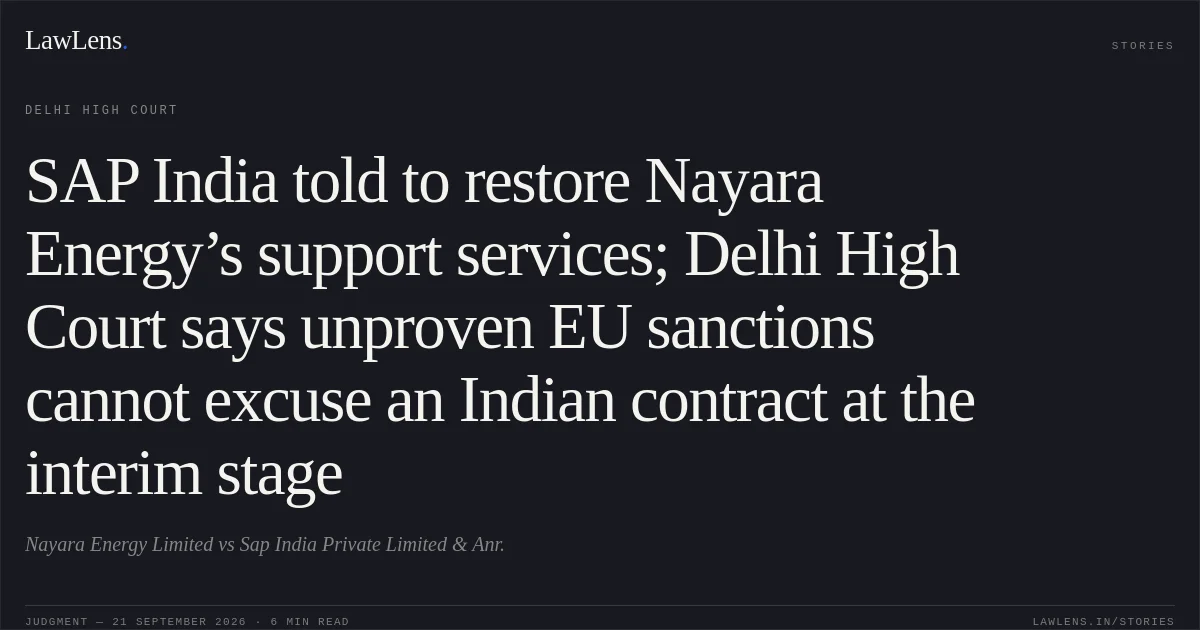
The Court allowed Nayara’s application for interim mandatory relief.
It held, prima facie, that the agreements were governed by Indian law; SAP could not rely at the interlocutory stage on unproved EU sanctions or German law to avoid its contractual obligations; the contracts were not inherently determinable or incapable of specific enforcement; and the EU sanctions did not establish contractual frustration or impossibility.
Source reference: paras. 258–266SAP India was directed to restore the status quo ante as it existed before 24 July 2025 and immediately resume all enterprise and software support services to Nayara under the respective agreements, including access to the SAP support ecosystem.
Source reference: para. 276The Court clarified that its findings were prima facie and would not prejudice the final adjudication of the suit.
Source reference: para. 277Acts & Sections Cited
12 provisions across 5 statutes referred to in this judgment. Each provision opens on LawLens.
Code of Civil Procedure, 19082
Specific Relief Act, 19633
Indian Contract Act, 18722
Bharatiya Sakshya Adhiniyam, 20232
Foreign Trade (Development and Regulation) Act, 19923
Original Court PDF
Nayara Energy LimitedvsSap India Private Limited & Anr.
Click to open original judgment
Original judgment, available to read, download and summarize on LawLens.in