Facts
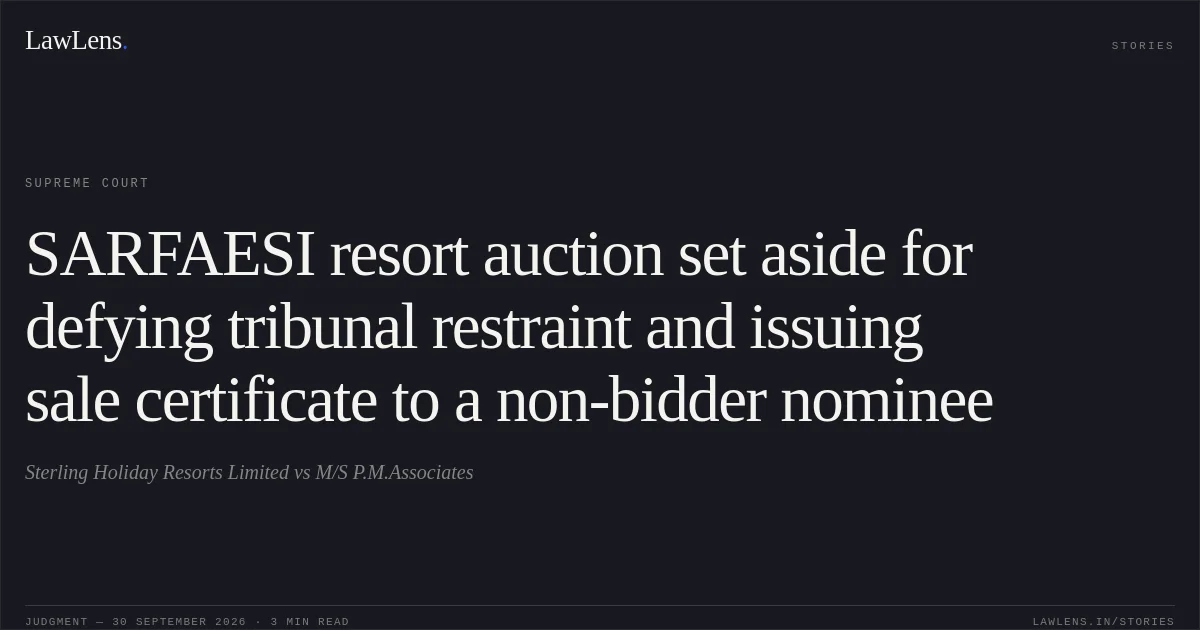
Sterling Holiday Resorts Limited (“the Borrower”) mortgaged its Ooty resort to IFCI and defaulted on the loan.
Source reference: para. 5–18IFCI initiated enforcement under the SARFAESI Act and issued an auction notice on 25 March 2010, fixing the reserve price at ₹20 crore.
Source reference: para. 5–18On 7 April 2010, the DRAT restrained IFCI from taking further steps under the Act, subject to the Borrower depositing ₹1 crore; the Borrower deposited that sum the next day.
Source reference: para. 5–18After the High Court set aside the DRAT’s order on 6 September 2011, IFCI opened the bids on 12 September 2011 and declared an individual bidder successful.
Source reference: para. 5–18The sale consideration was paid by M/s P.M. Associates, a partnership firm formed on that same date, and the sale certificate was issued to the firm.
Source reference: para. 5–18The Borrower later paid IFCI’s dues in full, after which IFCI cancelled the certificate and refunded the consideration with interest.
Source reference: para. 5–18The Madras High Court set aside the cancellation and upheld the sale; both the Borrower and the Purchaser appealed.
Source reference: para. 5–18Issues
1. Whether the auction initiated by the notice dated 25 March 2010 and culminating in the sale certificate dated 16 September 2011 complied with the SARFAESI Act, the Security Interest (Enforcement) Rules, 2002, and the auction terms.
Source reference: para. 242. Whether, in light of the alleged defects in the auction, the Purchaser acquired an enforceable right to the resort.
Source reference: paras. 32–35Law Applied
Section 13(8) of the SARFAESI Act, as it stood before its substitution in 2016, prohibited sale or transfer of the secured asset if the dues, costs, charges and expenses were tendered before the date fixed for sale or transfer.
Source reference: paras. 26–30Rules 8(5)–(8) and 9(1)–(6) of the Security Interest (Enforcement) Rules, 2002 required, among other things, valuation and fixation of a reserve price, prescribed notice and publication, expiry of the applicable thirty-day period before sale, confirmation in favour of the highest bidder, timely payment, and issuance of the sale certificate to that purchaser.
Source reference: paras. 26–30The Court held that these statutory safeguards are mandatory and that a statutory power must be exercised in the prescribed manner; a sale in breach of them cannot be sustained.
Source reference: paras. 26–30It also applied the principle that an act done in violation of a subsisting court or tribunal order is bereft of legal effect, and distinguished the finality generally accorded to auction sales by limiting that protection to sales conducted in accordance with law.
Source reference: paras. 31.1, 33Reasoning
The Court found multiple, independent defects in the sale process.
Source reference: paras. 31.1–35IFCI received a bid and earnest money while the DRAT’s restraint was in force; the subsequent High Court judgment could not retrospectively validate that step.
Source reference: paras. 31.1–35The Court also excluded the period of restraint when calculating the thirty-day period under Rule 9(1), leaving seventeen days after the restraint ended; the bids were opened and the sale concluded before that period expired.
Source reference: paras. 31.1–35The Borrower was not notified that the bids would be opened after the lengthy interruption.
Source reference: paras. 31.1–35Further, the sale certificate was issued to a firm that had not bid and was formed only on the date the bids were opened, contrary to the Rules and auction terms identifying the successful bidder as the purchaser.
Source reference: paras. 31.1–35IFCI also failed to produce the original sale records or evidence of the inter se bidding required by the notice.
Source reference: paras. 31.1–35Taken cumulatively, these defects invalidated the auction, so the Purchaser acquired no enforceable right under it.
Source reference: paras. 31.1–35The Court therefore did not decide the separate questions concerning the Authorised Officer’s power to cancel a certificate, registration of the certificate, or the precise point at which redemption was extinguished.
Source reference: paras. 31.1–35Holding
The Court held that the auction was conducted in violation of the applicable statutory procedure and auction terms, and set aside the Madras High Court’s judgment.
The Borrower’s appeals were allowed and the Purchaser’s appeals dismissed.
Source reference: para. 36The Court declined to proceed with the contempt petitions; the Purchaser’s SLP concerning the scheme of amalgamation was dismissed as no longer requiring consideration.
Source reference: para. 36There was no order as to costs.
Source reference: para. 36Acts & Sections Cited
4 provisions across 3 statutes referred to in this judgment. Each provision opens on LawLens.
Securitisation and Reconstruction of Financial Assets and Enforcement of Security Interest Act, 20022
Registration Act, 19081
General Clauses Act, 18971
Original Court PDF
Sterling Holiday Resorts LimitedvsM/S P.M.Associates
Click to open original judgment
Original judgment, available to read, download and summarize on LawLens.in