Facts
Respondent No. 2 lodged a complaint on 4 November 2024, leading to registration of Crime No. 276/2024 under Sections 352, 351(3) and 3(5) of the Bharatiya Nyaya Sanhita, 2023, and Sections 3(1)(r), 3(1)(s) and 3(2)(va) of the SC/ST (Prevention of Atrocities) Act, 1989.
Source reference: paras. 2–6, 9The parties were involved in a pending property dispute. The alleged caste-based abuse occurred on property that was the subject of that dispute; the prosecution witnesses said to have been present were respondent No. 2’s partner and labourers engaged by him. After a charge-sheet was filed, the accused petitioned to quash the proceedings.
Source reference: paras. 2–6, 9Issues
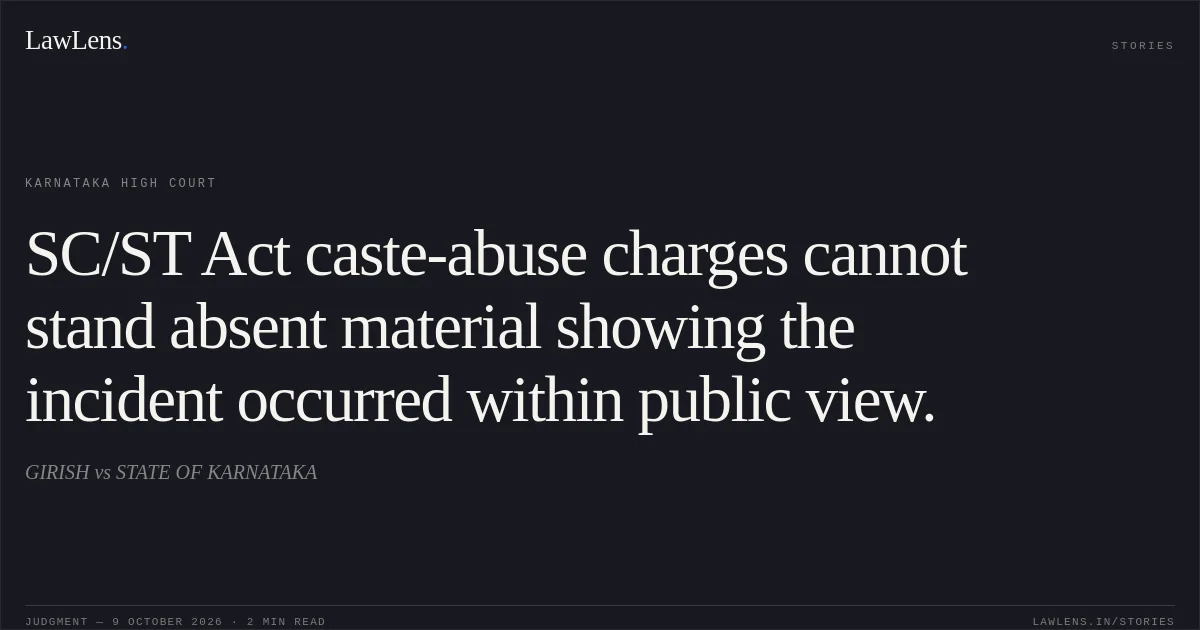
Whether the allegations and investigation material disclosed the essential requirement that the alleged caste-based insult or abuse occurred “within public view” for the purposes of Sections 3(1)(r) and 3(1)(s) of the SC/ST Act.
Source reference: paras. 11–12Whether the proceedings under Sections 3(1)(r), 3(1)(s) and consequentially Section 3(2)(va) of the SC/ST Act could continue where that requirement was not made out.
Source reference: paras. 19, 23–24Law Applied
Sections 3(1)(r) and 3(1)(s) of the SC/ST Act require the alleged intentional insult, intimidation or caste-name abuse to occur in a place “within public view.” “Public view” is distinct from “public place”: an incident on private property is not, for that reason alone, outside public view, while the mere presence of another person does not automatically satisfy the requirement; the circumstances and the identity and presence of those who witnessed or heard the alleged abuse must be considered.
Source reference: paras. 12–13The Court referred to Swaran Singh and Others v. State through Standing Counsel and Another, (2008) 8 SCC 435, particularly paragraph 28, in considering that requirement.
Source reference: para. 14Section 3(2)(va) could not be sustained insofar as it was based on the alleged offences under Sections 3(1)(r) and 3(1)(s) when those offences were not made out.
Source reference: para. 23Reasoning
The Court examined the prosecution material and found that the persons identified as witnesses were respondent No. 2’s partner and labourers, and that there was no material showing that another person had happened to be present and witnessed or heard the alleged abuse.
Source reference: paras. 16–22Their association with respondent No. 2 did not, by itself, make their evidence irrelevant; however, considered with the nature and location of the property and the circumstances of the incident, the material did not establish that the incident occurred in a location accessible to or visible to the public, or otherwise within public view.
Source reference: paras. 16–22The pending civil dispute alone did not justify quashing, but the absence of this statutory ingredient did.
Source reference: paras. 16–22The Court also held that filing a charge-sheet did not preclude it from assessing whether the alleged facts satisfied the essential ingredients of the offences.
Source reference: para. 21Holding
The Court held that the material did not make out the “public view” ingredient of Sections 3(1)(r) and 3(1)(s) of the SC/ST Act and that Section 3(2)(va), insofar as based on those alleged offences, could not be sustained.
It allowed the criminal petition and ordered that the proceedings in Spl.C. No. 06/2025 pending before the Additional District and Sessions Judge, Hassan, be quashed.
Source reference: Order, clauses (i)–(ii)Acts & Sections Cited
6 provisions across 4 statutes referred to in this judgment. Each provision opens on LawLens.
Code of Criminal Procedure, 19731
Bharatiya Nagarik Suraksha Sanhita, 20231
Bharatiya Nyaya Sanhita, 20233
Scheduled Castes and the Scheduled Tribes (Prevention of Atrocities) Act, 19891
Original Court PDF
GIRISHvsSTATE OF KARNATAKA
Click to open original judgment
Original judgment, available to read, download and summarize on LawLens.in