Facts
The complainant, Narayan Munda, a member of the Munda Scheduled Tribe, alleged that the appellant, a Halka Karamchari, demanded ₹1,000 for issuing revenue receipts in respect of land claimed by the complainant.
Source reference: paras. 3–4Upon the complainant’s inability to pay, the appellant allegedly refused to issue the receipts, threatened dispossession, and subsequently abused him by referring to his caste at Panchayat Bhawan on 13 September 1995.
Source reference: paras. 3–4The police submitted a final report in favour of the appellant, but the complainant’s protest petition was accepted and cognizance was taken.
Source reference: paras. 4–5After remand proceedings and framing of charges under Sections 3(1)(v) and 3(1)(x) of the Scheduled Castes and Scheduled Tribes (Prevention of Atrocities) Act, 1989, the trial court convicted the appellant under Section 3(1)(x) and sentenced him to one year’s rigorous imprisonment and a fine of ₹500.
Source reference: paras. 6–9The appellant challenged the conviction, contending that the statutory ingredients were not established and that the prosecution arose from his official refusal to issue revenue receipts.
Source reference: paras. 10–11Issues
1. Whether the prosecution proved beyond reasonable doubt that the appellant intentionally insulted or intimidated the complainant, a member of a Scheduled Tribe, with intent to humiliate him in a place within public view, thereby committing an offence under Section 3(1)(x) of the SC/ST (Prevention of Atrocities) Act, 1989?
Source reference: paras. 14, 20–212. Whether the contradictions in the complainant’s account and the surrounding circumstances demonstrated that the prosecution was motivated by the appellant’s refusal to issue revenue receipts rather than by any caste-based humiliation?
Source reference: para. 21Law Applied
The Court applied Section 3(1)(x) of the Scheduled Castes and Scheduled Tribes (Prevention of Atrocities) Act, 1989, which criminalises intentional insult or intimidation of a member of a Scheduled Caste or Scheduled Tribe with intent to humiliate that person in any place within public view.
Source reference: para. 20The prosecution was therefore required to establish the statutory elements of intentional insult or intimidation, the requisite intent to humiliate on account of the victim’s caste or tribal status, the victim’s membership of the protected community, and the occurrence in a place within public view.
Source reference: para. 20The Court also considered the general criminal-law requirement that guilt must be proved beyond reasonable doubt.
Source reference: paras. 20–21Although the appellant raised the issue of sanction under Section 197 of the Code of Criminal Procedure, the decision ultimately turned on the failure to establish the ingredients of Section 3(1)(x).
Source reference: para. 10Reasoning
The Court found material inconsistencies between the complaint and the complainant’s deposition.
Source reference: para. 21The complaint stated that the complainant had been accompanied by his father during the alleged incident, whereas in evidence he claimed to have been accompanied by Kamal Singh, Ratia Oraon, and Robot Oraon.
Source reference: para. 21The witnesses also admitted that an altercation had taken place from both sides and that the incident had not been reported contemporaneously.
Source reference: para. 17The Court held that the genesis of the dispute was the non-issuance of revenue receipts, not caste-based humiliation.
Source reference: para. 21The appellant had acted as a Halka Karamchari in circumstances where the land settlement was allegedly erroneous and the superior authorities had directed that rent receipts should not be issued.
Source reference: paras. 4, 21In that factual context, the Court concluded that the allegation of abuse did not reliably establish intentional insult or intimidation with the specific intent to humiliate the complainant as a member of a Scheduled Tribe in the manner required by Section 3(1)(x).
Source reference: para. 21Holding
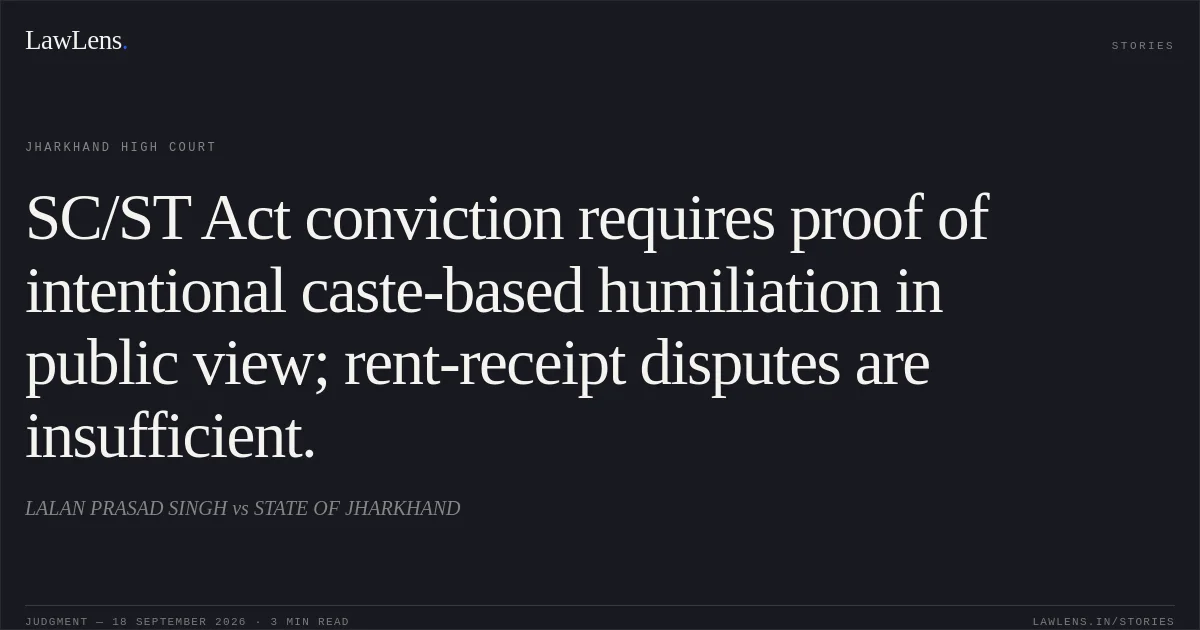
The High Court held that the prosecution failed to prove the essential ingredients of Section 3(1)(x) of the SC/ST (Prevention of Atrocities) Act beyond reasonable doubt.
The trial court’s conviction and sentence were set aside, the appellant was acquitted, and the appeal was allowed.
Source reference: paras. 21–22As the appellant was on bail, he was discharged from the liability of his bail bond and the sureties were released.
Source reference: para. 23Acts & Sections Cited
2 provisions across 2 statutes referred to in this judgment. Each provision opens on LawLens.
Scheduled Castes and the Scheduled Tribes (Prevention of Atrocities) Act, 19891
Code of Criminal Procedure, 19731
Original Court PDF
LALAN PRASAD SINGHvsSTATE OF JHARKHAND
Click to open original judgment
Original judgment, available to read, download and summarize on LawLens.in

![Competent authority must consider casual workers’ wage-benefit representation and issue a reasoned order.. Rati bhan singh and others vs DEPARTMENT OF CULTURE. CAT - ['Allahabad']. LawLens](/stories/thumbnails/competent-authority-must-consider-casual-workers-wage-benefit-representation-and-issue-a-r-ed76119895494f67a72a389de9ebe846.webp)
![Pay protection cannot be withdrawn or recovered without individual determination and prior hearing.. Mehraj Ud Din Wani vs D/o Education Ut Of J & K. CAT - ['Srinagar']. LawLens](/stories/thumbnails/pay-protection-cannot-be-withdrawn-or-recovered-without-individual-determination-and-prior-f1030926f7764c7fb6d8bce15c5054b2.webp)