Facts
The third respondent alleged that he belonged to the Adi Dravidar community and that land originally held by his family was conditional-assignment land.
Source reference: p. 2–6He alleged that the petitioners trespassed on and cultivated the land despite knowing its status, and attempted to dispossess him and his father.
Source reference: p. 2–6The petitioners claimed longstanding possession through their predecessors and contended that the dispute concerned competing civil claims to title and possession.
Source reference: p. 2–6A civil suit concerning the property was pending when the complaint was lodged.
Source reference: p. 2–6Following investigation, the Special Court took cognizance of offences under Sections 3(1)(f), 3(1)(g) and 3(1)(p) of the SC/ST (Prevention of Atrocities) Act, 1989.
Source reference: p. 2–6The petitioners sought to quash the proceedings under Section 528 of the Bharatiya Nagarik Suraksha Sanhita, 2023.
Source reference: p. 2–6Issues
1. Whether the materials disclosed the essential ingredients of offences under Sections 3(1)(f) and 3(1)(g) of the SC/ST Act, including wrongful occupation or cultivation of land belonging to a member of a Scheduled Caste or Scheduled Tribe.
Source reference: p. 7–102. Whether the proceedings should be quashed where the dispute was essentially civil and the materials did not disclose the foundational facts of the alleged offences.
Source reference: p. 7–10Law Applied
The Court considered Section 528 of the Bharatiya Nagarik Suraksha Sanhita, 2023, as the source of its jurisdiction to quash proceedings, and Sections 3(1)(f) and 3(1)(g) of the SC/ST (Prevention of Atrocities) Act, 1989.
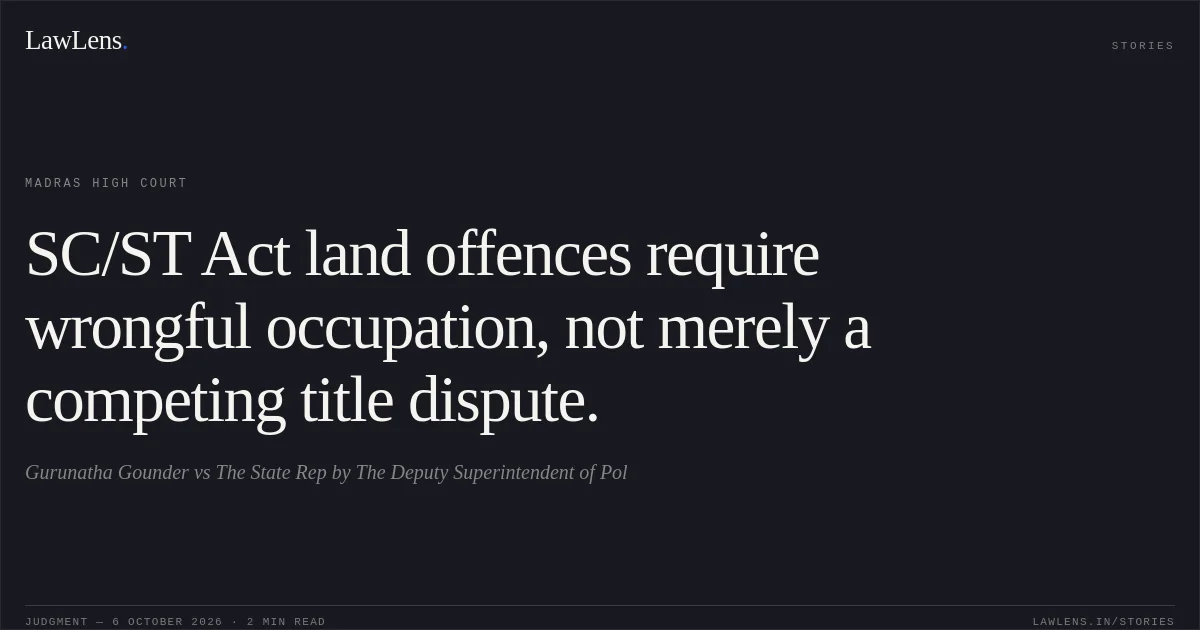
Source reference: p. 9–10It stated that, to attract Sections 3(1)(f) and 3(1)(g), the materials must disclose wrongful occupation or cultivation of land belonging to a member of a Scheduled Caste or Scheduled Tribe by a person outside those communities; “wrongfully” includes occupation or cultivation against the person’s will or without consent, or fabrication of records relating to the land.
Source reference: p. 9–10The judgment cited no precedent and did not separately set out or analyse the ingredients of Section 3(1)(p).
Source reference: p. 7–10Reasoning
The Court treated the dispute as one concerning title and possession, noting the parties’ competing claims and the petitioners’ and their predecessors’ claimed possession over several decades.
Source reference: p. 7–10It found that the materials did not establish that the petitioners had wrongfully dispossessed the third respondent, occupied or cultivated the land against his will or without consent, or fabricated records.
Source reference: p. 7–10The pending civil suit and the timing of the complaint further supported the Court’s view that the criminal proceedings arose from an essentially civil dispute and should not be used to exert pressure in it.
Source reference: p. 7–10On that basis, the Court held that the foundational ingredients of Sections 3(1)(f) and 3(1)(g) were absent.
Source reference: p. 7–10Holding
The Court allowed the petition and quashed the proceedings in Spl.S.C. No. 26 of 2026 before the Special Court for Trial of Cases under the SC/ST (POA) Act, Salem.
The connected miscellaneous petitions were closed.
Source reference: p. 10Acts & Sections Cited
2 provisions across 2 statutes referred to in this judgment. Each provision opens on LawLens.
Bharatiya Nagarik Suraksha Sanhita, 20231
Scheduled Castes and the Scheduled Tribes (Prevention of Atrocities) Act, 19891
Original Court PDF
Gurunatha GoundervsThe State Rep by The Deputy Superintendent of Pol
Click to open original judgment
Original judgment, available to read, download and summarize on LawLens.in