Facts
The petitioner challenged orders concerning the scheduling of prosecution-witness examination and an application to defer cross-examination under Section 231(2) CrPC.
Source reference: p. 1–2The trial court had allowed the accused persons’ scheduling request after hearing the Public Prosecutor, but without prior notice to the petitioner, the de facto complainant and victim in a case involving offences under Sections 323/341/506/34 IPC and Sections 3(i)(r) and 3(i)(s) of the SC/ST (Prevention of Atrocities) Act
Source reference: p. 1–3, 5A prosecution report confirmed that no notice had been served before the charge was framed or before the relevant petition was taken up; notice was served later, and the petitioner subsequently filed an objection.
Source reference: p. 3–4The petitioner also challenged the refusal to hear that objection afresh
Source reference: p. 1, 6Issues
1. Whether failure to give the victim notice of the relevant proceedings, including the hearing of the scheduling application, violated the victim’s rights under Section 15A of the SC/ST (Prevention of Atrocities) Act
Source reference: p. 2–4, 62. Whether the application could be entertained as a criminal revision despite being filed under Section 482 CrPC, and whether the challenged order should be set aside
Source reference: p. 2, 4–5Law Applied
Section 15A of the SC/ST (Prevention of Atrocities) Act safeguards victims’ rights to notice and participation in proceedings under the Act; the Supreme Court’s decision in Hariram Bhambhi v. Satyanarayan held that notice to a victim or dependent under Section 15A is mandatory to provide an opportunity of hearing
Source reference: p. 3–4The Court also relied on Akanksha Arora v. Tanay Maben, which states that the nomenclature of a petition is immaterial and that the High Court may treat a petition under Section 482 CrPC as a revision under Section 397 CrPC, or vice versa
Source reference: p. 4–5Section 231(2) CrPC was relevant to the underlying request to defer cross-examination, but the Court did not determine that request on its merits
Source reference: p. 1–2, 5Reasoning
The prosecution report established that the petitioner had not received notice before the charge was framed or before the scheduling application was considered.
Source reference: p. 3–4The Court held that this omission violated Section 15A and the mandatory notice requirement explained in Hariram Bhambhi, notwithstanding the Public Prosecutor’s presence when the application was heard
Source reference: p. 3–4, 5–6It rejected the maintainability objection based on the petition’s form, relying on Akanksha Arora to treat nomenclature as immaterial
Source reference: p. 2, 4–5Because the petitioner had not been heard, the Court directed that the objection be considered afresh rather than deciding the scheduling request itself.
Source reference: p. 6Holding
The revisional application was allowed.
The order dated 6 March 2025 was set aside, and the Special Court was directed to hear the petitioner’s objection afresh, pass a reasoned order, and fix the trial schedule in accordance with law
Source reference: p. 6Acts & Sections Cited
6 provisions across 3 statutes referred to in this judgment. Each provision opens on LawLens.
Scheduled Castes and the Scheduled Tribes (Prevention of Atrocities) Act, 19891
Code of Criminal Procedure, 19733
Indian Penal Code, 18602
Original Court PDF
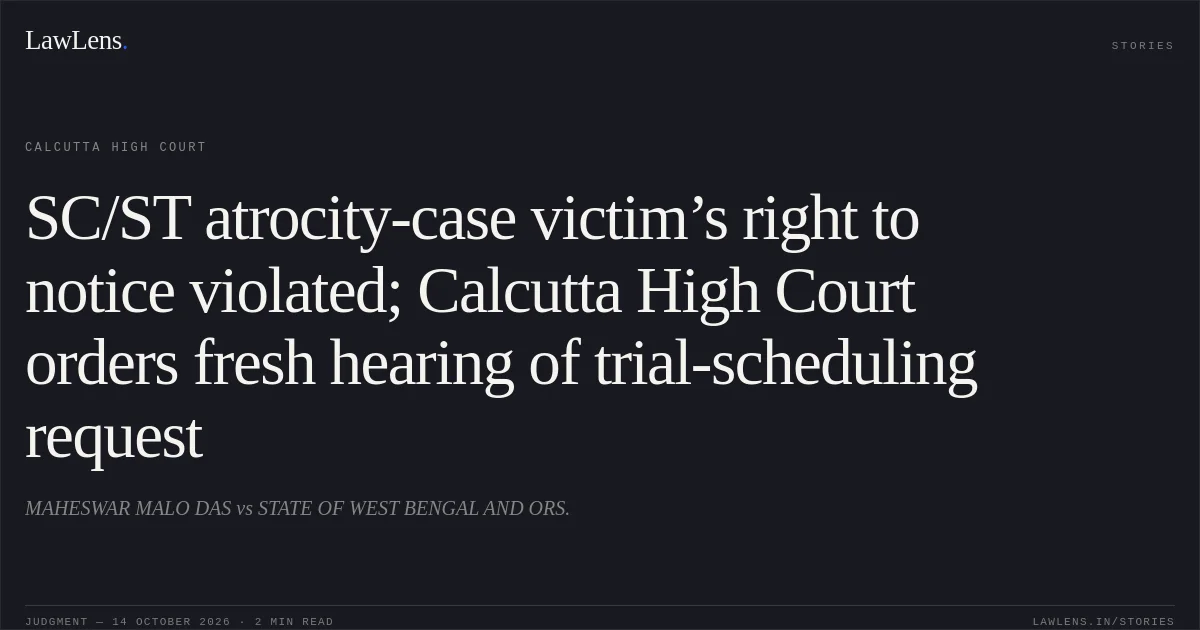
MAHESWAR MALO DASvsSTATE OF WEST BENGAL AND ORS.
Click to open original judgment
Original judgment, available to read, download and summarize on LawLens.in


