Facts
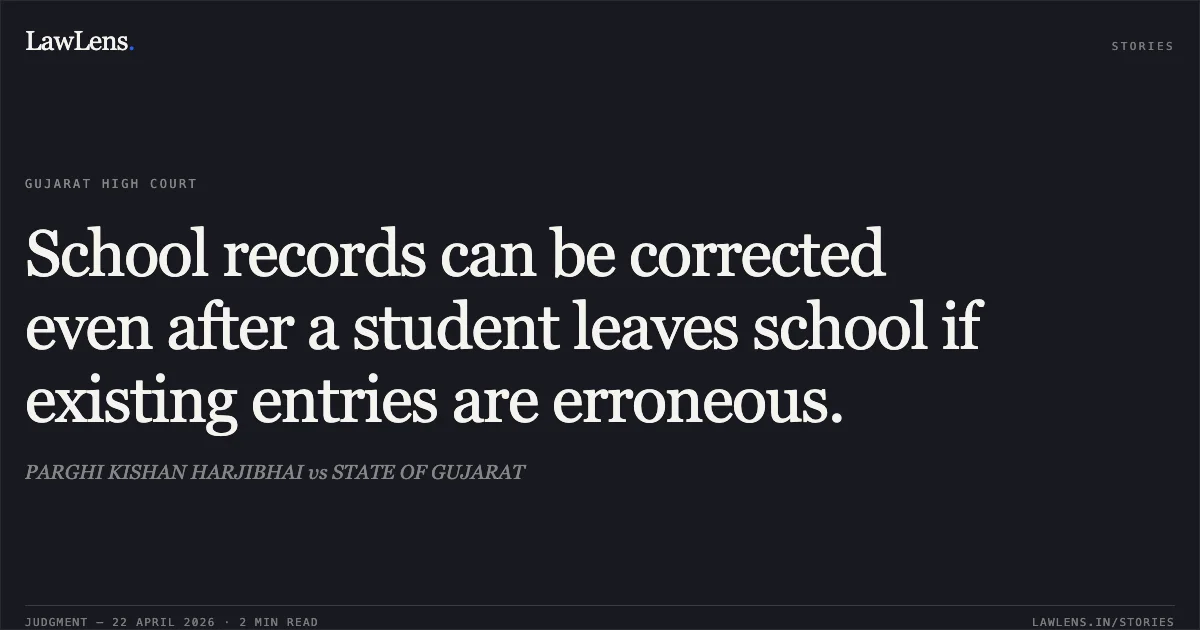
The petitioner completed Standard 10 at Government High School, Botad (Respondent No. 3) in 2012. His School Leaving Certificate (SLC) recorded his caste as "Hindu Chamar"
Source reference: para. 5The petitioner asserted his correct caste is "Hindu Vankar," supported by caste certificates issued by the Mamlatdar in 2010 and 2011
Source reference: para. 6He applied to the District Education Officer (DEO), Botad (Respondent No. 2), for correction, but the application was rejected on October 16, 2025. The DEO cited Regulations 12A(5)(6) of the Gujarat Secondary and Higher Secondary Education Regulations, stating that school records cannot be altered once a student has left the institution
Source reference: para. 7The petitioner subsequently challenged this rejection before the High Court
Source reference: para. 8Issues
1. Whether the District Education Officer has the authority to direct the correction of caste in a School Leaving Certificate after the student has left the school, notwithstanding the restrictive provisions of Regulation 12A
Source reference: para. 9, 142. Whether the refusal to correct a documented error in school records based on procedural technicalities constitutes an arbitrary exercise of power
Source reference: para. 14 (referencing precedent)Law Applied
The Court primarily interpreted Regulation 12A(5) and (6) of the Gujarat Secondary and Higher Secondary Education Regulations, which generally restricts amendments to school records after a student departs
Source reference: para. 7, 10The Court relied on the legal principle established in Ashifbhai Aminbhai Bhayani v. State of Gujarat (SCA No. 18550 of 2021) and previous Division Bench rulings, which hold that errors in statutory documents must be corrected to prevent arbitrary injury to a citizen. These precedents establish that the DEO possesses the inherent power to issue directions for such corrections when supported by high-evidentiary value documents, such as statutory certificates issued by a Mamlatdar or Registrar
Source reference: para. 10, 14, 15Reasoning
The Court observed that while the respondent authorities relied on the restrictive language of Rule 12A to deny the correction, judicial precedents have consistently held that authorities are not "error-proof" and total denial of correction amounts to a violation of public duty
Source reference: para. 14The Court noted that the petitioner provided credible evidence, including his own caste certificates and those of his real brother, showing the "Hindu Vankar" status
Source reference: para. 6, 13Applying the reasoning from the Ashifbhai case, the Court found that a resident should not be forced to "run from pillar to post" for a genuine correction when there is no dispute regarding the authenticity of the supporting statutory certificates
Source reference: para. 14The High Court determined that the DEO failed to exercise their jurisdiction to verify the documents and provide relief, rendering the rejection order unsustainable
Source reference: para. 16Holding
The Court allowed the petition and quashed the DEO's order dated October 16, 2025. It held that the restrictions under Rule 12A(5)(6) do not preclude the Court or the DEO from correcting a genuine error in caste
The Court directed the petitioner to submit a fresh application to the DEO with supporting family documents. It further directed the DEO to verify the genuineness of these documents and, upon satisfaction, instruct Respondent No. 3 to issue a fresh SLC reflecting the caste as "Hindu Vankar" within three months
Source reference: para. 16, 17Acts & Sections Cited
2 provisions across 1 statute referred to in this judgment. Each provision opens on LawLens.
Registration of Births and Deaths Act, 19692
Original Court PDF
PARGHI KISHAN HARJIBHAIvsSTATE OF GUJARAT
Click to open original judgment
Original judgment, available to read, download and summarize on LawLens.in