01Facts
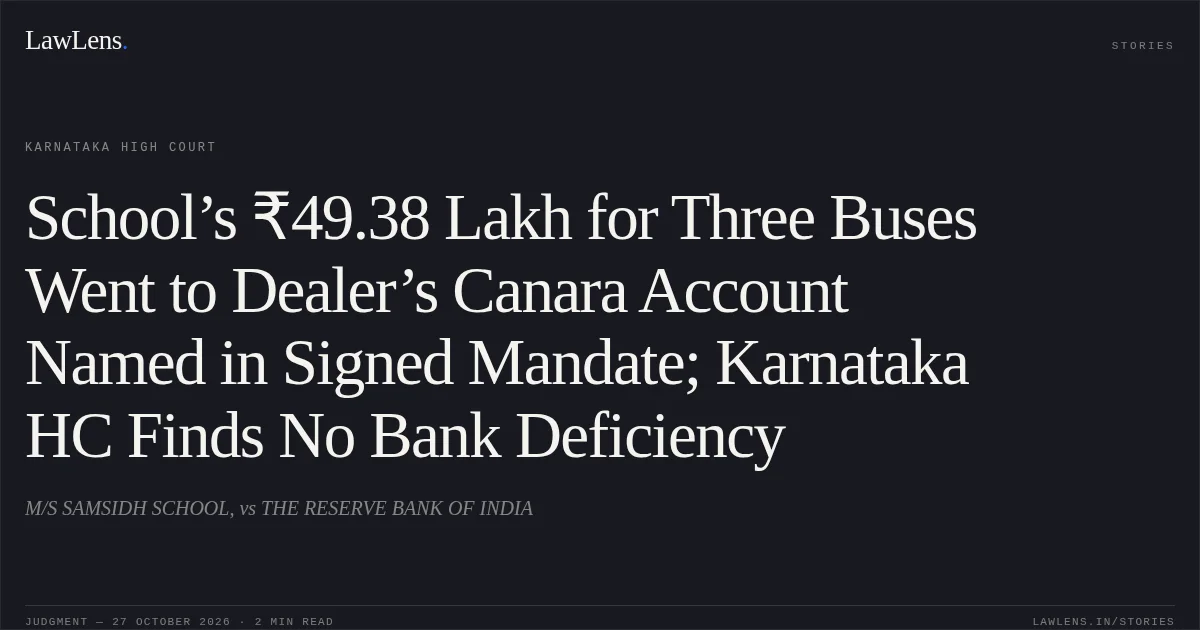
The petitioners sought finance from Kotak Mahindra Bank (KMB) to purchase three buses from respondent No. 7.
pp. 4–5KMB disbursed a total of ₹49,38,000 to respondent No. 7’s Canara Bank account.
pp. 4–5The petitioners alleged that they had instructed KMB to remit the funds to respondent No. 7’s Bank of India account, and that the buses were consequently not delivered.
pp. 4–5The RBI Ombudsman closed their complaint, finding no deficiency in KMB’s service.
pp. 4–5The petitioners challenged that decision under Articles 226 and 227 of the Constitution and also sought relief concerning recovery proceedings on the loans.
pp. 4–502Issues
i.1. Whether the Ombudsman’s finding of no deficiency in service by KMB, in light of the disbursement mandate and the subsequent communications relied on by the petitioners, warranted interference under Articles 226 and 227
pp. 9–16ii.2. Whether the petitioners were entitled to the further reliefs sought concerning coercive recovery and liability for amounts allegedly not received
pp. 4, 7–8, 1603Law Applied
The Court considered its supervisory and writ jurisdiction under Articles 226 and 227 of the Constitution in reviewing the Ombudsman’s decision.
pp. 3–4, 14–16It applied the principle that disbursement in accordance with the borrower’s documented instruction does not, on the facts of this case, establish deficiency in service.
pp. 3–4, 14–16No specific statutory provision or judicial precedent was cited as the basis for the decision.
pp. 3–4, 14–1604Reasoning
The Court found that the signed disbursement request and accompanying documents identified respondent No. 7’s Canara Bank account, and that the petitioners’ claim that the relevant forms were fabricated was untenable on the material before it.
pp. 9–16Although the petitioners relied on a WhatsApp communication showing respondent No. 7’s Bank of India details and on KMB emails, the Court considered that the loan disbursement mandate had been executed after the WhatsApp communication and directed payment to the Canara Bank account.
pp. 9–16It also found that the emails reflected efforts to address the grievance, not an admission of wrongdoing; the funds had been transferred to another account of respondent No. 7, rather than to a third party.
pp. 9–16The Court therefore found no basis to treat KMB’s disbursement as deficient or to disturb the Ombudsman’s conclusion.
pp. 9–1605Holding
The Court held that the Ombudsman’s decision disclosing no deficiency in KMB’s service was not erroneous and did not warrant interference.
p. 16It dismissed the writ petition and disposed of the pending interlocutory applications.
p. 16Original Court PDF
M/S SAMSIDH SCHOOL,vsTHE RESERVE BANK OF INDIA
Click to open original judgment
Original judgment, available to read, download and summarize on LawLens.in