Facts
The petitioner, a Peon in the Department of Revenue posted at Tehsil Chachoda, was suspended on 16.02.2016
Source reference: para. 2Following a departmental enquiry regarding alleged misconduct, the disciplinary authority (Collector, Guna) issued a show-cause notice on 30.03.2017
Source reference: para. 3Despite the petitioner’s reply, the disciplinary authority imposed a major punishment of stoppage of two annual increments with cumulative effect on 05.05.2017
Source reference: para. 2The petitioner’s appeal to the Commissioner, Gwalior Division, was rejected on 05.09.2017
Source reference: para. 2The petitioner challenged these orders via a Writ of Certiorari, alleging a lack of opportunity for cross-examination and that the authorities passed non-speaking, mechanical orders without applying their minds
Source reference: para. 2Issues
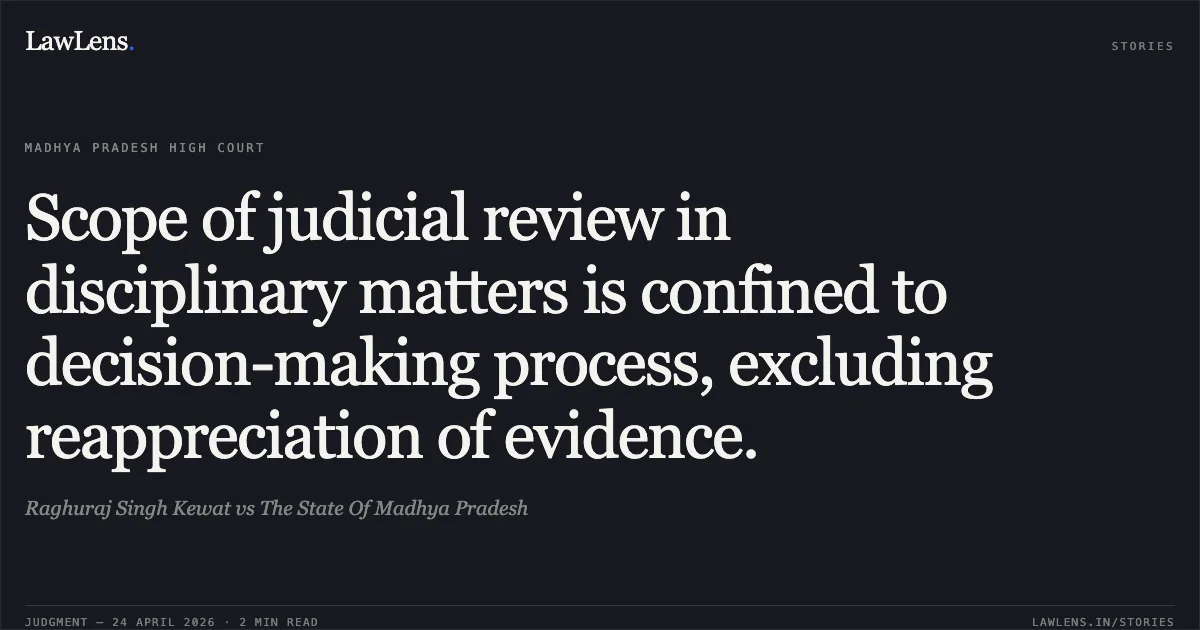
1. Whether the High Court, in the exercise of its writ jurisdiction under Article 226, can act as an appellate authority to reappreciate evidence in a departmental enquiry.
Source reference: para. 6, 82. Whether the disciplinary proceedings violated the principles of natural justice and if the punishment was disproportionate.
Source reference: para. 2, 9Law Applied
The court primarily applied the principles of judicial review governing departmental enquiries as established by the Supreme Court in State of Karnataka v. N. Gangraj (2020), which limits the court's power to the decision-making process rather than the decision itself
Source reference: para. 6It further relied on B.C. Chaturvedi v. Union of India (1995) and Union of India v. P. Gunasekaran (2015), which established that High Courts cannot reassess evidence, adequacy, or reliability unless the findings are based on "no evidence" or are perverse
Source reference: para. 6, 9The doctrine of "preponderance of probability" was identified as the standard of proof in departmental matters, distinct from the "proof beyond reasonable doubt" required in criminal trials
Source reference: para. 6/para. 8 in Sardar Bahadur citationReasoning
The Court observed that the enquiry officer conducted proceedings fairly and the petitioner was provided adequate opportunity to present a defense
Source reference: para. 3Regarding the petitioner's claim of denied cross-examination, the Court noted this objection was raised for the first time in the writ petition and was absent from the prior departmental stages
Source reference: para. 3Applying the precedents of N. Gangraj and Ramesh Dinkar Punde, the Court reasoned that its jurisdiction under Article 226/227 is circumscribed to correcting procedural errors or manifest miscarriages of justice
Source reference: para. 11Since the findings were based on legal evidence and the disciplinary authority agreed with the enquiry report after considering the petitioner’s reply, the Court held it could not substitute its own findings for those of the administrative authorities
Source reference: para. 10-11The Court found no evidence of perversity or violation of statutory rules
Source reference: para. 10Holding
The Court answered the issues in the negative, holding that it cannot act as an appellate authority to reappreciate evidence where the enquiry was conducted in accordance with law
The court concluded that the punishment was based on a proper departmental enquiry and maintained the orders passed by the Disciplinary and Appellate Authorities
Source reference: para. 11Consequently, the petition was dismissed, and no relief was granted
Source reference: para. 12Original Court PDF
Raghuraj Singh KewatvsThe State Of Madhya Pradesh
Click to open original judgment
Original judgment, available to read, download and summarize on LawLens.in