Facts
The respondent (Irfan Yusuf) applied for the post of Laboratory Officer under the OBC category at the Indian Institute of Technology (IIT).
Source reference: no citationAfter qualifying for the written and technical tests, he was placed at serial No. 1 in the waiting list.
Source reference: p. 2On 25.10.2023, the petitioners cancelled his candidature alleging he provided incorrect experience information.
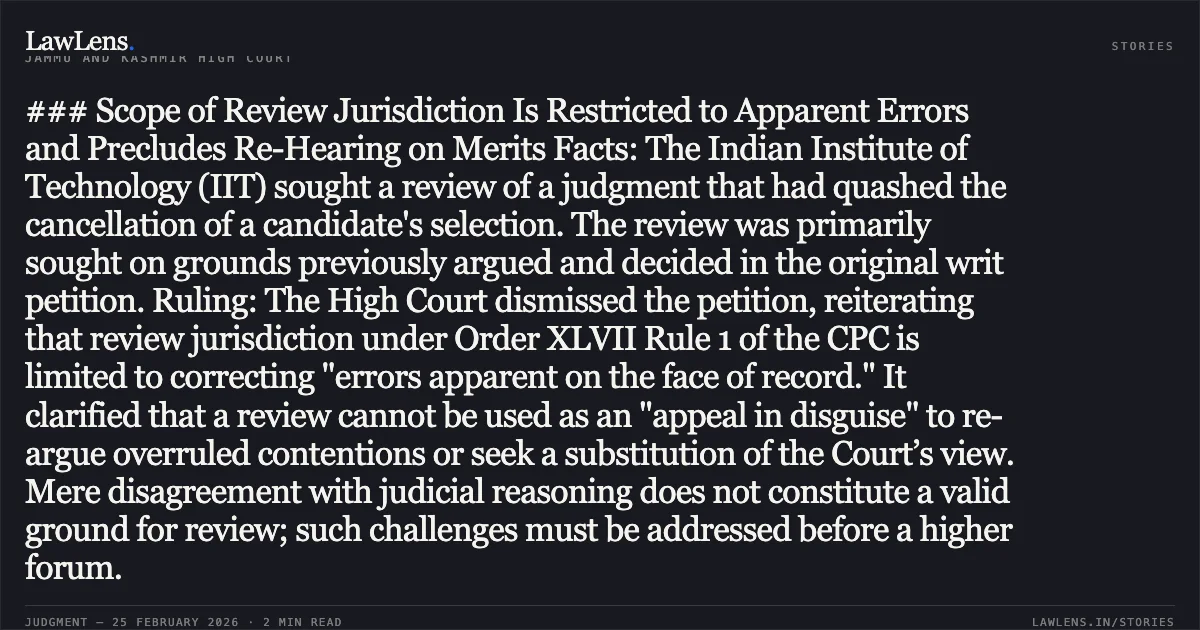
Source reference: p. 2The respondent challenged this via a writ petition, which the High Court allowed on 12.12.2025, quashing the cancellation and directing his retrospective appointment due to the non-joining of the selected candidate.
Source reference: p. 3The petitioners subsequently filed this review petition seeking to set aside the judgment dated 12.12.2025.
Source reference: p. 1Issues
Whether the review petitioners established sufficient grounds under Order XLVII Rule 1 of the CPC or Rule 65 of the J&K High Court Rules to warrant a review of the impugned judgment.
Source reference: p. 8 / para. 7Whether an error apparent on the face of the record exists, or if the petitioners are attempting to seek a re-hearing of the case under the guise of a review.
Source reference: p. 9 / para. 8Law Applied
The Court applied Rule 65 of the J&K High Court Rules, 1999, which restricts the power of review to grounds enumerated under Order XLVII Rule 1 of the Civil Procedure Code (CPC).
Source reference: p. 4-5Under these provisions, a review is permissible only upon the discovery of new evidence (despite due diligence), a mistake or error apparent on the face of the record, or for any other "sufficient reason".
Source reference: p. 5-6The Court relied on *Parsion Devi v. Sumitri Devi*, which clarifies that an error must be self-evident and not require a process of reasoning to detect.
Source reference: p. 6The Court relied on *Lily Thomas v. Union of India*, which establishes that review power is for correcting mistakes, not substituting views or acting as an "appeal in disguise".
Source reference: p. 7Reasoning
The Court examined the grounds raised by the petitioners.
Source reference: no citationIt observed that the arguments presented in the review petition were a mere repetition of the original contentions already addressed and adjudicated in the main writ petition.
Source reference: p. 9The Court reasoned that if the logic applied in the original judgment was legally flawed, the proper remedy was an appeal to a higher forum rather than a review.
Source reference: p. 9Following the precedent in *Inderchand Jain v. Motilal*, the Court emphasized that it cannot sit in appeal over its own order or allow a re-hearing of the matter.
Source reference: p. 7Since no new evidence was produced and no self-evident error was found on the face of the record, the Court determined that the legal threshold for exercising review jurisdiction was not met.
Source reference: p. 9-10Holding
The Court held that the review petition lacked merit as it disclosed no error apparent on the face of the record.
The Court answered the issues by affirming that all contentions had been appropriately dealt with in the original judgment and that a mere repetition of overruled arguments does not justify review.
Source reference: p. 9Consequently, the review petition was dismissed.
Source reference: p. 10Acts & Sections Cited
2 provisions across 1 statute referred to in this judgment. Each provision opens on LawLens.
Code of Civil Procedure, 19082
Original Court PDF
Indian Institute of Technology & Ors. v. Irfan Yusuf & Others RP No. 1/2026 in WP(C) No. 2804/2023
Click to open original judgment
Original judgment, available to read, download and summarize on LawLens.in


