Facts
The Appellant, Geron Corporation, filed a PCT national phase application (No. 4506/DELNP/2015) titled ‘DIAGNOSTIC MARKERS FOR TREATING CELL PROLIFERATIVE DISORDERS WITH TELOMERASE INHIBITORS’
Source reference: para 4The Subject Patent Application claimed an in vitro screening method to select individuals diagnosed with or suspected of having cancer who would benefit from telomerase inhibitor treatment.
Source reference: para 7The selection was based on whether the average relative telomere length in cancer cells was in the 50th percentile or less compared to a known standard.
Source reference: para 7The Respondent (Controller) refused the application on 31.12.2021, primarily holding that the claims were directed toward a non-patentable diagnostic method under Section 3(i) of the Patents Act.
Source reference: para 8, 12The Appellant challenged this, arguing the method was for "screening" individuals already diagnosed, not for the "identification of the nature of a medical illness".
Source reference: para 9.2Issues
1. Whether the claimed in vitro screening method for selecting patients for telomerase inhibitor therapy constitutes a "diagnostic method" excluded from patentability under Section 3(i) of the Patents Act, 1970.
Source reference: para 142. Whether the distinction between "screening" and "diagnosis" is determinative for the purposes of Section 3(i).
Source reference: para 25, 32Law Applied
The court primarily applied Section 3(i) of the Patents Act, 1970, which excludes from patentability any process for the medicinal, surgical, curative, prophylactic, diagnostic, therapeutic, or other treatment of human beings.
Source reference: para 16It relied on the Manual of Patent Office Practice and Procedure and the Guidelines for Examination of Biotechnology Applications (2013), which define diagnosis as the identification of a medical illness through history, symptoms, and tests.
Source reference: para 17, 19The court further integrated principles from Chinese University of Hong Kong v. Assistant Controller of Patents & Designs, establishing that "diagnostic" should be limited to processes that disclose pathology for treatment.
Source reference: para 20Precedents from Natera Inc. v. Assistant Controller of Patents and Designs and Sequenom Inc. v. The Controller of Patents were applied to clarify that Section 3(i) makes no distinction between in vivo and in vitro processes and includes tests that influence a medical practitioner’s treatment decisions, even if they do not confirm a final pathology.
Source reference: para 21, 22Reasoning
The Court analyzed the independent claim and the complete specification, finding that the method involves a two-step process: (i) determining telomere length from a biological sample and (ii) comparing that length against a threshold (≤50th percentile) to decide if a patient should receive therapy.
Source reference: para 28, 30The Court rejected the Appellant’s argument that "screening" is distinct from "diagnosis," noting that the label is not determinative if the test is inherently capable of identifying a condition or its severity for treatment.
Source reference: para 25, 32Applying the "treatment decision" test, the Court reasoned that since the results of this screening directly dictate whether a medical practitioner prescribes telomerase inhibitor therapy, it is an essential part of the diagnostic and treatment process.
Source reference: para 32, 33Furthermore, the Court observed that Section 3(i) is intended to prevent the monopolization of medical decision-making; granting a patent would unfairly restrict practitioners from using telomere length as a threshold rule for patient selection.
Source reference: para 25, 32The Court also noted that while the EPC (Article 53(c)) allows in vitro diagnostic methods, Indian law under Section 3(i) is broader and does not distinguish between in vivo and in vitro methods.
Source reference: para 25, 32Holding
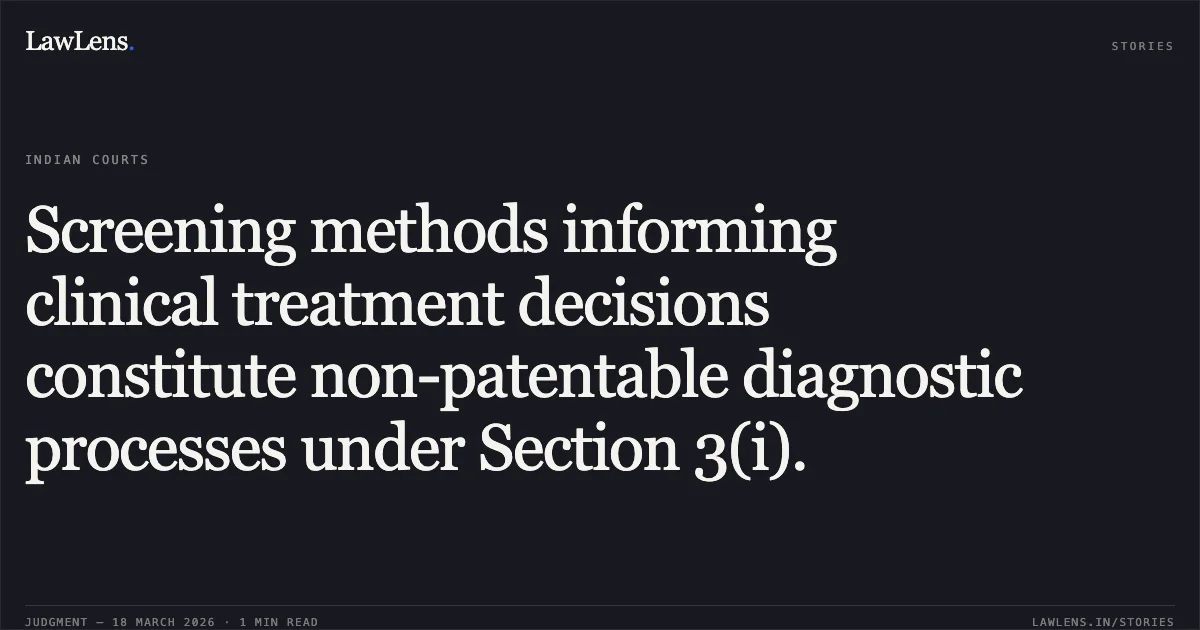
The Court answered the issues in the affirmative, holding that the claimed method, despite being drafted as an in vitro screening process, is in substance a diagnostic method for the treatment of human beings and is thus barred under Section 3(i).
The Court affirmed that foreign grants (USA/Europe) do not bind Indian patent authorities where the Subject Patent Application violates specific Indian statutory exclusions.
Source reference: para 34The appeal was dismissed, and the Controller’s order of refusal was upheld.
Source reference: para 37Acts & Sections Cited
5 provisions across 2 statutes referred to in this judgment. Each provision opens on LawLens.
Patents Act, 19704
Code of Civil Procedure, 19081
Original Court PDF
Geron CorporationvsThe Assistant Controller Of Patents And Designs
Click to open original judgment
Original judgment, available to read, download and summarize on LawLens.in