Facts
A search under Section 132 of the Income Tax Act was initiated against Sri K. Narayan Raju.
Source reference: para 2During this process, a warrant was issued to search the residential premises of the Respondent (Sri C.R. Ram Mohan Raju) based on a "reason to suspect" that the primary target's documents were hidden there.
Source reference: para 3.1, 9.2Based on materials seized from this location, the Assessing Officer (AO) recorded satisfaction under Section 153C and issued assessment notices for AYs 2011-12 to 2018-19.
Source reference: para 2.2The Respondent challenged these notices via a writ petition, arguing that since his premises were searched, he should be treated as a "searched person" under Section 153A rather than an "other person" under Section 153C.
Source reference: para 2.3The learned Single Judge quashed the notices.
Source reference: para 2.6The Revenue appealed this decision.
Source reference: para 1Issues
1. Whether a person whose premises are searched under a warrant issued in another person's name qualifies as a "searched person" under Section 153A or "any other person" under Section 153C.
Source reference: para 7.12. Whether Section 153C requires the recording of a separate satisfaction note for each individual assessment year.
Source reference: para 393. Whether the writ petition was liable for dismissal on the grounds of inordinate delay and laches.
Source reference: para 59Law Applied
The court applied Section 132 of the Income Tax Act, distinguishing between "reason to believe" against a person (clauses a-c) and "reason to suspect" regarding a premises (clauses i-v).
Source reference: para 7.6It relied on Section 153A for assessments of persons "searched" and Section 153C for "other persons".
Source reference: para 6C. Ramaiah Reddy v. CIT, establishing that search is person-centric.
Source reference: para 13PCIT v. Associated Mining Company, holding that premises identification is incidental to the target person.
Source reference: para 14CIT v. Calcutta Knitwears along with Super Malls (P) Ltd. v. CIT, which clarified that a consolidated satisfaction note is sufficient for Section 153C, especially when the AO for both parties is the same.
Source reference: para 43, 44Reasoning
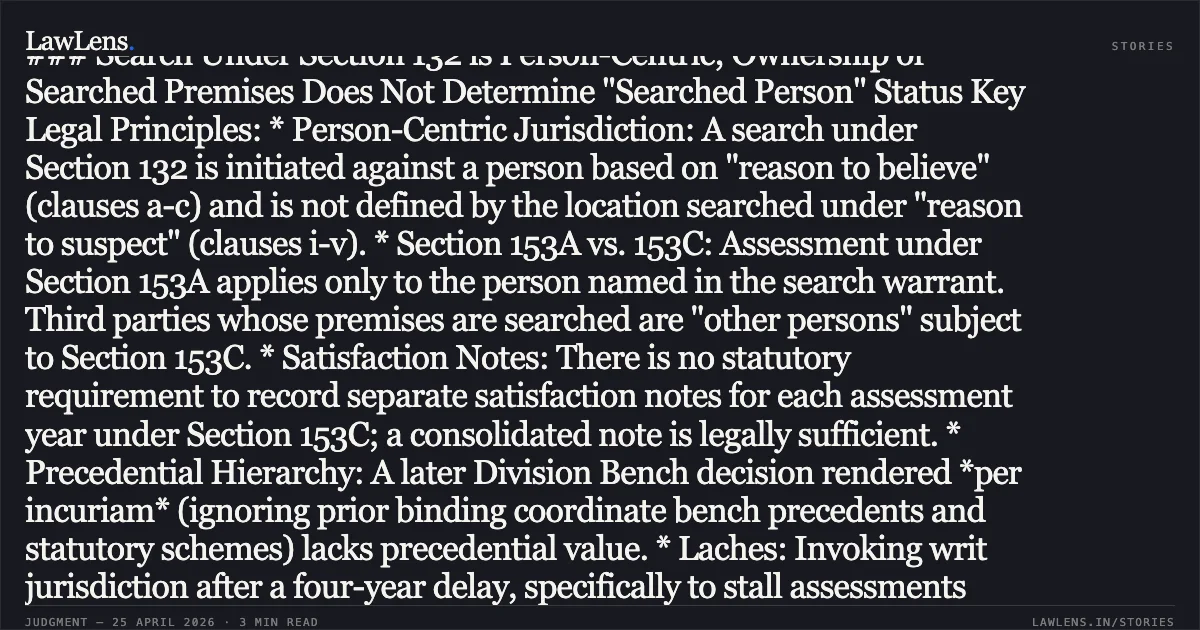
The Court reasoned that Section 132 is person-centric; the "searched person" is defined by the "reason to believe" recorded in the satisfaction note and the name on the warrant (Form 45), not the ownership of the searched location.
Source reference: para 7.9, 9.9Upon perusal of the sealed satisfaction note, the Court found the warrant was issued in the name of K. Narayan Raju, while the Respondent’s address was merely the place of execution.
Source reference: para 9.2, 9.4Consequently, the Respondent was correctly categorized as an "other person" under Section 153C.
Source reference: para 10.3Regarding the procedural challenge, the Court held that Section 153C does not explicitly mandate year-wise satisfaction notes; a consolidated note suffices if it indicates the documents belong to the "other person".
Source reference: para 50, 52Finally, the Court noted that the Respondent approached the High Court with a four-and-a-half-year delay, just one month before the assessment deadline, which constituted fatal laches.
Source reference: para 60, 63Holding
The Court answered that a search is person-specific and the Respondent was an "other person" under Section 153C.
It held that a consolidated satisfaction note is legally valid.
Source reference: para 57The Division Bench set aside the Single Judge’s order, dismissed the original writ petition, and restored the notices issued under Section 153C for AYs 2011-12 to 2018-19.
Source reference: para 70The court emphasized that judicial discipline required following earlier Benches (Ramaiah Reddy and Associated Mining) over the later Sunil Kumar Sharma decision, which was deemed per incuriam for failing to consider the former.
Source reference: para 33, 35Acts & Sections Cited
4 provisions across 3 statutes referred to in this judgment. Each provision opens on LawLens.
KARNATAKA HIGH COURT ACT, 19611
Information Technology Act, 20001
Contempt of Courts Act, 19712
Original Court PDF
THE DEPUTY COMMISSIONER OF INCOME TAXvsSRI C R RAM MOHAN RAJU
Click to open original judgment
Original judgment, available to read, download and summarize on LawLens.in


