01Facts
The petitioner, a former director of Amrit Projects (N.E.) Limited (APNEL), resigned on 8 April 2013.
¶ 13–18SEBI found that APNEL had issued redeemable preference shares between financial years 2009–10 and 2012–13, raising ₹10,38,54,000 from 5,033 investors.
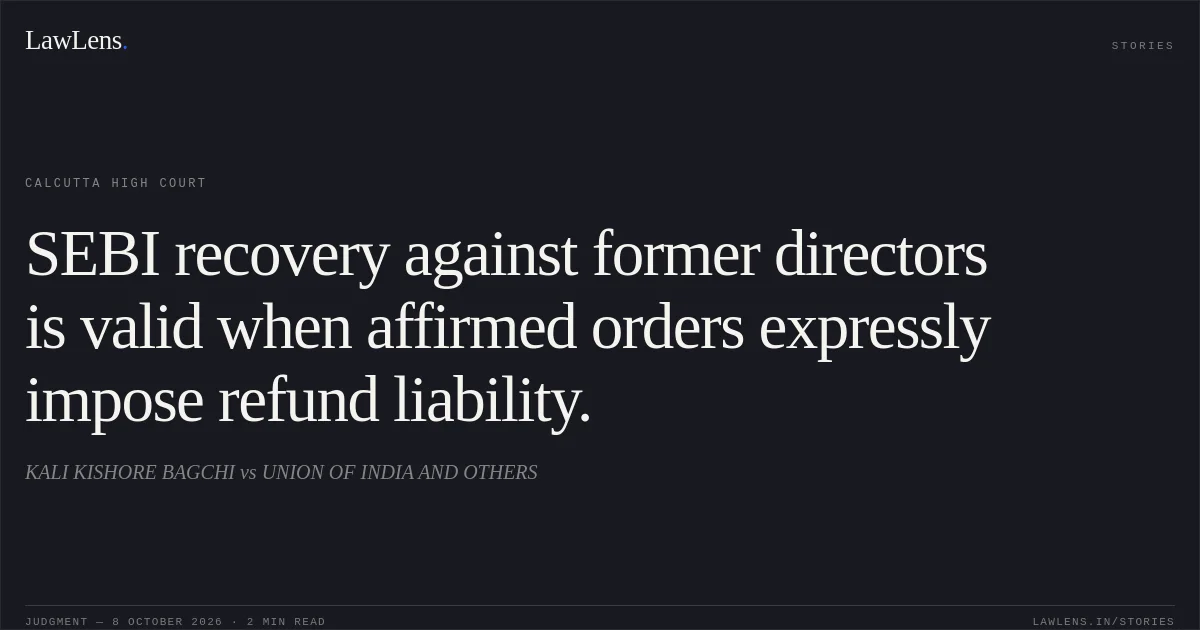
¶ 13–18By an order dated 23 February 2016, SEBI’s Whole Time Member directed APNEL and its directors, including the petitioner, to refund the money with interest and imposed related restraints.
¶ 13–18The Securities Appellate Tribunal dismissed the petitioner’s appeal on 10 January 2018.
¶ 13–18SEBI later initiated recovery proceedings and attached the petitioner’s bank accounts; on 21 October 2024, the Recovery Officer directed remittance of attached funds towards a stated liability of ₹9,93,29,277.
¶ 13–18The petitioner challenged the freezing and remittance, arguing that he had no liability and disputing the recovery calculation
¶ 13–1802Issues
i.Whether SEBI’s Recovery Officer could attach the petitioner’s personal bank accounts and direct remittance when the petitioner contended that he had no liability to refund the amounts collected by APNEL
¶ 11, 18ii.Whether the amount stated in the remittance order was improperly calculated
¶ 18, 2103Law Applied
The Court considered the SEBI Act, 1992, including Sections 11B and 28A: Section 11B provides the basis for SEBI’s directions, while Section 28A permits recovery of amounts due under securities laws.
¶ 5, 14It also referred to Section 73(2) of the Companies Act, 1956, which was the basis for calculating interest on investor repayments under the Whole Time Member’s order.
¶ 5, 14The operative rule in this case was that recovery could proceed to enforce the final SEBI order directing the company and its directors to refund investor money; the Court cited no judicial precedents
¶ 5, 14Provisions in the judgment · 1 · Linked ones open on LawLens
Securities and Exchange Board of India Act, 1992 Section 11
04Reasoning
The Court found that the petitioner was a director throughout the relevant fundraising period and had resigned only on 8 April 2013.
¶ 19–22The Securities Appellate Tribunal had already rejected his contention that he was not a director at the relevant time, and the 2016 refund direction expressly named him alongside APNEL’s other directors.
¶ 19–22The Court therefore treated the recovery proceedings as enforcement of an existing direction, rather than a determination of liability for the first time.
¶ 19–22On quantum, it noted that SEBI had identified collections of ₹10,38,54,000 and that the recovery proceedings initially concerned that amount; the remittance order stated a liability of ₹9,93,29,277.
¶ 19–22It found no illegality in the remittance order
¶ 19–2205Holding
The Court rejected the petitioner’s challenge, holding that it found no illegality in the Recovery Officer’s remittance order dated 21 October 2024.
¶ 22–23W.P.O. No. 159 of 2026 was dismissed
¶ 22–23Original Court PDF
KALI KISHORE BAGCHIvsUNION OF INDIA AND OTHERS
Click to open original judgment
Original judgment, available to read, download and summarize on LawLens.in