01Facts
Late Gopal Dey Choudhury owned 10 lechas of land and was survived by four daughters and one son, Jayanta Dey Choudhury.
p. 3 · ¶ 3–5Jayanta occupied the property and subsequently died.
p. 3 · ¶ 3–5One of Gopal’s daughters also died, leaving legal heirs.
p. 3 · ¶ 3–5The deceased daughter’s heirs and the other daughters claimed their respective shares in Gopal’s property.
p. 3 · ¶ 3–5The appellants contended that 2 lechas were occupied by an electricity transformer, leaving only 8 lechas for partition among five sharers.
p. 3 · ¶ 6They argued that their resulting share would be less than 2 lechas and insufficient for construction of a house, and invoked Section 2 of the Partition Act, 1893, seeking sale of the other shares in their favour.
p. 3 · ¶ 6The trial court decreed the matter on 3 May 2019, and the first appellate court affirmed the decree on 9 November 2022.
p. 3 · ¶ 2The appellants then preferred the present Regular Second Appeal under Section 100 CPC.
p. 3 · ¶ 202Issues
i.Whether Section 6 of the Hindu Succession (Amendment) Act, 2005 applied where the parties were governed by the Dayabhaga school of Hindu law?
p. 3 · ¶ 7, Issue Iii.Whether the findings of both courts below were perverse for failure to consider the evidence on record?
p. 3 · ¶ 7, Issue II03Law Applied
The Court applied Section 100 of the Code of Civil Procedure, under which a Regular Second Appeal lies only on a substantial question of law and the High Court cannot ordinarily reappreciate evidence.
p. 3 · ¶ 6Section 2 of the Partition Act, 1893 was relied upon by the appellants in support of their request for sale of the other co-sharers’ interests, but its applicability depended on the existence of a legally sustainable ground for interference.
p. 3 · ¶ 6The Court also considered Section 6 of the Hindu Succession (Amendment) Act, 2005 in the context of the Dayabhaga school of law.
p. 3 · ¶ 7Relying on Govindaraju v. Mariamman, (2005) 2 SCC 500, and the principle stated in Santosh Hazari v. Purushottam Tiwari, (2001) 3 SCC 179, the Court held that a substantial question of law must be debatable, arise from the pleadings and sustainable findings of fact, and materially affect the parties’ rights; a mere question of fact or a settled proposition of law is insufficient.
p. 4 · ¶ 10Provisions in the judgment · 2 · Linked ones open on LawLens
Code of Civil Procedure, 1908 Section 100
Partition Act, 1893 Section 2
04Reasoning
The Court held that the appellants’ grievance principally concerned the size and utility of the share they would receive, particularly in view of the transformer occupying part of the land and the alleged inability to construct a house on a smaller parcel.
p. 3 · ¶ 6, 8The entitlement of the parties to equal shares was not materially disputed.
p. 4 · ¶ 9The questions framed at admission did not disclose any genuine substantial question of law; rather, they sought reconsideration of factual matters and the evidence assessed by the courts below.
p. 4 · ¶ 10–12In a second appeal under Section 100 CPC, the High Court was not entitled to reappreciate such evidence absent a legally sustainable substantial question of law.
p. 4 · ¶ 10–12The Court therefore found no perversity or other basis for disturbing the concurrent findings.
p. 4 · ¶ 10–1205Holding
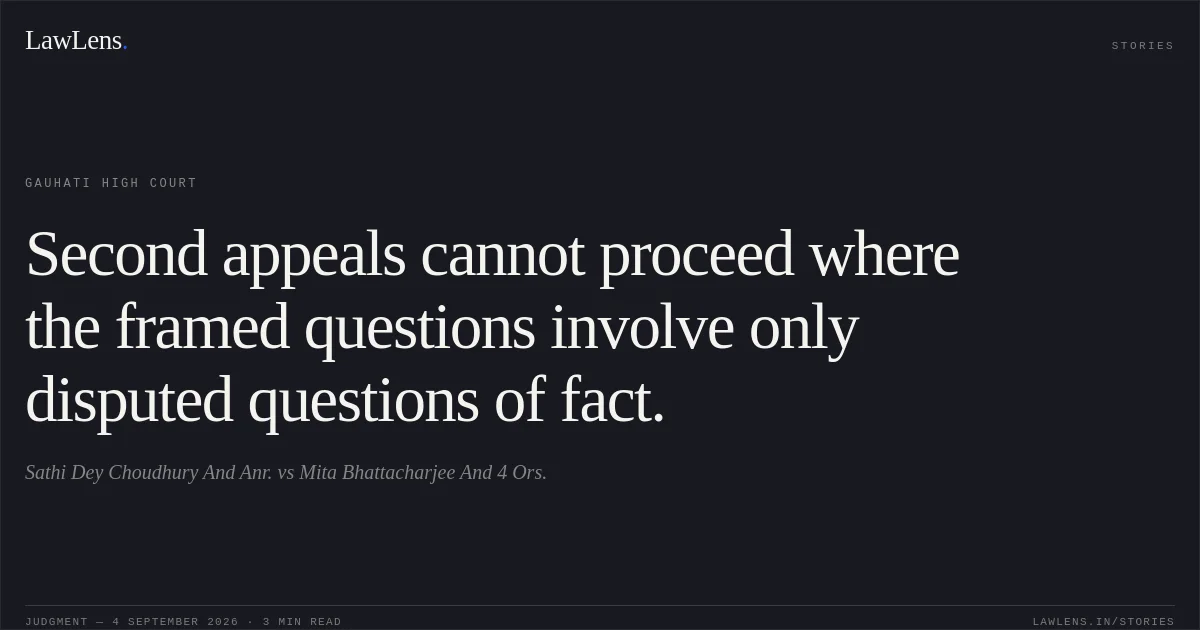
The Court answered the appeal against the appellants, holding that the formulated questions were not substantial questions of law but, in substance, questions of fact.
p. 4 · ¶ 12–13The appeal was dismissed for lack of merit, and the Trial Court Record was directed to be sent back.
p. 4 · ¶ 12–13Original Court PDF
Sathi Dey Choudhury And Anr.vsMita Bhattacharjee And 4 Ors.
Click to open original judgment
Original judgment, available to read, download and summarize on LawLens.in