Facts
The respondent (wife) filed an application under Section 125 Cr.P.C. for maintenance, which the Family Court, Katni, allowed on 31.03.2018, awarding ₹10,000 per month.
Source reference: p. 1This followed a long litigation history: a 1989 maintenance order (later modified to ₹200/month in 1991) and a 2002 ex-parte decree of divorce granted to the petitioner (husband) on the grounds of adultery.
Source reference: paras. 7-8The wife’s attempt to set aside the divorce decree under Order 9 Rule 13 CPC was dismissed in 2003.
Source reference: para. 8The husband challenged the 2018 order via this revision, arguing that a second Section 125 application was not maintainable and that the divorce decree based on adultery barred maintenance.
Source reference: para. 4Issues
1. Whether a second application for maintenance under Section 125 Cr.P.C. is maintainable when a previous order under the same section is already in force.
Source reference: para. 112. Whether an ex-parte decree of divorce granted on the grounds of adultery operates as res judicata to bar a claim for maintenance.
Source reference: para. 12Law Applied
Section 125 and Section 127 of the Cr.P.C., noting that Section 127 provides the statutory remedy for enhancement of maintenance due to changed circumstances, rather than filing a fresh Section 125 petition.
Source reference: para. 11The court relied on Erach Boman Khavar v. Tukaram Shridhar Bhat and Saroja v. Chinnusamy, which establish that an ex-parte decree is as effective as a bi-party decree and constitutes a decision on merits if the court was satisfied with the plaintiff's claim.
Source reference: paras. 13-14Reasoning
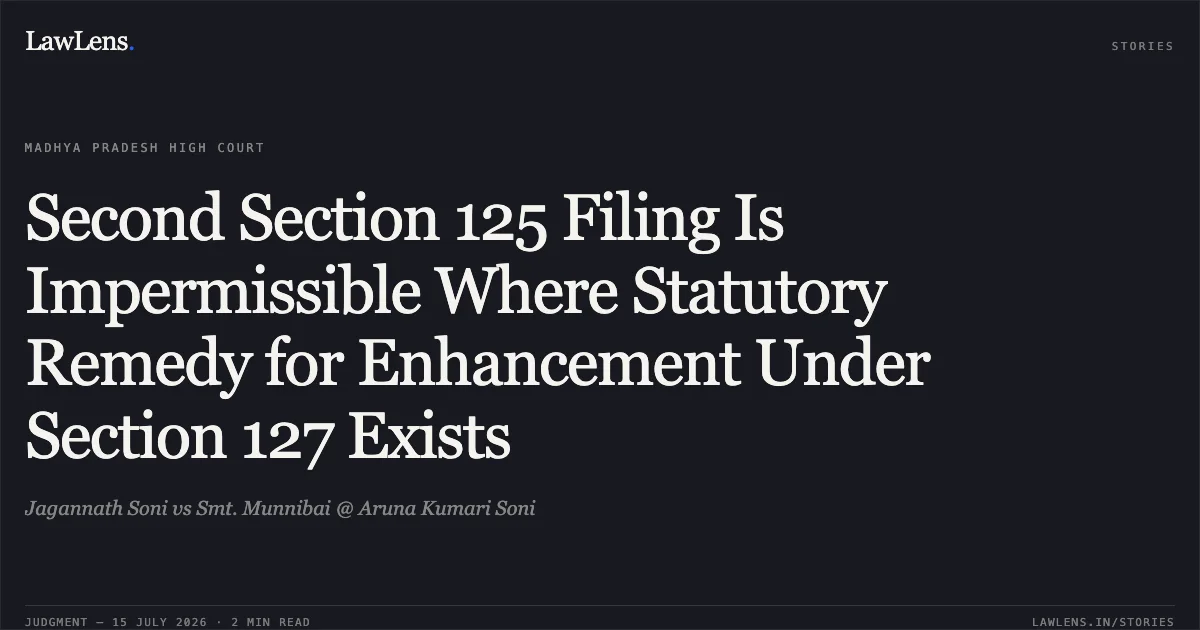
The High Court found that the Family Court erred in treating the second Section 125 application as maintainable. It reasoned that since a maintenance order from 1991 already existed, the respondent’s proper remedy for an increase in amount was an application under Section 127 Cr.P.C., not a fresh filing under Section 125.
Source reference: para. 11The court held that because the divorce was granted on the specific finding of adultery and the wife’s challenge to that decree had failed (and attained finality), the decree operated as res judicata.
Source reference: paras. 8, 12The court noted that the precedents cited by the Family Court (Mahua Biswas and Sunanda Chandrakant) were distinguishable on their facts and did not support the maintenance of a second application in this specific procedural context.
Source reference: paras. 9-10Holding
The High Court held that an ex-parte decree is legally binding until set aside and must be considered in maintenance proceedings.
The High Court allowed the criminal revision partly, set aside the impugned order, and remanded the matter to the Family Court for fresh consideration of the facts regarding adultery and maintainability.
Source reference: paras. 15, 18As an interim measure, the husband was directed to continue paying ₹4,000 per month until the final disposal by the Family Court.
Source reference: para. 17All parties were directed to appear before the Family Court on 17.08.2026.
Source reference: para. 16Acts & Sections Cited
3 provisions across 1 statute referred to in this judgment. Each provision opens on LawLens.
Code of Criminal Procedure, 19733
Original Court PDF
Jagannath SonivsSmt. Munnibai @ Aruna Kumari Soni
Click to open original judgment
Original judgment, available to read, download and summarize on LawLens.in