Facts
The petitioner, an Excise Sub-Inspector, was initially placed under suspension by order dated 4 September 2025.
Source reference: paras. 2–3; pp. 3–4Subsequently, after a charge-sheet/challan was filed against him before the competent criminal court under the Prevention of Corruption Act, 1988, the respondents passed a further suspension order dated 19 June 2026/19 August 2026 under Rule 9(1)(b) of the Chhattisgarh Civil Services (Classification, Control and Appeal) Rules, 1966 (“CCA Rules”).
Source reference: paras. 2–3; pp. 3–4The petitioner challenged the subsequent suspension, contending that it was a second suspension and therefore attracted Rule 9(5)(b) of the CCA Rules.
Source reference: para. 1; pp. 1–3The State contended that the impugned order was independently issued under Rule 9(1)(b) because of the filing of the criminal charge-sheet and could not be treated as a second suspension for the purposes of Rule 9(5)(b).
Source reference: para. 4; p. 4Issues
Whether the subsequent suspension order, issued after filing of a criminal charge-sheet against the petitioner under the Prevention of Corruption Act, was validly passed under Rule 9(1)(b) of the CCA Rules?
Source reference: paras. 2, 6–8; pp. 3–7Whether the fact that the petitioner had earlier been suspended attracted Rule 9(5)(b), thereby invalidating the subsequent suspension order in the absence of compliance with that provision?
Source reference: paras. 3, 9–10; pp. 3–4, 7–8Whether the decision in Ritu Surange v. State of Chhattisgarh & Others, W.A. No. 215 of 2022, governed the present case?
Source reference: paras. 3, 9–10; pp. 3–4, 7–8Law Applied
The Court applied Rule 9(1)(b) of the CCA Rules, which authorises the competent authority to place a government servant under suspension where a criminal case against him is under investigation, inquiry, or trial.
Source reference: para. 6; pp. 5–6The first proviso to Rule 9(1) further mandates that a government servant shall invariably be suspended when a challan for a criminal offence involving corruption or moral turpitude is filed against him.
Source reference: paras. 6–7; pp. 5–6The Court also considered Rule 9(5)(b), relied upon by the petitioner in relation to a second suspension, but held that its applicability depends on the legal basis and circumstances of the subsequent suspension.
Source reference: paras. 3, 9; pp. 3–4, 7The Court distinguished Ritu Surange v. State of Chhattisgarh & Others, W.A. No. 215 of 2022, decided on 16 June 2022, as concerning a different factual and legal situation involving suspension in connection with a departmental charge-sheet.
Source reference: paras. 3, 10; pp. 3–4, 7–8Reasoning
The Court found that the impugned suspension was passed after filing of the criminal charge-sheet/challan under the Prevention of Corruption Act before the competent criminal court.
Source reference: para. 8; p. 7Consequently, the case fell squarely within Rule 9(1)(b), and the first proviso made suspension mandatory where the criminal offence involved corruption.
Source reference: para. 8; p. 7The Court rejected the petitioner’s argument that the order was invalid merely because it followed an earlier suspension.
Source reference: para. 9; p. 7It held that the two suspension orders had to be examined with reference to the provisions under which they were issued; the impugned order was an independent exercise of power under Rule 9(1)(b), prompted by the initiation of criminal proceedings.
Source reference: para. 9; p. 7Since Ritu Surange concerned a materially different situation involving a departmental proceeding, it did not control the present case.
Source reference: para. 10; pp. 7–8The Court therefore found no illegality or infirmity in the impugned order.
Source reference: para. 11; p. 8Holding
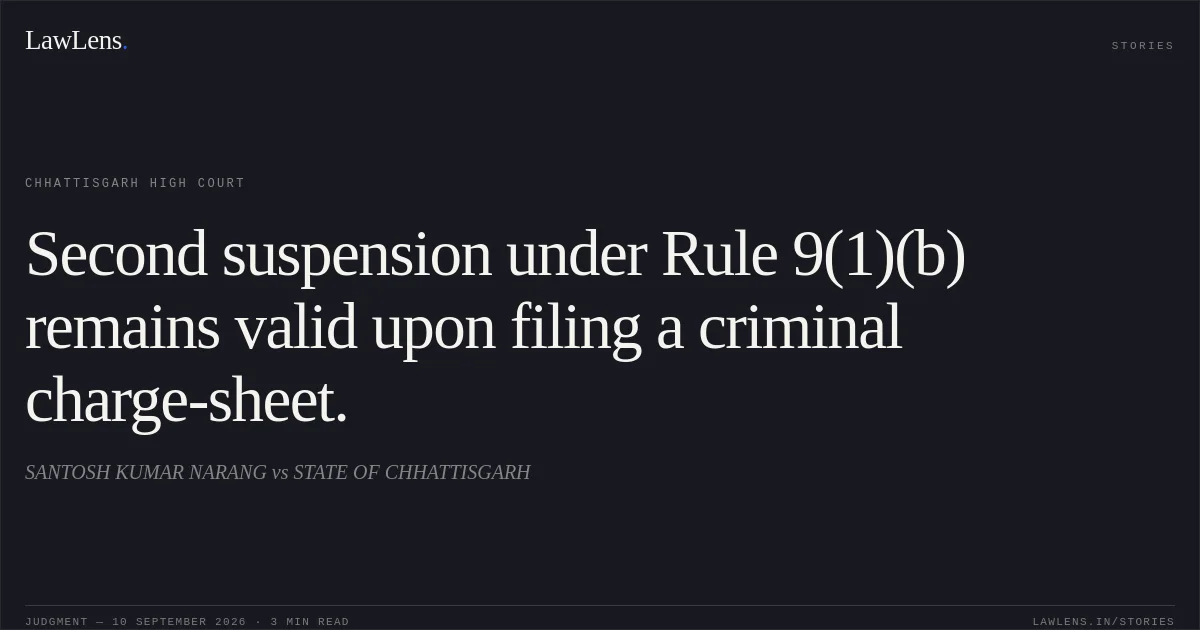
The Court held that the subsequent suspension was validly imposed under Rule 9(1)(b) of the CCA Rules following the filing of a corruption-related criminal charge-sheet.
The earlier suspension did not, in the circumstances, render the subsequent order a legally impermissible “second suspension” under Rule 9(5)(b).
Source reference: paras. 11–12; p. 8The writ petition was accordingly dismissed, and no relief of quashing, reinstatement, or consequential service benefits was granted.
Source reference: paras. 11–12; p. 8Original Court PDF
SANTOSH KUMAR NARANGvsSTATE OF CHHATTISGARH
Click to open original judgment
Original judgment, available to read, download and summarize on LawLens.in
![Respondents must decide promotion representations by a reasoned speaking order within four weeks.. quasar shafi vs SOCIAL WELFARE. CAT - ['Srinagar']. LawLens](/stories/thumbnails/respondents-must-decide-promotion-representations-by-a-reasoned-speaking-order-within-four-8a34c8fac3e74d9d9cf41fca9f207d29.webp)