Facts
The appellant, a police officer, was convicted under Section 7 of the Prevention of Corruption Act, 1988, for allegedly demanding monthly bribes of ₹3,000 from a parking attendant operating an unauthorised parking area.
Source reference: p. 1–5The Trial Court acquitted him under Section 13(1)(d) of the Act.
Source reference: p. 1–5On appeal, the appellant challenged the finding of demand, relying principally on the complainant’s denial and the alleged inadmissibility and unreliability of the recorded conversation.
Source reference: p. 1–5The complainant admitted approaching the Anti-Corruption Branch and participating in a recording exercise, but denied the alleged demand and stated that he had copied the formal complaint despite disputing its contents.
Source reference: p. 12–14The original recording device was not produced, and the prosecution did not produce a Section 65B certificate for the CD and transcript.
Source reference: p. 20–22Issues
1. Whether the prosecution proved beyond reasonable doubt that the appellant demanded or attempted to obtain illegal gratification, notwithstanding the complainant’s denial and the absence of proof of payment or recovery.
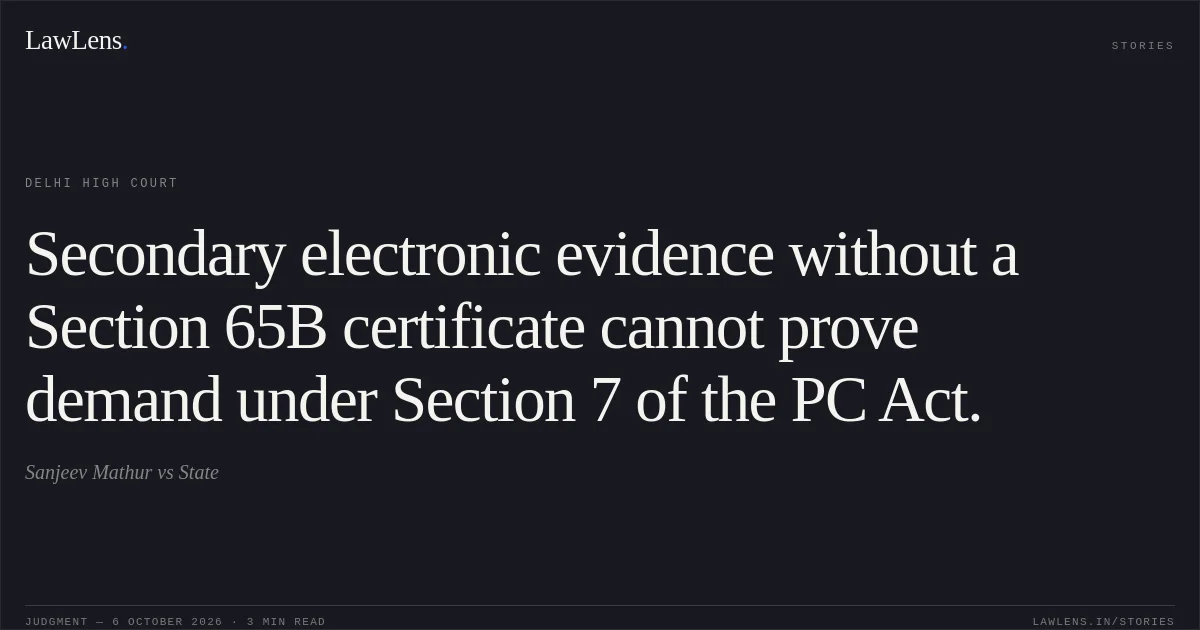
Source reference: p. 10–11, 27–292. Whether the CD and transcript of the recorded conversation were admissible without a certificate under Section 65B of the Evidence Act, where the original recording device was not produced.
Source reference: p. 19–22Law Applied
Section 7 of the Prevention of Corruption Act, as applicable to the case, requires proof of the conduct constituting the offence, including the relevant demand, offer, acceptance, agreement to accept, or attempt to obtain illegal gratification; the expressions “agrees to accept” and “attempts to obtain” do not dispense with proof of the underlying conduct.
Source reference: p. 11, 24–27Under Arjun Panditrao Khotkar v. Kailash Kushanrao Gorantyal, a Section 65B(4) certificate is a condition precedent to admitting a computer output as secondary electronic evidence, unless the original electronic record itself is produced.
Source reference: p. 20–22Under Neeraj Dutta v. State (NCT of Delhi), demand and acceptance may be proved by direct or circumstantial evidence, but the foundational facts must first be established; the statutory presumption under Section 20 follows proof of the relevant facts.
Source reference: p. 25–27A hostile witness’s evidence is not wholly erased and may be relied on to the extent it is reliable and corroborated, as recognised in K.P. Tamilmaran v. State.
Source reference: p. 14–15Reasoning
The complainant’s testimony established his interactions with the appellant, his approach to the Anti-Corruption Branch, and his participation in the recording exercise, but he expressly denied that the appellant demanded a bribe.
Source reference: p. 12–14, 18–19, 27–28His admission that the appellant referred to ₹3,000 as a monthly “rishwat” was relevant, but did not, by itself, establish a demand in the alleged circumstances.
Source reference: p. 12–14, 18–19, 27–28The CD and transcript could not supply the missing corroboration: they were secondary electronic evidence, the original recording device was not produced, and no Section 65B certificate was filed. The Court therefore excluded them from consideration as proof of the conversation’s contents.
Source reference: p. 20–23The other witnesses corroborated the recording exercise and the parties’ official connection, but had no personal knowledge of the alleged demand; nor was the alleged payment proved by recovery or independent evidence.
Source reference: p. 16–19, 27–29Applying Neeraj Dutta, the remaining evidence did not establish the essential foundational fact of demand beyond reasonable doubt.
Source reference: p. 25–29Holding
The Court held that the prosecution failed to prove the Section 7 charge beyond reasonable doubt.
It set aside the appellant’s conviction and acquitted him of that charge.
Source reference: p. 29–30The Trial Court’s acquittal under Section 13(1)(d) was left undisturbed, and the appeal was allowed and disposed of.
Source reference: p. 29–30Acts & Sections Cited
5 provisions across 3 statutes referred to in this judgment. Each provision opens on LawLens.
Prevention of Corruption Act, 19883
Indian Penal Code, 18601
Code of Criminal Procedure, 19731
Original Court PDF
Sanjeev MathurvsState
Click to open original judgment
Original judgment, available to read, download and summarize on LawLens.in