Facts
The Appellant married the deceased approximately ten years prior to the incident; they had two children
Source reference: p.5On 16.03.2018, the Kazigaon Police Station received information that the deceased had committed suicide by hanging
Source reference: p.2The police found the body on the veranda of the matrimonial home
Source reference: p.3The father of the deceased (PW-1) filed an FIR alleging murder and dowry-related cruelty
Source reference: p.5Medical evidence from the post-mortem (PW-5) and a court witness (CW-1) indicated that the death was caused by homicidal ligature strangulation, noting a fractured hyoid bone and transverse ligature marks inconsistent with suicidal hanging
Source reference: p.8-10The Trial Court convicted the Appellant under Sections 302 and 498-A of the IPC
Source reference: p.2The Appellant challenged this, contending the case rested on an incomplete chain of circumstantial evidence
Source reference: p.3Issues
1. Whether the prosecution succeeded in establishing a complete chain of circumstances consistent only with the guilt of the accused and excluding every hypothesis of innocence
Source reference: p.5 / para 102. Whether the burden of proof could be shifted to the accused under Section 106 of the Evidence Act solely because the death occurred in the matrimonial home
Source reference: p.4, 153. Whether the non-examination of a material witness (the Appellant’s brother who first reported the death) warranted an adverse inference against the prosecution
Source reference: p.12, 14Law Applied
The court applied Sections 302 (murder) and 498-A (matrimonial cruelty) of the IPC
Source reference: p.2It relied on the "Panchsheel" principles of circumstantial evidence established in Sharad Birdhichand Sarda v. State of Maharashtra, requiring a complete and consistent chain of evidence
Source reference: p.11Regarding the burden of proof, the court applied Section 106 of the Indian Evidence Act, 1872, as interpreted in Nagendra Sah v. State of Bihar and Balvir Singh v. State of Uttarakhand, which holds that Section 106 does not absolve the prosecution of its primary burden to establish a prima facie case
Source reference: p.15-18It further cited Deny Bora v. State of Assam regarding the adverse inference drawn from the non-examination of material witnesses
Source reference: p.12-14Reasoning
While the court acknowledged that medical evidence established the death as homicidal, it found the circumstantial chain regarding the Appellant's involvement to be broken.
Source reference: p.11, 19First, the prosecution failed to prove the Appellant's exclusive presence at the scene; evidence showed other family members were present and a marriage ceremony was ongoing in the house, providing access to multiple persons
Source reference: p.12, 20Second, independent witnesses (PW-3 and PW-4) contradicted the allegations of dowry harassment, describing the couple's relationship as cordial
Source reference: p.7-8Third, the court drew an adverse inference from the non-examination of the Appellant's younger brother, a material witness who first discovered the body and reported it as a suicide
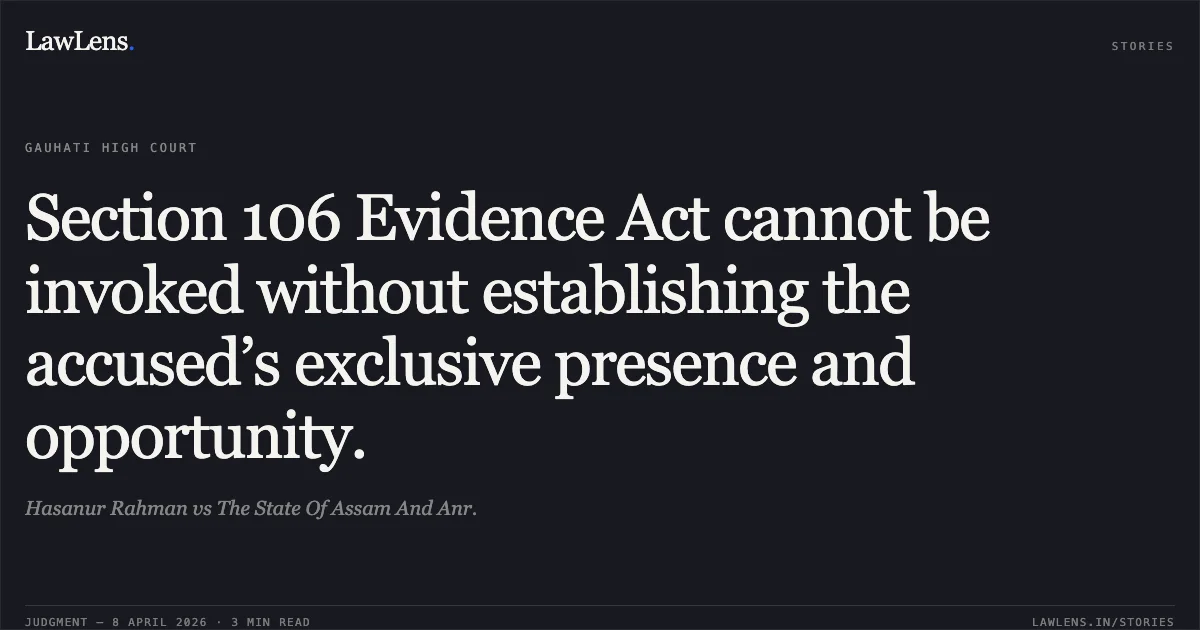
Source reference: p.12, 21Finally, the court held that Section 106 of the Evidence Act cannot be invoked to "cure" a gap in the prosecution’s case; since the prosecution failed to establish foundational facts (like the Appellant's exclusive opportunity), the Appellant's failure to provide a "true" explanation did not complete the chain of guilt
Source reference: p.21Holding
The Court allowed the appeal, holding that the prosecution failed to prove its case beyond a reasonable doubt as the chain of circumstances was incomplete and allowed for plausible hypotheses of innocence
The High Court set aside the judgment dated 20.02.2023 and the order of sentence dated 21.02.2023 passed by the District & Sessions Judge, Kokrajhar
Source reference: p.2, 21The Appellant was acquitted of all charges under Sections 302 and 498-A IPC and ordered to be released forthwith
Source reference: p.22Acts & Sections Cited
2 provisions across 2 statutes referred to in this judgment. Each provision opens on LawLens.
Indian Penal Code, 18601
Code of Criminal Procedure, 19731
Original Court PDF
Hasanur RahmanvsThe State Of Assam And Anr.
Click to open original judgment
Original judgment, available to read, download and summarize on LawLens.in


