Facts
The Petitioner, a Ludhiana-based jeweler, challenged a revisional order dated March 30, 2022, which upheld a penalty of ₹16,00,000/- imposed on him for involvement in gold smuggling
Source reference: p.2, para. 2-3The matter originated when a passenger, Salil Puri, was intercepted at IGI Airport with approximately 1 kg of gold
Source reference: p.4, para. 5(ii-iii)In statements recorded under Section 108 of the Customs Act, 1962, the passenger confessed to acting as a carrier for the Petitioner and revealed three prior instances of smuggling totaling 2,920 grams of gold valued at ₹81,76,000/-
Source reference: p.4, para. 5(iv); p.6, para. 11Further investigations, including statements from a money exchanger (Raman Kumar) and forensic analysis of the passenger’s mobile phone, established a financial and communicative link between the Petitioner and the smuggling operation
Source reference: p.6, para. 12-14The Petitioner failed to cooperate with summons prior to the issuance of the Show Cause Notice
Source reference: p.7, para. 15Issues
1. Whether the statements recorded under Section 108 of the Customs Act and collateral forensic evidence were sufficient to establish the Petitioner's liability for penalty under the Act
Source reference: p.5, para. 6; p.8, para. 212. Whether the Petitioner could claim parity with the passenger, who was permitted to re-export the seized gold upon payment of a redemption fine, to seek a reduction in penalty
Source reference: p.5, para. 7; p.9, para. 24Law Applied
The Court primarily applied Sections 111, 112, 114A, 114AA, and 117 of the Customs Act, 1962, which govern the confiscation of goods and the imposition of penalties for improper importation and use of false documents
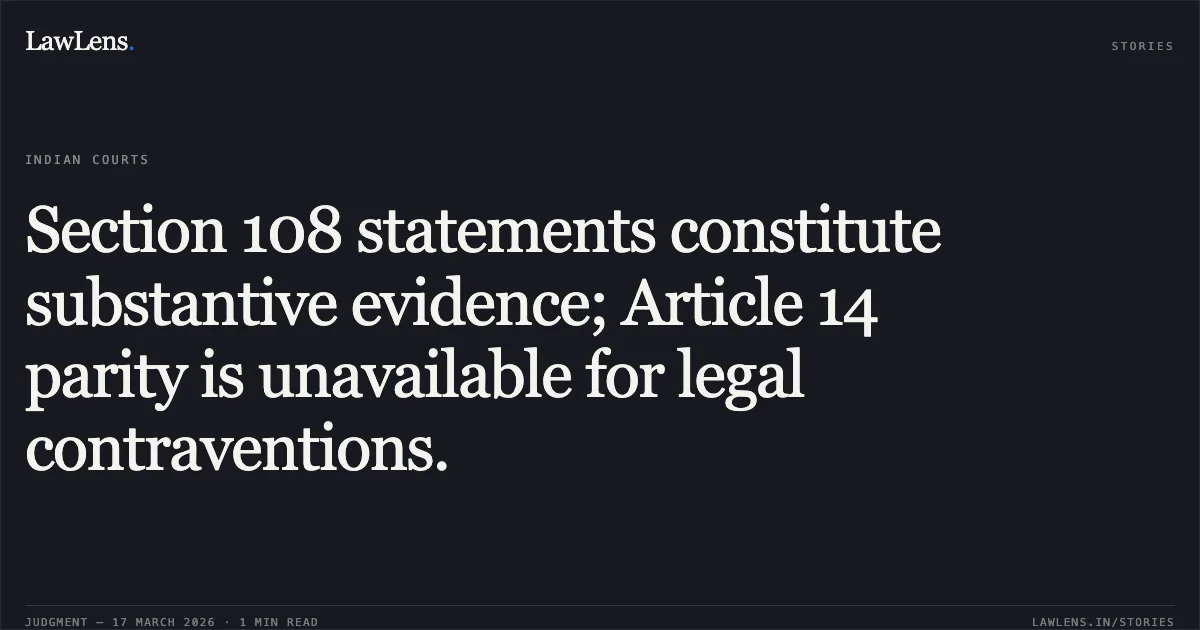
Source reference: p.7-8, para. 17-20It relied on the evidentiary principle established in Naresh J. Sukhawani v. Union of India (1995), which holds that a statement recorded under Section 108 of the Customs Act is substantive evidence and can be used to implicate co-noticees, unlike statements recorded under Section 161 of the CrPC
Source reference: p.8, para. 22The Court applied the principle that Article 14 of the Constitution cannot be invoked to claim "negative equality" or parity in illegal acts
Source reference: p.9, para. 24Reasoning
The Court observed that the Petitioner’s involvement was corroborated by consistent statements from both the carrier and the money exchanger, which detailed the logistics of currency exchange and gold delivery
Source reference: p.5-6, para. 10-13This testimonial evidence was reinforced by forensic analysis of mobile data, which established a direct relationship between the parties for the purpose of purchasing and bringing gold into India
Source reference: p.6-7, para. 14Applying the Naresh J. Sukhawani precedent, the Court held that these Section 108 statements constituted a legal basis for the penalty, as they clearly inculpated the Petitioner in the contravention of the Act
Source reference: p.8, para. 22-23The Court further reasoned that the Petitioner's intent to deal with goods he knew were liable for confiscation justified the levy of penalties under Sections 114A and 114AA
Source reference: p.7-8, para. 19-20Holding
The Court dismissed the writ petition, upholding the orders of the lower authorities and the Revisional Authority
It held that there was sufficient material to connect the Petitioner to the smuggling activities and that the penalty was in accordance with statutory mandates
Source reference: p.8, para. 21; p.9, para. 23The Court rejected the Petitioner's plea for parity with the passenger, ruling that Article 14 of the Constitution does not provide for equal treatment in the context of flouting the law
Source reference: p.9, para. 24No grounds were found for interference in the court’s extraordinary jurisdiction
Source reference: p.9, para. 25Acts & Sections Cited
9 provisions across 2 statutes referred to in this judgment. Each provision opens on LawLens.
Customs Act,19628
Code of Criminal Procedure, 19731
Original Court PDF
Gautam JainvsUnion Of India & Ors
Click to open original judgment
Original judgment, available to read, download and summarize on LawLens.in