Facts
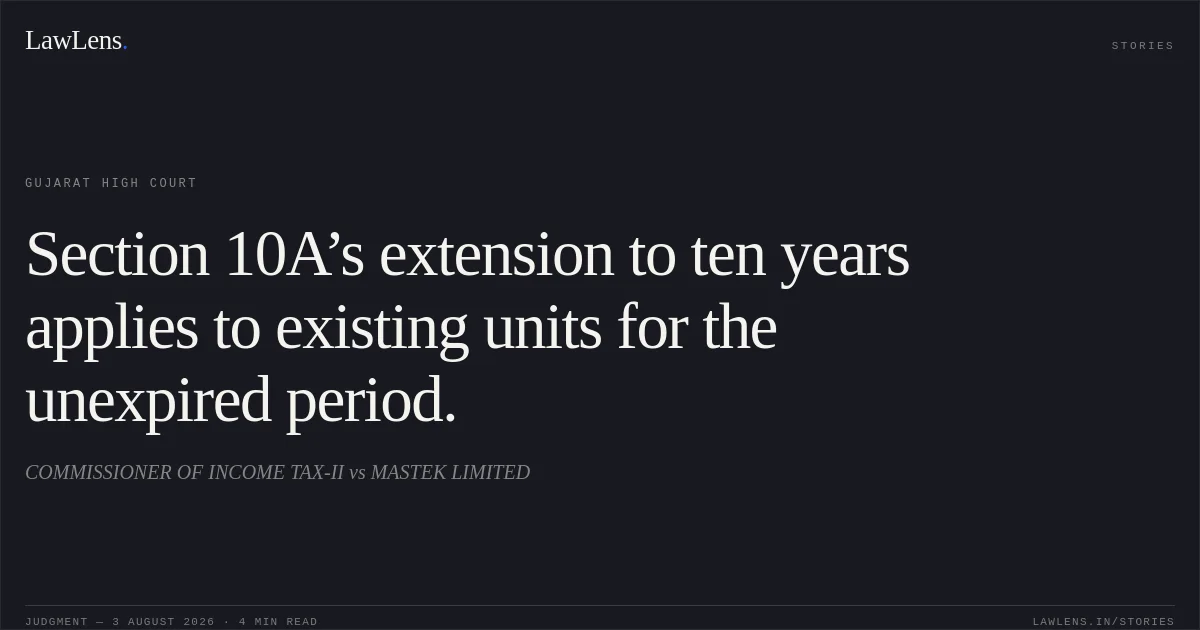
Mastek Limited, engaged in software development, operated Unit No. 106 in the SEEPZ, Mumbai, which commenced operations in 1990/Assessment Year 1991–92.
Source reference: paras. 2–12; pp. 2–12The assessee claimed deduction under Section 10A of the Income-tax Act, 1961 (“the Act”) for five consecutive assessment years, 1991–92 to 1995–96, and subsequently claimed deduction under Section 80HHE for Assessment Years 1996–97 to 1998–99.
Source reference: paras. 2–12; pp. 2–12Following the amendment to Section 10A with effect from 1 April 1999, which extended the tax-holiday period from five years to ten consecutive assessment years, the assessee claimed Section 10A deduction for Unit No. 106 for Assessment Years 1999–2000 and 2000–01.
Source reference: paras. 2–12; pp. 2–12The Assessing Officer rejected the claim, holding that the assessee had exhausted its entitlement under the unamended provision and that the intervening claims under Section 80HHE constituted a break.
Source reference: paras. 2–12; pp. 2–12The Commissioner (Appeals) affirmed the disallowance.
Source reference: paras. 2–12; pp. 2–12The Income Tax Appellate Tribunal reversed those orders and allowed the claim, subject to recomputation of the deductions under Sections 10A and 80HHE.
Source reference: paras. 2–12; pp. 2–12The Revenue challenged the Tribunal’s decision under Section 260A of the Act.
Source reference: paras. 2–12; pp. 2–12Issues
1. Whether the Tribunal was correct in law and on facts in reversing the Commissioner (Appeals)’s order and allowing Mastek Limited’s claim for deduction under Section 10A in respect of Unit No. 106 for Assessment Years 1999–2000 and 2000–01.
Source reference: para. 3, p. 22. Whether an undertaking that had availed the five-year deduction under the unamended Section 10A and thereafter claimed deduction under Section 80HHE could claim the remaining years of the amended ten-year tax-holiday period.
Source reference: paras. 13–23, pp. 12–20; paras. 28–34, pp. 26–34Law Applied
The Court applied Section 10A of the Act as it stood before and after the Income-tax (Second Amendment) Act, 1998.
Source reference: paras. 25–27, pp. 20–26Under the pre-amendment provision, the undertaking was entitled to the tax holiday for five consecutive assessment years, initially within a block of eight years.
Source reference: paras. 25–27, pp. 20–26With effect from 1 April 1999, Section 10A granted a deduction of profits derived from exports for ten consecutive assessment years beginning with the assessment year relevant to the previous year in which the undertaking commenced manufacture or production of eligible articles, things, or computer software.
Source reference: para. 27, p. 25The Court relied principally on CIT v. DSL Software Ltd., 351 ITR 385 (Karn.), which held that an undertaking which had enjoyed the earlier five-year benefit could claim the unexpired portion of the ten-year period introduced by the amendment, provided the ten-year block had not expired when the amended provision came into force.
Source reference: paras. 28–30, pp. 26–31That principle had been affirmed by the Supreme Court through dismissal of the Revenue’s SLP in CIT v. Deutsche Software Ltd., 399 ITR 570 (SC).
Source reference: para. 30, p. 31The Court also considered Expo Packaging v. Assistant Commissioner of Income Tax, 26 taxmann.com 230 (Guj.), and distinguished the Revenue’s reliance on Principal CIT v. Wipro Ltd., 446 ITR 1 (SC), observing that Wipro concerned compliance with a mandatory statutory declaration and did not decide the issue of continuation of a tax holiday after legislative extension.
Source reference: paras. 14–22, pp. 12–20Reasoning
Unit No. 106 commenced operations in Assessment Year 1991–92.
Source reference: paras. 28–30, pp. 26–31Accordingly, the amended provision created a ten-year block extending from Assessment Years 1991–92 to 2000–01.
Source reference: paras. 28–30, pp. 26–31Although the assessee had claimed the benefit for the first five years and used Section 80HHE for the following three years, the amendment extended the duration of the tax holiday from five to ten years; it did not provide that the earlier utilisation of five years permanently exhausted the undertaking’s eligibility.
Source reference: paras. 28–30, pp. 26–31The Court held that the relevant test was whether the ten consecutive assessment years from commencement of manufacture had expired before 1 April 1999.
Source reference: paras. 31–34, pp. 31–34Since the block remained unexpired, the assessee was entitled to claim the deduction for the remaining Assessment Years 1999–2000 and 2000–01.
Source reference: paras. 31–34, pp. 31–34The absence of a Section 10A claim during the intervening years did not constitute a legally disabling break, because the amended Section 10A concerned the duration of the eligibility period rather than continuous annual utilisation of the deduction.
Source reference: paras. 31–34, pp. 31–34The Tribunal had therefore correctly applied the legislative purpose of extending the tax holiday to ten years to promote exports.
Source reference: paras. 28–29, pp. 26–30Holding
The substantial question of law was answered in favour of Mastek Limited and against the Revenue.
The Court held that the assessee could claim the Section 10A deduction for the remaining two years of the ten-year period applicable to Unit No. 106, namely Assessment Years 1999–2000 and 2000–01, notwithstanding its earlier five-year Section 10A claims and intervening Section 80HHE claims.
Source reference: paras. 33–35, pp. 33–34Both tax appeals filed by the Revenue were accordingly dismissed.
Source reference: para. 35, p. 34Acts & Sections Cited
19 provisions across 1 statute referred to in this judgment. Linked provisions open on LawLens.
Income Tax Act, 1961
Original Court PDF
COMMISSIONER OF INCOME TAX-IIvsMASTEK LIMITED
Click to open original judgment
Original judgment, available to read, download and summarize on LawLens.in