Facts
GAIL India Limited and Shree Vaishanavi Ispat Limited entered into a Gas Sales Agreement dated 16 December 2021 for the supply of gas to the Respondent’s industrial units in West Bengal. The agreement imposed a minimum gas-lifting obligation, with Take-or-Pay (“TOP”) charges becoming payable upon failure to lift the stipulated quantity. GAIL alleged that the Respondent stopped drawing gas from 1 November 2022, resulting in claims of approximately ₹14,39,33,231 towards TOP charges and interest for Contract Years 2023, 2024 and 2025
Source reference: para. 1–2GAIL initiated the contractual dispute-resolution process by issuing a conciliation letter dated 19 December 2025 under Clause 13.6. The Respondent sought additional time and thereafter disputed the claims and requested re-conciliation on 19 January 2026. GAIL subsequently invoked arbitration on 12 February 2026 and issued a corrigendum dated 27 February 2026 incorporating claims for Contract Year 2025. As the parties could not agree on the appointment of an arbitrator, GAIL filed the present petition under Section 11(6) of the Arbitration and Conciliation Act, 1996
Source reference: paras. 3–4The Respondent objected that the arbitration notice was premature because Clause 13.6 prescribed a mandatory multi-tier mechanism involving mutual discussions and conciliation under the GAIL (India) Limited Conciliation Rules, 2010 before arbitration could be invoked. During the proceedings, the Court referred the parties to conciliation by order dated 21 May 2026, but the conciliation failed
Source reference: paras. 5–6Issues
1. Whether the petition under Section 11(6) of the Arbitration and Conciliation Act, 1996 was maintainable despite the Respondent’s objection that the contractual pre-arbitral, multi-tier dispute-resolution mechanism had not been completed?
Source reference: paras. 5, 7, 132. Whether a Sole Arbitrator should be appointed to adjudicate the disputes arising from the Gas Sales Agreement?
Source reference: paras. 1, 8–103. Whether the petition under Section 9 of the Act should be treated as an application under Section 17 after constitution of the arbitral tribunal?
Source reference: paras. 17–19Law Applied
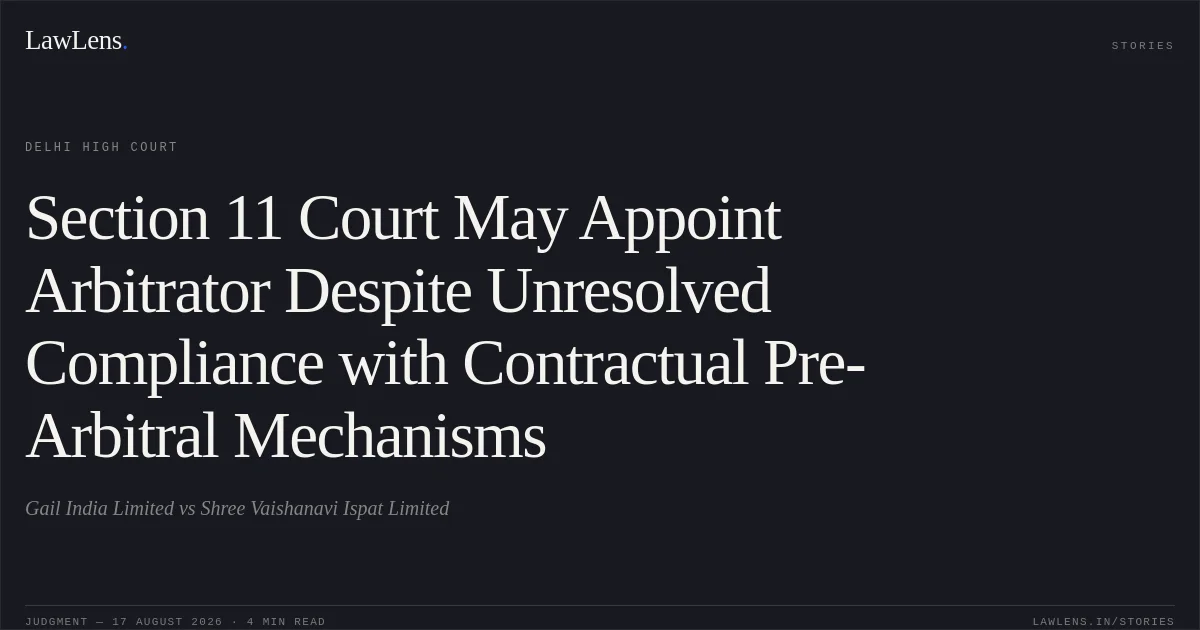
The Court applied Section 11(6) of the Arbitration and Conciliation Act, 1996, governing the appointment of an arbitrator where the parties fail to agree on the appointment mechanism, and held that the enquiry at the referral stage is confined to examining the prima facie existence of an arbitration agreement
Source reference: para. 8The Court relied on SBI General Insurance Co. Ltd. v. Krish Spinning, 2024 SCC OnLine SC 1754, for this limited-scrutiny principle
Source reference: para. 8The Court also referred to Sections 9 and 17 of the Act: once an arbitral tribunal is constituted, an application for interim measures under Section 9 is to be considered by the tribunal under Section 17, subject to the statutory framework
Source reference: paras. 17–18Contractual objections concerning satisfaction of a multi-tier dispute-resolution clause, arbitrability and jurisdiction were left open for determination by the arbitral tribunal
Source reference: para. 13Reasoning
The Court found that the existence of a valid arbitration agreement between the parties was undisputed
Source reference: para. 9Applying the restricted scope of examination under Section 11, the Court considered that it was not necessary at that stage to finally determine whether GAIL had fully complied with the mutual discussion and conciliation requirements under Clause 13.6. Although the Respondent maintained that the arbitration invocation was premature, the Court had already referred the parties to conciliation during the proceedings, and that process had failed
Source reference: paras. 6–7Accordingly, the Court appointed a Sole Arbitrator while expressly preserving the Respondent’s right to raise before the tribunal all objections relating to arbitrability, jurisdiction and compliance with the contractual multi-tier mechanism. Since the arbitral tribunal was being constituted, the Section 9 petition was directed to be treated as an application under Section 17, with the existing interim order continuing until the tribunal considered the application
Source reference: paras. 10, 13–14, 17–18Holding
The Court allowed the Section 11 petition and appointed Mr. Ravindra Bhat, former Judge of the Supreme Court of India, as the Sole Arbitrator to adjudicate the disputes between the parties
The arbitration was directed to be conducted under the rules and aegis of the Delhi International Arbitration Centre, with the arbitrator’s fees governed by the DIAC Schedule of Fees
Source reference: para. 12The tribunal was directed to enter upon the reference within two weeks and furnish the requisite disclosures under Section 12(2) within two weeks of entering upon the reference
Source reference: paras. 10–11All objections, including those concerning the pre-arbitral mechanism, jurisdiction and arbitrability, were left open for determination by the Sole Arbitrator. The Section 9 petition was disposed of by treating it as an application under Section 17, and the interim order was continued until consideration of that application by the tribunal
Source reference: paras. 13, 17–19Acts & Sections Cited
4 provisions across 1 statute referred to in this judgment. Each provision opens on LawLens.
Arbitration and Conciliation Act, 19964
Original Court PDF
Gail India LimitedvsShree Vaishanavi Ispat Limited
Click to open original judgment
Original judgment, available to read, download and summarize on LawLens.in