Facts
The deceased, Santola Devi, married Dharmendra Mandal in 2002 and died in March 2007 at her matrimonial home.
Source reference: para. 3, 8–9Her father alleged that her in-laws, including her brother-in-law Dilchandra Mandal, had harassed her over dowry and forced her to consume Thimet
Source reference: para. 3, 8–9The post-mortem doctor suspected death by poisoning but preserved the viscera; no chemical-analysis report was produced
Source reference: para. 13, 19The trial court convicted the accused under Section 304-B read with Section 34 IPC and sentenced them to life imprisonment.
Source reference: para. 2During the appeal, the appeals of the deceased’s husband and father-in-law abated; Dilchandra’s appeal proceeded
Source reference: para. 16Issues
Whether the prosecution proved the essential ingredients of dowry death under Section 304-B IPC against Dilchandra Mandal, including cruelty or harassment for dowry soon before the deceased’s death.
Source reference: para. 23, 27Whether the evidence established that the deceased died by poisoning and supported the allegation that Dilchandra participated in administering poison.
Source reference: para. 19–22, 25–27Law Applied
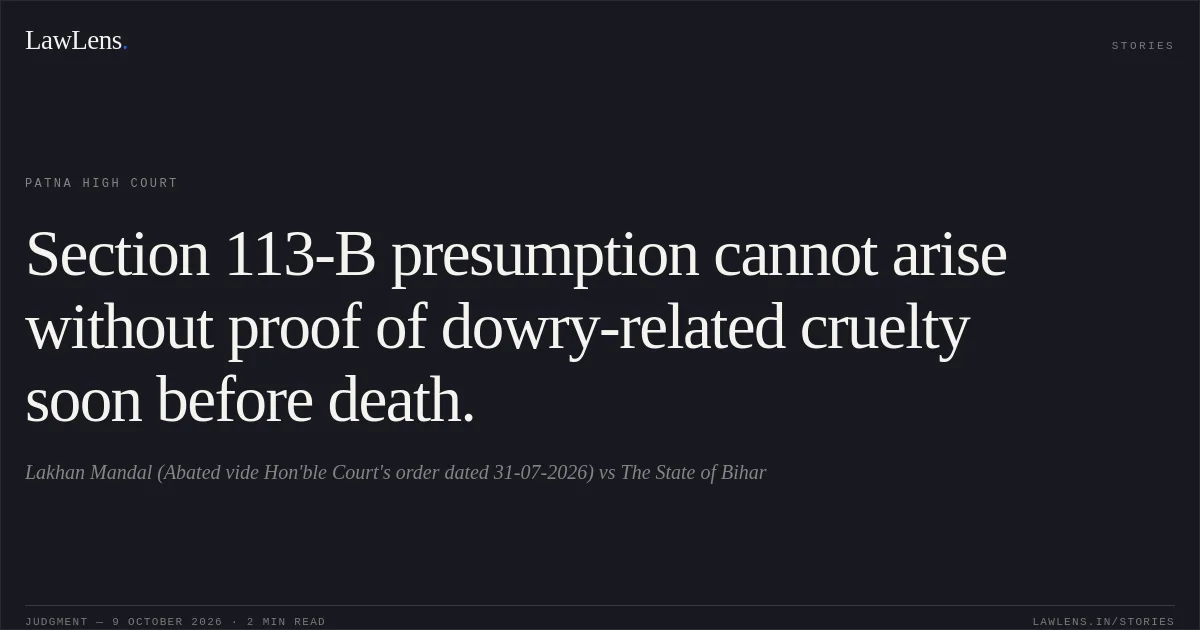
Section 304-B IPC applies where a woman’s death occurs otherwise than under normal circumstances within seven years of marriage and she was subjected, soon before her death, to cruelty or harassment by her husband or a relative for or in connection with a dowry demand; Section 113-B of the Evidence Act requires the court to presume that the accused caused the dowry death only after the prosecution establishes such soon-before cruelty or harassment
Source reference: para. 23A mere dowry demand is insufficient without proof of the accused’s act of cruelty or harassment, and omnibus allegations against family members—particularly relatives other than the husband and parents—require careful scrutiny
Source reference: para. 24The judgment also stated that a poisoning case requires proof that death resulted from poison, that the accused possessed the poison, and that the accused had an opportunity to administer it
Source reference: para. 26Reasoning
Although the death occurred within seven years of marriage and the doctor suspected poisoning, the viscera report was absent and the medical opinion was not confirmed by chemical analysis
Source reference: para. 19, 22, 25The allegations against Dilchandra were general and linked principally to the fact that more dowry was allegedly received at his marriage; the Court found insufficient proof of his specific participation in dowry-related cruelty soon before the death
Source reference: para. 17–18, 21, 27The absence of external injuries and the lack of proof that poison was recovered or possessed by an accused further weakened the allegation of forcible administration.
Source reference: para. 22, 25–27Accordingly, the statutory presumption under Section 113-B could not sustain the conviction
Source reference: para. 22, 25–27Holding
The High Court held that the evidence did not establish the case for dowry death against Dilchandra Mandal and allowed his appeal
It set aside his conviction and life sentence, acquitted him of the charges, and discharged him from the liabilities of his bail bonds
Source reference: para. 28–30Acts & Sections Cited
4 provisions across 2 statutes referred to in this judgment. Each provision opens on LawLens.
Indian Penal Code, 18603
Dowry Prohibition Act, 19611
Original Court PDF
Lakhan Mandal (Abated vide Hon'ble Court's order dated 31-07-2026)vsThe State of Bihar
Click to open original judgment
Original judgment, available to read, download and summarize on LawLens.in