Facts
Mayuriben died by suicide approximately two years after marrying respondent No. 1.
Source reference: para. 1–2.3The prosecution alleged that her husband and in-laws subjected her to physical and mental cruelty and made dowry-related demands, thereby abetting her suicide.
Source reference: para. 1–2.3The Trial Court acquitted the respondents of offences under Sections 306, 498-A and 114 of the IPC. The State appealed against the acquittal.
Source reference: para. 1–2.3Issues
Whether the Trial Court erred in acquitting the respondents of the charged offences.
Source reference: para. 6Whether the Trial Court committed an error of law or fact in appreciating the prosecution evidence, or whether its acquittal was illegal or perverse.
Source reference: para. 6Law Applied
Sections 498-A and 306 of the IPC require proof of cruelty, as defined in Section 498-A, and abetment of suicide; abetment must satisfy Section 107 of the IPC and cannot be established merely by suspicion.
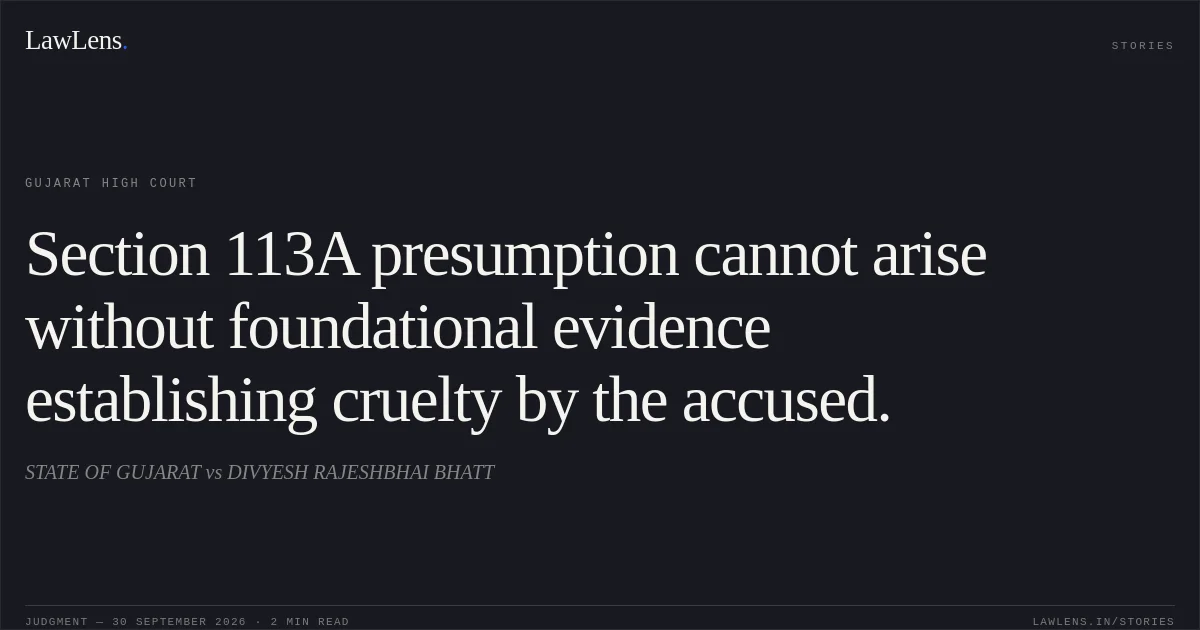
Source reference: paras. 18, 20Under Section 113-A of the Indian Evidence Act, the court may presume abetment where a married woman commits suicide within seven years of marriage and her husband or his relative subjected her to cruelty; the presumption is discretionary and requires foundational facts establishing cruelty.
Source reference: paras. 17, 19–20In an appeal against acquittal, the appellate court may review and reappreciate the evidence, but must account for the reinforced presumption of innocence; where two reasonable views are possible, the acquittal should not be disturbed.
Source reference: paras. 24–27; Chandrappa v. State of Karnataka, (2007) 4 SCC 415; Rajesh Prasad v. State of Bihar, (2022) 3 SCC 471Reasoning
The High Court found that the complainant’s deposition contained material omissions and exaggerations compared with the FIR, while the evidence of the complainant and the deceased’s mother was also affected by omissions and concerns about the influence of a relative.
Source reference: paras. 10, 13–14The Investigating Officer’s evidence disclosed no sufficient investigative material establishing cruelty or ill-treatment, and the prosecution had no independent witness supporting its case.
Source reference: paras. 15–16In the absence of cogent evidence proving cruelty or conduct amounting to abetment, the foundational facts for invoking Section 113-A were not established; the statutory presumption therefore could not sustain the charges.
Source reference: paras. 17–19, 22The Trial Court’s view was supported by the evidence and was not shown to be perverse or manifestly erroneous, so the appellate principles governing acquittals did not warrant interference.
Source reference: paras. 24–29Holding
The High Court held that the prosecution had failed to prove the offences beyond reasonable doubt and that the Trial Court had committed no error of fact or law in acquitting the respondents.
The State’s appeal was dismissed, the acquittal was confirmed, the bail bonds were cancelled, and the record and proceedings were directed to be returned to the Trial Court.
Source reference: para. 30Acts & Sections Cited
6 provisions across 2 statutes referred to in this judgment. Each provision opens on LawLens.
Code of Criminal Procedure, 19733
Indian Penal Code, 18603
Original Court PDF
STATE OF GUJARATvsDIVYESH RAJESHBHAI BHATT
Click to open original judgment
Original judgment, available to read, download and summarize on LawLens.in