Facts
The appellants were the husband and in-laws of the deceased woman, who had been married to appellant no. 1 approximately four years before the alleged occurrence.
Source reference: no citationThe prosecution alleged that, after an initial period of peaceful matrimonial life, the deceased was subjected to cruelty and harassment for dowry, namely a motorcycle and ₹1 lakh in cash.
Source reference: no citationIt was further alleged that she was poisoned and killed and that the accused persons concealed the death by hurriedly cremating her body without informing her parental family or the police and without post-mortem examination.
Source reference: para. 3An FIR was registered under Sections 304-B, 201, 120-B and 34 of the Indian Penal Code; after investigation, the appellants were sent for trial.
Source reference: para. 4The trial court convicted appellant no. 1 under Sections 304-B and 201 IPC and appellants nos. 2 to 5 under Section 201 IPC.
Source reference: para. 2Of the eleven prosecution witnesses, six turned hostile; although P.Ws. 1, 4 and 6 initially supported the prosecution, their cross-examinations contained material contradictions, including evidence that the deceased was treated well and that the informant had participated in the cremation.
Source reference: paras. 5, 8Issues
Whether the prosecution proved the essential ingredients of dowry death under Section 304-B IPC, particularly that the deceased was subjected to cruelty or harassment for dowry “soon before her death,” so as to attract the presumption under Section 113-B of the Evidence Act?
Source reference: paras. 8, 11–12Whether the conviction of appellant no. 1 under Section 304-B IPC could be sustained in the absence of reliable evidence establishing dowry-related cruelty or harassment prior to the deceased’s death?
Source reference: paras. 9, 11–12Whether the convictions of appellants nos. 2 to 5 under Section 201 IPC were sustainable when the evidence indicated that the informant himself was present at the cremation?
Source reference: para. 12Law Applied
The court applied Section 304-B IPC, which requires proof that: (i) the death of a woman was caused by burns, bodily injury, or otherwise than under normal circumstances; (ii) the death occurred within seven years of marriage; and (iii) soon before her death, she was subjected to cruelty or harassment by her husband or his relatives in connection with a demand for dowry.
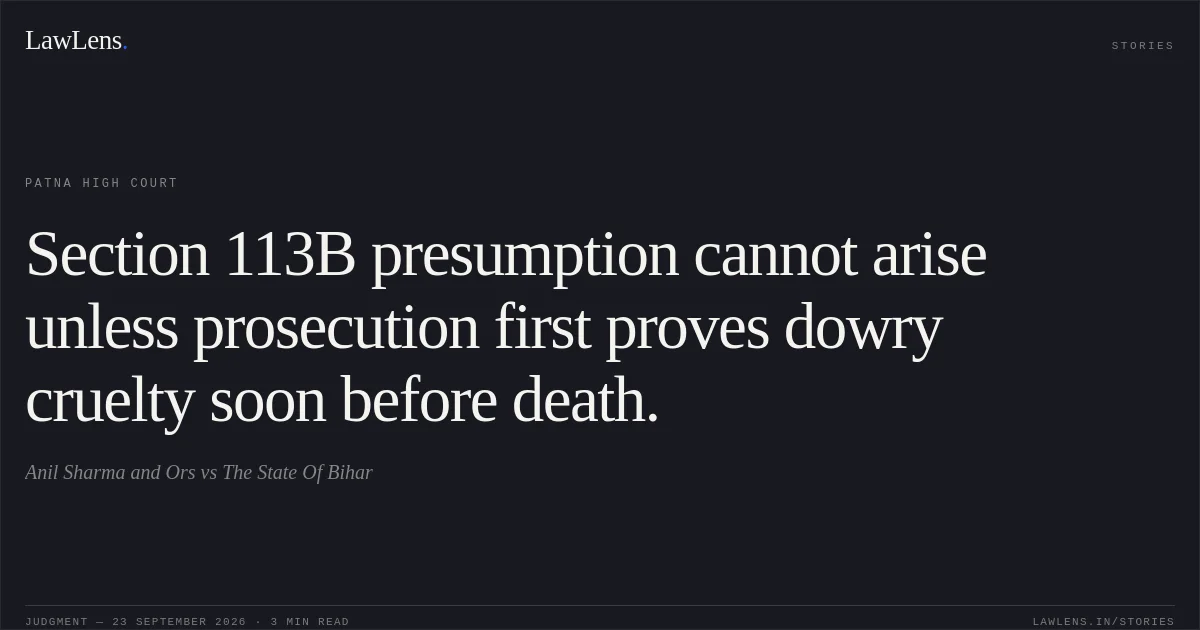
Source reference: para. 8Section 113-B of the Indian Evidence Act permits a presumption of dowry death only after the prosecution first establishes these foundational ingredients; the presumption is rebuttable and the burden shifts to the accused only thereafter.
Source reference: para. 12Section 201 IPC concerns causing disappearance of evidence of an offence or giving false information with the intention of screening the offender from legal punishment.
Source reference: paras. 2–4The court held that the prosecution’s failure to prove an essential ingredient of Section 304-B prevented the operation of the statutory presumption under Section 113-B.
Source reference: para. 12Reasoning
The court found that none of the prosecution witnesses had witnessed the alleged occurrence and that the prosecution produced no reliable evidence of dowry demand or cruelty immediately preceding the death.
Source reference: para. 11The testimony of the principal prosecution witnesses was materially weakened in cross-examination: the informant stated that the deceased’s in-laws treated her well and did not torture her, while also admitting his presence at the cremation.
Source reference: para. 8Since the foundational facts required by Section 304-B IPC were not proved, the presumption under Section 113-B of the Evidence Act could not arise and the burden did not shift to the accused.
Source reference: para. 12Consequently, the conviction of appellant no. 1 for dowry death was unsustainable.
Source reference: no citationThe court further held that the informant’s presence at the cremation undermined the prosecution allegation that appellants nos. 2 to 5 had independently concealed the death or cremated the body to screen the offender, rendering their convictions under Section 201 IPC unsustainable.
Source reference: para. 12Holding
The High Court allowed the appeal and set aside the judgment of conviction dated 30 July 2018 and the order of sentence dated 1 August 2018 passed by the Sessions Judge, Supaul.
All appellants were acquitted of the charges, and they were discharged from the liability of their bail bonds.
Source reference: para. 14Acts & Sections Cited
2 provisions across 1 statute referred to in this judgment. Each provision opens on LawLens.
Indian Penal Code, 18602
Original Court PDF
Anil Sharma and OrsvsThe State Of Bihar
Click to open original judgment
Original judgment, available to read, download and summarize on LawLens.in