Facts
The appellant (A1) married the deceased on 18.04.2014. At the time of marriage, 2½ sovereigns of gold and ₹50,000 were provided as dowry.
Source reference: para 3The prosecution alleged that the accused subsequently demanded an additional 2½ sovereigns and ₹50,000, leading to harassment.
Source reference: para 3On 26.02.2016, within two years of marriage, the deceased consumed poison and died at a government hospital.
Source reference: para 4-5An enquiry by the Revenue Divisional Officer (RDO) under Ex.P11 concluded there was no prima facie evidence of dowry-related harassment.
Source reference: para 6, 26Despite this, the police altered the investigation from Section 174 Cr.P.C. to Sections 498A and 304B of the IPC.
Source reference: para 7The trial court convicted A1 for offences under Sections 498A and 304B IPC and Section 4 of the Dowry Prohibition Act, sentencing him to seven years of rigorous imprisonment, while acquitting his parents (A2 and A3).
Source reference: para 2, 11Issues
1. Whether the prosecution successfully established the foundational facts of dowry demand and cruelty "soon before death" to trigger the presumption under Section 113B of the Evidence Act?
Source reference: para 36, 382. Whether the ocular and medical evidence was sufficient to sustain a conviction under Sections 498A and 304B of the IPC?
Source reference: para 37, 39Law Applied
The court applied Section 304B of the IPC (Dowry Death), which mandates that the deceased must have been subjected to cruelty or harassment by her husband or relatives "soon before her death" in connection with a dowry demand.
Source reference: para 36It further applied Section 498A of the IPC regarding matrimonial cruelty and Section 4 of the Dowry Prohibition Act.
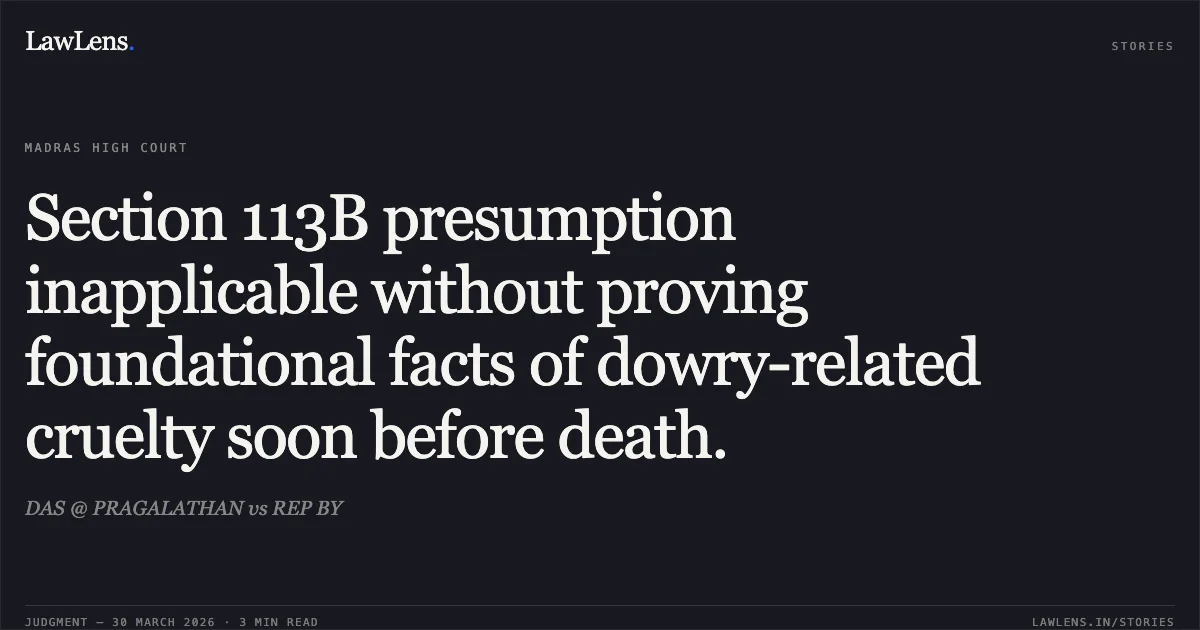
Source reference: para 2Centrally, the court relied on Section 113B of the Indian Evidence Act, which creates a statutory presumption of dowry death only after the prosecution proves the foundational facts of harassment related to dowry occurring shortly before the death.
Source reference: para 38Reasoning
The High Court found the prosecution's case riddled with inconsistencies.
Source reference: no citationFirst, the testimonies of PW1 (mother) and PW2 (sister) were contradictory; PW1 admitted the couple lived happily for a year and that A1 managed her properties, contradicting claims of continuous harassment.
Source reference: para 19, 37Second, the RDO report (Ex.P11) specifically ruled out dowry as a cause of death.
Source reference: para 26Third, medical evidence was unreliable: the initial Accident Register (Ex.P9) recorded no injuries, whereas the postmortem report (Ex.P8)—prepared with a two-day delay—noted abrasions which the doctors (PW12 and PW13) admitted could have resulted from "fits" rather than assault.
Source reference: para 31-33Fourth, the recovery of the pesticide bottle (MO1) was deemed fabricated, as its manufacturing date was months after the date of the occurrence.
Source reference: para 25The court determined that since the prosecution failed to prove the deceased was subjected to cruelty in connection with dowry "soon before death," the legal presumption under Section 113B could not be invoked.
Source reference: para 38-39Holding
The Court held that the trial court's findings were perverse as it failed to realize that the foundational facts for a dowry death conviction were not established.
The High Court allowed the appeal and set aside the conviction and sentence dated 24.02.2022. The appellant (A1) was acquitted of all charges under Sections 498A and 304B IPC and Section 4 of the Dowry Prohibition Act, with directions to refund any fines paid and cancel existing bail bonds.
Source reference: para 40-41Acts & Sections Cited
6 provisions across 3 statutes referred to in this judgment. Each provision opens on LawLens.
Code of Criminal Procedure, 19734
Indian Penal Code, 18601
Dowry Prohibition Act, 19611
Original Court PDF
DAS @ PRAGALATHANvsREP BY
Click to open original judgment
Original judgment, available to read, download and summarize on LawLens.in