Facts
The petitioner, an outsourced manpower and related-services provider, had been providing services to the respondent since 2011.
Source reference: p. 1On 21 March 2014, the parties executed two contracts—WC/REV/146/14 for outsourced salary services and WC/REV/147/14 for reimbursement of outsourced-service expenses—for the period 1 April 2014 to 31 March 2015, with extension contemplated on mutually agreed written terms.
Source reference: pp. 1–2Although negotiations for fresh contracts for 2015–16 continued after the respondent sought a fresh proposal on 16 March 2015, the respondent communicated on 5 May 2015 that both contracts stood terminated.
Source reference: p. 2The petitioner invoked arbitration, claiming approximately ₹5.48 crore for salary, expenses, recruitment costs, loss of credibility, loss of business and other alleged losses. The respondent raised a counterclaim of approximately ₹27.80 lakh.
Source reference: p. 2The arbitral tribunal held that the contracts had not automatically expired on 31 March 2015 and stood extended until 30 June 2015; termination with effect from 1 April 2015 was therefore in breach of contract.
Source reference: p. 2It awarded ₹11,21,810 to the petitioner and ₹27,40,066 to the respondent, resulting in a net award of ₹16,18,256 in favour of the respondent, with interest at 12% per annum from the date of the award.
Source reference: pp. 5–6The petitioner challenged the award under Section 34 of the Arbitration and Conciliation Act, 1996 (“the Act”).
Source reference: p. 1Issues
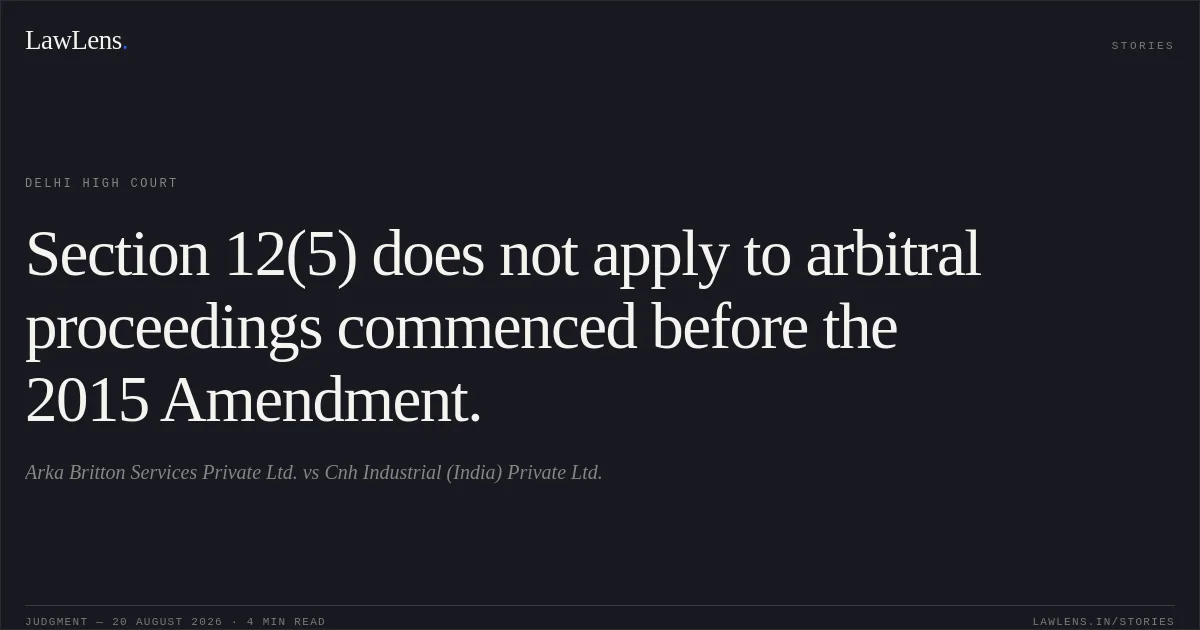
Whether the appointment of the arbitrator was invalid under Section 12(5) of the Act, as introduced by the Arbitration and Conciliation (Amendment) Act, 2015, because the award was rendered after the amendment came into force?
Source reference: pp. 3–5; para. 6Whether the arbitral tribunal erred in rejecting the petitioner’s claims for salary, telephone and travel expenses, service tax and education cess on the ground that the petitioner had not established any corresponding loss?
Source reference: pp. 6–9; paras. 8–11Whether the claims for recruitment costs, loss of credibility and loss of business were arbitrable and arose from the contracts?
Source reference: pp. 8–9; para. 12Whether the impugned award disclosed perversity, patent illegality, conflict with public policy or any other ground warranting interference under Section 34 of the Act?
Source reference: pp. 9–12; paras. 13–14Law Applied
Section 26 of the Arbitration and Conciliation (Amendment) Act, 2015 governs the temporal applicability of the amendments, and where arbitral proceedings commenced before the amendment, the amended Section 12(5) does not invalidate an otherwise valid appointment.
Source reference: pp. 4–5; para. 6The Court relied on DV Anand v. Hindustan Petroleum Corporation Ltd., Kamal Kumar v. Municipal Corporation of Delhi, Ellora Paper Mills Ltd. v. State of Madhya Pradesh, and the Supreme Court decisions referred to therein.
Source reference: pp. 4–5; para. 6In claims for damages under Section 73 of the Contract Act, 1872, breach alone is insufficient; the claimant must establish actual loss or show that such loss is incapable of proof.
Source reference: pp. 6–8; para. 9The Court relied on Kailash Nath Associates v. DDA for the requirement of loss or damage and on State of Rajasthan v. Ferro Concrete Construction (P) Ltd. for the proposition that an award based merely on an unsupported claim, without evidence, is unsustainable.
Source reference: pp. 6–8; para. 9Under Section 34 of the Act, the court does not sit as an appellate court, reappreciate evidence or substitute a plausible arbitral view with another possible view.
Source reference: pp. 9–12; para. 13Interference is confined to the statutory grounds, including patent illegality, perversity, conflict with public policy or contravention of the fundamental policy of Indian law.
Source reference: pp. 9–12; para. 13Reasoning
The Court rejected the Section 12(5) challenge because the arbitration had commenced in September 2015, before the amended provision was applicable in the manner contended for by the petitioner; the subsequent delivery of the award did not invalidate the arbitrator’s appointment.
Source reference: pp. 4–5; para. 6Although the tribunal found that the respondent had breached the contracts by terminating them prematurely, it separately examined whether the petitioner had suffered compensable loss.
Source reference: pp. 6–8; paras. 8–11It accepted the tribunal’s factual finding that the respondent had paid the employees’ salary and telephone/travel expenses directly and that the petitioner had not established any corresponding liability or expenditure.
Source reference: pp. 6–8; paras. 8–11The petitioner therefore failed to prove actual loss, while the tribunal nevertheless awarded the petitioner its 8% remuneration or mark-up for the relevant period.
Source reference: pp. 6–8; paras. 8–11The Court also upheld rejection of the recruitment-cost, loss-of-credibility and loss-of-business claims.
Source reference: p. 9; para. 12The claims were either unsupported by pleadings, not contemplated by the contracts, or unsupported by evidence.
Source reference: p. 9; para. 12In particular, the contractual arrangement operated on a “collect and pay” basis, the petitioner had no demonstrated monetary loss after the relevant payments were made, and the petitioner’s own witness stated that it had no other client, undermining the claim for loss of business.
Source reference: p. 9; para. 12Since the tribunal’s conclusions were at least plausible and were based on the contractual terms, pleadings and evidence, the Court held that reassessment of those findings was impermissible under Section 34.
Source reference: pp. 9–12; paras. 13–14Holding
The Court held that Section 12(5), as introduced by the 2015 Amendment Act, did not invalidate the arbitrator’s appointment because the arbitral proceedings had commenced before the relevant amendment.
It further held that, notwithstanding the respondent’s contractual breach, the petitioner failed to prove compensable actual loss in respect of the rejected claims, and that the claims for recruitment costs, loss of credibility and loss of business were either non-contractual, non-arbitrable or unsupported by evidence.
Source reference: pp. 4–9Finding no perversity, patent illegality, conflict with public policy or other ground under Section 34 of the Act, the Court upheld the arbitral award and dismissed the petition.
Source reference: p. 12; paras. 14–15Acts & Sections Cited
4 provisions across 2 statutes referred to in this judgment. Each provision opens on LawLens.
Arbitration and Conciliation Act, 19962
Indian Contract Act, 18722
Original Court PDF
Arka Britton Services Private Ltd.vsCnh Industrial (India) Private Ltd.
Click to open original judgment
Original judgment, available to read, download and summarize on LawLens.in