Facts
The petitioner, a medium-scale cement manufacturing unit with a sanctioned contract demand of 1067 KVA, was subjected to surprise inspections on 15 February 2008 and 3 June 2008. The inspections allegedly disclosed meter-seal tampering, theft and pilferage of electricity, following which criminal cases were instituted and the petitioner’s electricity supply was disconnected
Source reference: p.4–5; para. 5.1–5.4Assessment orders dated 19 February 2008 and 11 July 2008 were passed under Section 126 of the Electricity Act, 2003, assessing amounts of ₹7,14,720 and ₹28,58,736 respectively. The petitioner deposited these amounts to secure restoration of electricity
Source reference: p.3–5; paras. 5.3–5.4The criminal proceedings subsequently ended with acceptance of final reports, although the Electricity Board filed a protest petition, registered as Complaint Case No. 874 of 2009
Source reference: p.5–6; paras. 5.5–5.6The petitioner’s earlier writ petitions were withdrawn with liberty to pursue statutory appeals under Section 127 of the Electricity Act. The appeals were ultimately dismissed by the appellate authority on 31 January 2019 on the ground that, in view of Section 154 and the pending protest petition, the authority lacked jurisdiction to direct refund and the appeals were not maintainable
Source reference: p.5–7; paras. 5.7–6Issues
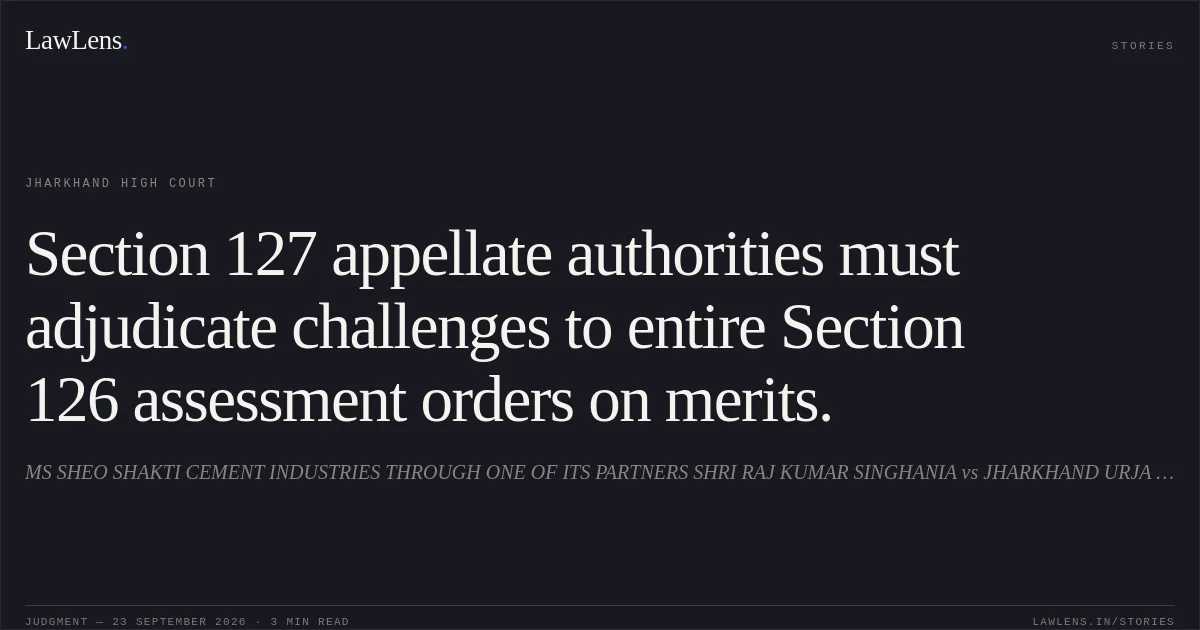
Whether the appeals under Section 127 of the Electricity Act were maintainable when the petitioner challenged the assessment orders in their entirety, although it also sought refund of the deposited amounts?
Source reference: p.6–10; paras. 6.1–6.5Whether the appellate authority erred in dismissing the appeals solely on the basis that it lacked jurisdiction to order refund under Section 154, without adjudicating the petitioner’s challenge to the assessment orders on merits?
Source reference: p.6–10; paras. 6–7Law Applied
The Court applied Section 126 of the Electricity Act, 2003, which governs assessment of charges for unauthorised use of electricity, and Section 127, which provides the statutory appellate remedy against an assessment order under Section 126
Source reference: p.3, p.5–6The Court also considered Section 154, which was relied upon by the appellate authority in relation to the consequences of criminal proceedings and refund.
Source reference: no citationThe appellate authority exercising power under Section 127 acts as a quasi-judicial authority and must consider the appeal comprehensively, hear the parties, and pass a reasoned order addressing the grounds and reliefs raised
Source reference: p.7; para. 6.2It cannot reject an appeal merely by considering one ancillary relief, such as refund, while failing to adjudicate the substantive challenge to the assessment order.
Source reference: no citationReasoning
The High Court examined the prayers in the petitioner’s memoranda of appeal and found that the petitioner had expressly sought setting aside of the assessment orders, in addition to refund, interest and consequential relief
Source reference: p.7–9; paras. 6.3–6.5Therefore, the respondent’s contention that the petitioner had not challenged the entire assessment order was rejected.
Source reference: no citationThe appellate authority had focused only on its perceived inability to direct refund under Section 154 because the protest petition was pending, and consequently dismissed the appeals as not maintainable
Source reference: p.6–7; para. 6This approach failed to address the principal statutory challenge under Section 127 to the assessment orders themselves.
Source reference: no citationThe High Court accordingly held that the appellate authority had not exercised its quasi-judicial jurisdiction properly and was required to decide the appeals on their merits
Source reference: p.9–10; paras. 6.5–7.2Holding
The High Court set aside the appellate orders dated 31 January 2019 passed in Appeal Nos. 47/2013–14 and 45/2012–13
The matters were remanded to the appellate authority to consider the petitioner’s complete challenge to the assessment orders, hear the parties, and pass reasoned orders within three months of receiving the High Court’s order.
Source reference: p.10; paras. 7.1–7.3The appellate authority was directed to consider limitation in light of the pendency of the writ petitions since 2021
Source reference: p.10; paras. 7.1–7.3The writ petitions were consequently allowed, without the High Court itself deciding the substantive validity of the assessments or directing immediate refund.
Source reference: no citationActs & Sections Cited
6 provisions across 2 statutes referred to in this judgment. Each provision opens on LawLens.
Electricity Act, 20035
Indian Penal Code, 18601
Original Court PDF
MS SHEO SHAKTI CEMENT INDUSTRIES THROUGH ONE OF ITS PARTNERS SHRI RAJ KUMAR SINGHANIAvsJHARKHAND URJA VIKASH NIGAM LTD JUVNL
Click to open original judgment
Original judgment, available to read, download and summarize on LawLens.in