Facts
The assessee-trust was granted provisional approval on 10 March 2022 for Assessment Years 2022–23 to 2024–25. It subsequently applied for regular registration in Form 10AB under Section 12A(1)(ac)(iii) of the Income Tax Act, 1961. The Commissioner of Income Tax (Exemptions) issued notices seeking documents and details regarding the genuineness of the trust’s activities. On examining the material, the Commissioner found that, during Assessment Years 2019–20 to 2022–23, the trust had incurred expenditure only on religious activities, which, according to him, were not covered by the trust’s objects and were not genuine. The application for registration was consequently rejected on 29 August 2023.
Source reference: p.2–4The Income Tax Appellate Tribunal allowed the trust’s appeal, relying upon Malik Hasmullah Islamic Education and Welfare Society, and set aside the Commissioner’s order with a direction to grant registration in accordance with law. The Revenue challenged the Tribunal’s decision under Section 260A of the Act.
Source reference: p.4–5Issues
1. Whether, on the facts and circumstances of the case, the Tribunal erred in holding that the activities of the trust were in consonance with its objects and objectives?
Source reference: p.1–22. Whether the Tribunal erred in proceeding on the basis that the trust’s registration application had been rejected by invoking Section 13(1)(b) of the Income Tax Act?
Source reference: p.1–2Law Applied
Section 260A of the Income Tax Act permits a tax appeal to the High Court only where a substantial question of law arises. Section 12A(1)(ac)(iii) governs an application for registration of a trust under the charitable-trust regime.
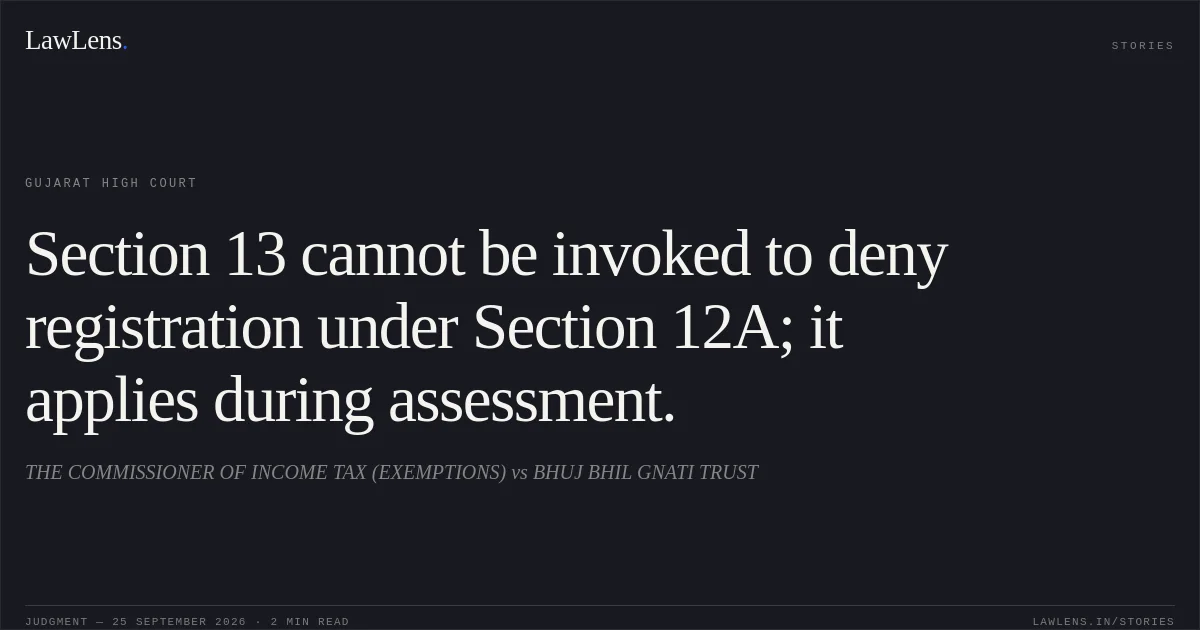
Source reference: p.2–3Section 13(1)(b), concerning exclusion from tax exemption in cases involving religious or sectarian benefit, was considered in light of the Supreme Court’s decision in CIT v. Dawoodi Bohara Jamat, [2014] 43 taxmann.com 243 (SC), which recognises that a composite trust having both religious and charitable objects is not, merely for that reason, covered by Section 13(1)(b). The Court further accepted the principle that the applicability of Section 13 is ordinarily a matter for the Assessing Officer during assessment and not a ground for the Commissioner to reject registration under Section 12A.
Source reference: p.5–7Reasoning
The Tribunal had found that the assessee-trust was a composite trust containing both religious and charitable objects, with most of its objects being charitable. The High Court noted that the Revenue’s own submission was that the issue stood covered by Dawoodi Bohara Jamat.
Source reference: p.6–7Applying that principle, the Court held that the mere presence of religious activities or mixed objects did not justify rejection of registration under Section 12A by invoking Section 13(1)(b). Whether the trust would ultimately be disentitled to exemption under Section 13 was an issue capable of examination by the Assessing Officer while framing the assessment. Consequently, the Tribunal’s order did not give rise to any substantial question of law under Section 260A.
Source reference: p.5–8Holding
The High Court answered the proposed questions against the Revenue, holding that no question of law, much less a substantial question of law, arose from the Tribunal’s order.
The tax appeal was accordingly dismissed, with no order as to costs.
Source reference: p.8Acts & Sections Cited
8 provisions across 1 statute referred to in this judgment. Linked provisions open on LawLens.
Income Tax Act, 19618
Original Court PDF
THE COMMISSIONER OF INCOME TAX (EXEMPTIONS)vsBHUJ BHIL GNATI TRUST
Click to open original judgment
Original judgment, available to read, download and summarize on LawLens.in