01Facts
The petitioner, an Advocate and Notary, is accused No. 7 in C.C. No. 33606/2023, arising from Crime No. 317/2017 (registered 27.08.2021) at Pulakeshinagar Police Station, for offences under Sections 199, 200, 205, 209, 417, 419, 420, 465, 468, 471, 120(B) and 511 r/w 34 and 35 of the IPC.
¶ 1The complaint was lodged on 27.08.2021 by respondent No. 2, who alleged that a General Power of Attorney (GPA) given to him in connection with premises rented for his showroom was forged.
¶ 2In a separate suit (S.C. No. 113/2017), the GPA relied on by another party was allegedly forged and the suit was dismissed on 29.06.2017 for that reason.
¶ 3The specific allegation against the petitioner is that, knowing the documents were fabricated, she notarised the rental agreement and affidavits.
¶ 3After investigation, the police filed a charge sheet and the Magistrate took cognizance, prompting the petition under Section 482 Cr.P.C.
¶ 3The petitioner's sole contention was that the complaint was not made by an officer authorised under Section 13 of the Notaries Act, 1952.
¶ 5The HCGP fairly conceded that the complaint was not lodged by an authorised person.
¶ 602Issues
i.1. Whether the Magistrate's cognizance of offences against a Notary, for acts done in the exercise or purported exercise of her notarial functions, is barred under Section 13 of the Notaries Act, 1952, where the complaint was not made in writing by an officer authorised by the Central or State Government.
¶ 5 · ¶ 8ii.2. Whether the cognizance order against the petitioner (accused No. 7) can be sustained in law in the absence of compliance with the statutory requirement.
¶ 903Law Applied
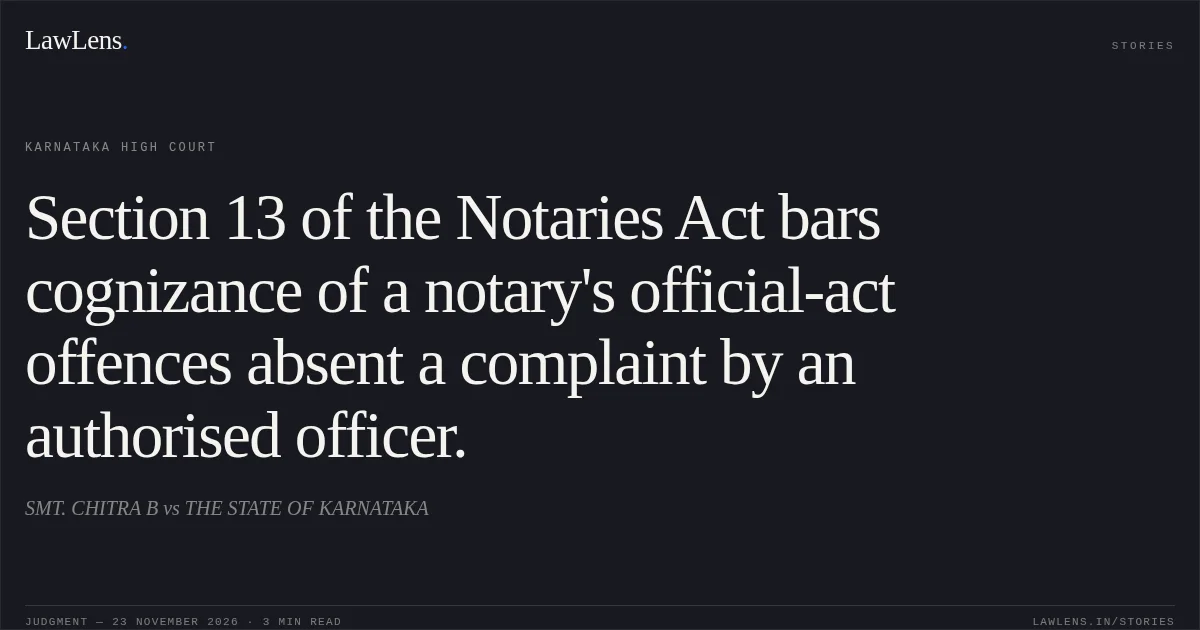
Section 13 of the Notaries Act, 1952, bars any Court from taking cognizance of an offence alleged to have been committed by a Notary in the exercise or purported exercise of her functions under the Act, except upon a complaint in writing made by an officer authorised by the Central or State Government by general or special order in this behalf.
¶ 5 · ¶ 8The statutory bar is mandatory, so cognizance taken without a complaint from such an authorised officer is unsustainable.
¶ 9The judgment cites no precedents.
Provisions in the judgment · 15 · Linked ones open on LawLens
Code of Criminal Procedure, 1973 Section 482
Indian Penal Code, 1860 13 provisions
Section 199Section 200Section 205Section 209Section 417Section 419Section 420Section 465Section 468Section 471Section 511Section 34Section 35Notaries Act, 1952 Section 13
04Reasoning
The court accepted that the petitioner was functioning as a Notary and that the allegation concerns her attestation of the rental agreement and affidavits without corresponding register entries.
¶ 8It held that the alleged acts fall within the exercise or purported exercise of notarial functions, so Section 13 applies.
¶ 8The court then examined the charge sheet and found that it disclosed the complaint was lodged by respondent No. 2, a private individual, and not by any officer authorised by the Central or State Government.
¶ 9Because the statutory precondition for cognizance was absent, the court held that the Magistrate's cognizance order could not stand.
¶ 9The court did not examine the merits of the forgery allegations, as the decision rests entirely on the statutory bar.
¶ 8–905Holding
The Court held that cognizance of offences against a Notary acting in her official capacity, on a complaint not made by an authorised officer under Section 13 of the Notaries Act, 1952, is barred in law.
¶ 9The petition is allowed, and the proceedings against the petitioner (accused No. 7) in C.C. No. 33606/2023 are quashed. The State is left at liberty to initiate appropriate proceedings against the petitioner in accordance with law, if required.
¶ 9, order (ii) · ¶ 9, order (iii)Original Court PDF
SMT. CHITRA BvsTHE STATE OF KARNATAKA
Click to open original judgment
Original judgment, available to read, download and summarize on LawLens.in