Facts
Opposite parties Nos. 2 and 3 initiated proceedings under Section 133 CrPC before the Sub-Divisional Magistrate, Madhupur, concerning an alleged obstruction to a public way.
Source reference: p. 2The Magistrate called for a report from the Circle Officer, who reported that no road was obstructed. Despite that report, the Magistrate ordered removal of the obstruction, relying on earlier reports, without first making a conditional order under Section 133 CrPC or providing an opportunity to adduce evidence after the petitioner filed a show-cause response.
Source reference: p. 2–3The petitioner’s criminal revision was dismissed without addressing those objections.
Source reference: p. 3–4He then sought relief under Section 482 CrPC.
Source reference: p. 2Issues
Whether the Magistrate’s order under Section 133 CrPC was sustainable when no preliminary or conditional order had been made and the procedure under Section 138 CrPC had not been followed
Source reference: p. 5–6Whether the revisional court’s dismissal was sustainable when it did not address the petitioner’s grounds concerning those procedural omissions
Source reference: p. 6–7Law Applied
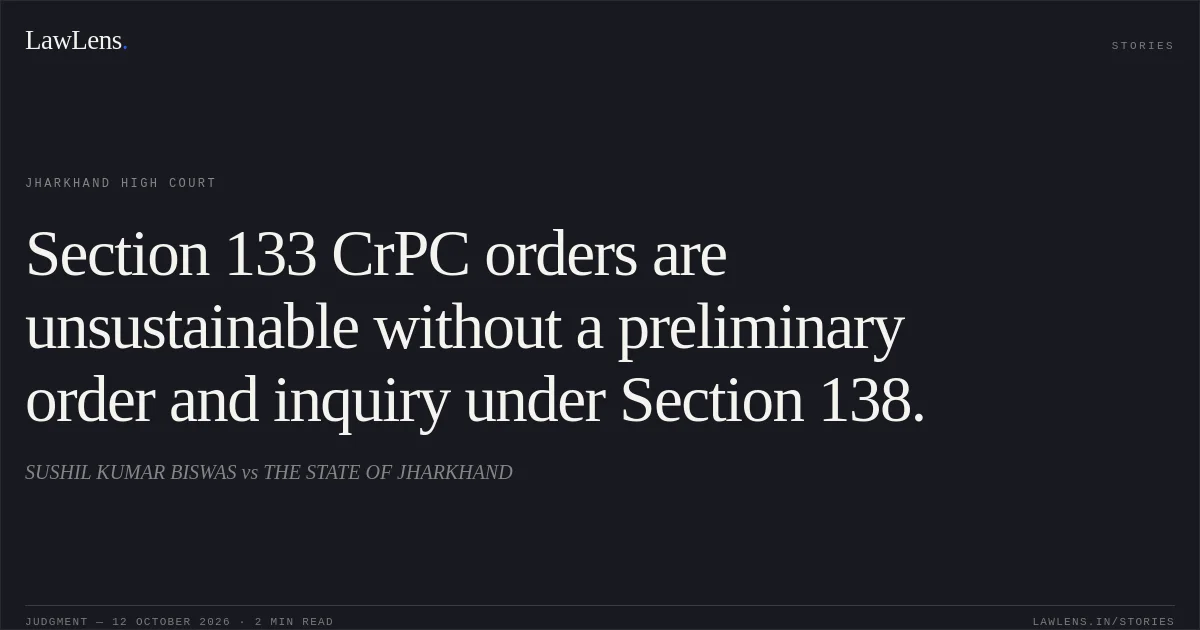
Under Section 133 CrPC, a Magistrate must draw up a preliminary or conditional order before proceeding to require removal of a public nuisance; that order is a sine qua non for initiating the statutory process.
Source reference: p. 5–6Where the person proceeded against appears and shows cause, Section 138 CrPC requires the Magistrate to take evidence as in a summons case.
Source reference: p. 5–6In C.A. Avarachan v. C.V. Sreenivasan & Another, 1995 Supreme (SC) 415, the Supreme Court held that failure to draw up the preliminary order and follow Section 138 CrPC renders the Magistrate’s final order unsustainable.
Source reference: p. 4–5Reasoning
The record contained no preliminary order under Section 133 CrPC, and, although the petitioner filed a show-cause response, the Magistrate gave the parties no opportunity to adduce evidence under Section 138 CrPC.
Source reference: p. 6These omissions violated mandatory procedural requirements and, applying C.A. Avarachan, made the Magistrate’s order unsustainable.
Source reference: p. 6The revisional court noted the petitioner’s objections but failed to address them, instead dismissing the revision without resolving the alleged procedural defects; its order was therefore also unsustainable.
Source reference: p. 6–7Holding
The High Court allowed the petition to the stated extent, quashed the revisional court’s order dated 4 September 2021 and the Magistrate’s order dated 13 May 2017 qua the petitioner only
and remitted Criminal Misc. Case No. 370 of 2015 to the Sub-Divisional Magistrate, Madhupur, for a fresh order in accordance with law.
Source reference: p. 7–8Acts & Sections Cited
5 provisions across 2 statutes referred to in this judgment. Each provision opens on LawLens.
Code of Criminal Procedure, 19734
Indian Penal Code, 18601
Original Court PDF
SUSHIL KUMAR BISWASvsTHE STATE OF JHARKHAND
Click to open original judgment
Original judgment, available to read, download and summarize on LawLens.in