Facts
The original complainant filed an appeal under Section 378 of the Code of Criminal Procedure, 1973, challenging the Trial Court’s order dated 11 November 2020 acquitting the accused in a case under Section 138 of the Negotiable Instruments Act.
Source reference: para. 1; p. 1The High Court considered whether, in light of Celestium Financial v. A. Gnanasekaran and related decisions, the complainant’s appeal should be pursued before the Sessions Court as a victim’s appeal under the proviso to Section 372 CrPC.
Source reference: paras. 3–7; pp. 2–5The State submitted that the issue was pending before the Supreme Court for authoritative consideration.
Source reference: para. 5; p. 3Issues
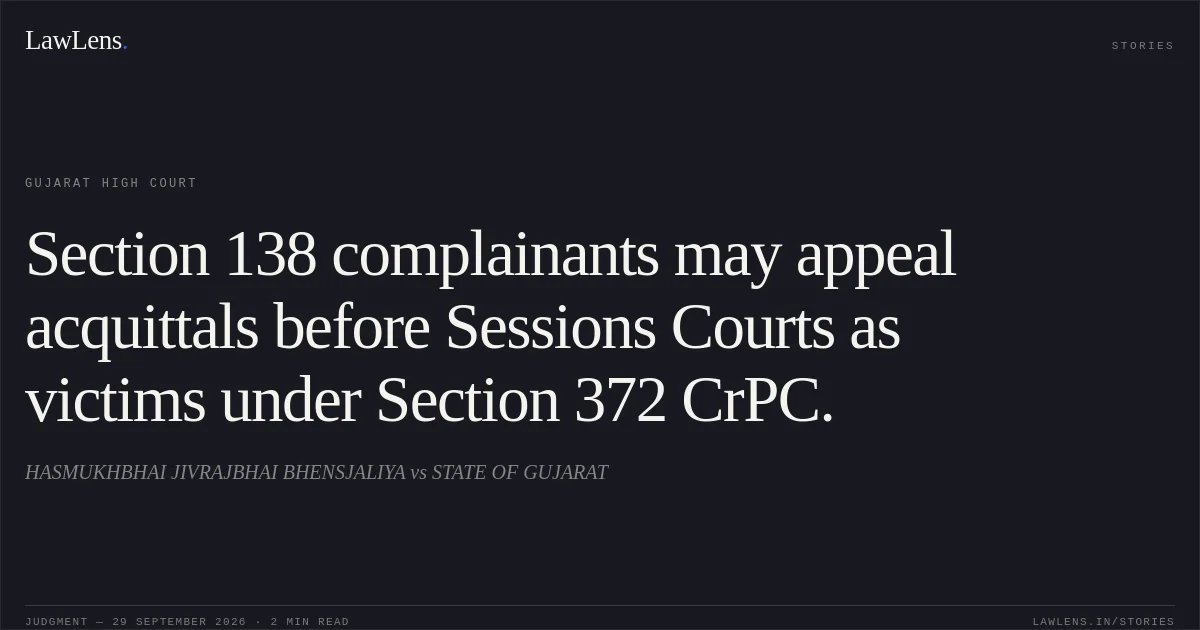
Whether the complainant’s appeal against acquittal in a Section 138 Negotiable Instruments Act case should be transferred to the Sessions Court and treated as an appeal under the proviso to Section 372 CrPC.
Source reference: paras. 3–7; pp. 2–5Whether the High Court should decide the merits of the acquittal appeal at that stage.
Source reference: para. 7; p. 5Law Applied
The Court relied on the proviso to Section 372 CrPC, which grants a victim a right to appeal against an acquittal to the court to which an appeal ordinarily lies from the trial court’s order, and on Section 413 of the Bharatiya Nagarik Suraksha Sanhita, 2023, its corresponding provision.
Source reference: para. 4; p. 2; para. 7; p. 5Applying Celestium Financial v. A. Gnanasekaran, the Court noted that a complainant in a prosecution under Section 138 of the Negotiable Instruments Act is also a victim and may appeal under the proviso to Section 372 CrPC before the immediately superior court, the Sessions Court, rather than proceeding under Section 378 CrPC.
Source reference: paras. 4, 6; pp. 2–4The Court also relied on Shivsinh Ganpatsinh Solanki v. State of Gujarat and Thakar Hariprasad Dalsukhram v. State of Gujarat.
Source reference: paras. 4, 7; pp. 2, 5It noted that the issue in Celestium Financial was pending before the Supreme Court for consideration by a larger Bench and that the matter was therefore subject to the final outcome of that reference.
Source reference: para. 5; p. 3Reasoning
The complainant’s appeal had been instituted in the High Court under Section 378 CrPC, but the Court considered the decisions recognising a Section 138 complainant as a victim entitled to appeal under the proviso to Section 372 CrPC.
Source reference: paras. 4–7; pp. 2–5On that basis, it directed that the appeal be transferred to the Sessions Court and treated and numbered there as a victim’s appeal under Section 372 CrPC or Section 413 BNSS.
Source reference: paras. 4–7; pp. 2–5Because the governing issue remained pending before the Supreme Court, the transfer direction was made subject to the final outcome of that reference.
Source reference: para. 5; p. 3The High Court did not examine the merits of the acquittal.
Source reference: para. 8; p. 5Holding
The appeal was disposed of with a direction to the Registry to transfer it, along with the relevant record and proceedings, to the concerned Sessions Court. That court was to treat and number it as an appeal under the proviso to Section 372 CrPC or Section 413 BNSS and issue notice to the parties.
The Sessions Court was asked to endeavour to decide the matter expeditiously; the High Court expressly left the merits open.
Source reference: para. 8; p. 5Acts & Sections Cited
8 provisions across 3 statutes referred to in this judgment. Each provision opens on LawLens.
Code of Criminal Procedure, 19735
Negotiable Instruments Act, 18812
Bharatiya Nagarik Suraksha Sanhita, 20231
Original Court PDF
HASMUKHBHAI JIVRAJBHAI BHENSJALIYAvsSTATE OF GUJARAT
Click to open original judgment
Original judgment, available to read, download and summarize on LawLens.in
![Retiral benefits cannot be withheld for disciplinary proceedings barred by post-retirement limitation.. ARUN JADHAV vs HOUSING AND URBAN AFFAIRS. CAT - ['Ernakulam']. LawLens](/stories/thumbnails/retiral-benefits-cannot-be-withheld-for-disciplinary-proceedings-barred-by-post-retirement-2904ba6a9e6b49cf9e70191ac4924f70.webp)
![Revaluation-based appointments must be assigned to the examination’s original vacancy year.. Tanazi Viswanath Sagar vs DEPARTMENT OF POSTS. CAT - ['Bangalore']. LawLens](/stories/thumbnails/revaluation-based-appointments-must-be-assigned-to-the-examinations-original-vacancy-year-90bb609c522f4688980c3615f61132fe.webp)
![An OMR sheet must be evaluated when examination records can verify a mistakenly entered booklet number.. KM JYOTI vs KENDRIYA VIDYALAYA SANGATHAN (KVS). CAT - ['Delhi']. LawLens](/stories/thumbnails/an-omr-sheet-must-be-evaluated-when-examination-records-can-verify-a-mistakenly-entered-bo-628f90f6f63e414cb40ce5a73ff688c9.webp)