Facts
The respondent filed a private complaint under Section 200 of the Code of Criminal Procedure alleging an offence under Section 138 of the Negotiable Instruments Act, 1881 (“NI Act”).
Source reference: pp. 2–4, 8–10The complaint arose from a sale transaction under which the petitioner allegedly issued a cheque for ₹59,71,154.
Source reference: pp. 2–4, 8–10After the cheque was issued, the petitioner transferred ₹20 lakh to the respondent.
Source reference: pp. 2–4, 8–10The complaint stated that the remaining liability was approximately ₹39,71,000, and that the parties agreed the cheque could be presented if the petitioner failed to pay the balance, provided the ₹20 lakh was refunded.
Source reference: pp. 2–4, 8–10The respondent presented the cheque for its full amount without refunding or accounting for that payment; the cheque was returned with the endorsement “Payment Stopped.”
Source reference: pp. 2–4, 8–10The Magistrate took cognizance on 28 August 2023, and the petitioner sought to quash the proceedings under Section 482 CrPC.
Source reference: pp. 2–4, 8–10Issues
1. Whether presenting the cheque for its full amount, after a part-payment had reduced the legally enforceable liability, attracted Section 138 of the NI Act
Source reference: pp. 9–112. Whether the proceedings and cognizance order should be quashed under Section 482 CrPC on the basis of the complaint’s own averments
Source reference: pp. 4, 15–16Law Applied
Section 138 of the NI Act applies where a cheque issued in discharge, wholly or partly, of a legally enforceable debt or liability is dishonoured, subject to the statutory conditions.
Source reference: pp. 11–14Under Sections 15 and 56 of the NI Act, a part-payment made after a cheque is drawn may be endorsed on the instrument, which may then be negotiated for the balance.
Source reference: pp. 11–14Relying on *Dashrathbhai Trikambhai Patel v. Hitesh Mahendrabhai Patel*, (2023) 1 SCC 578, the Court applied the rule that the dishonoured cheque must represent the legally enforceable debt on the date of presentation or maturity; where a part-payment is made after drawing the cheque, the payment must be endorsed, and an unendorsed cheque for the original amount does not attract Section 138 if that amount exceeds the debt then due.
Source reference: pp. 11–14Reasoning
The complaint itself acknowledged the ₹20 lakh payment and stated that the outstanding liability was reduced to approximately ₹39,71,000.
Source reference: pp. 8–15It also disclosed that the respondent presented the cheque for ₹59,71,000 without refunding or accounting for the payment.
Source reference: pp. 8–15Applying *Dashrathbhai*, the Court held that, on the complaint’s own account, the cheque amount exceeded the legally enforceable liability at presentation.
Source reference: pp. 8–15The petitioner’s failure to reply to the statutory notice did not alter that conclusion.
Source reference: pp. 8–15Holding
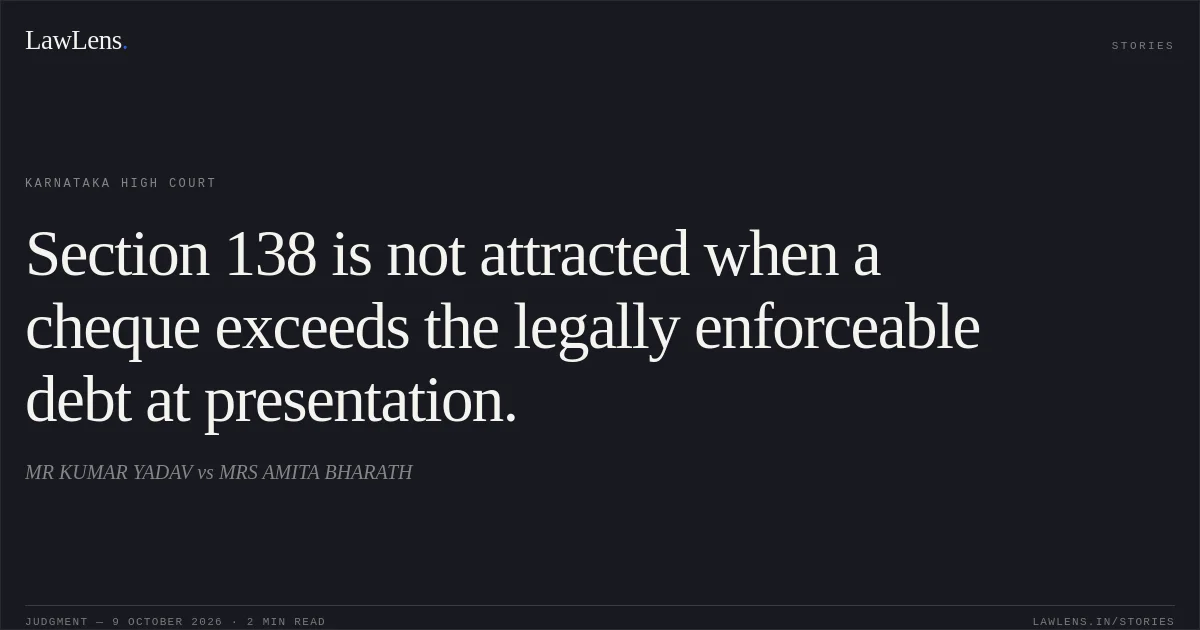
The Court held that the proceedings under Section 138 could not continue because the cheque, when presented, exceeded the legally enforceable debt established by the complaint’s averments.
It allowed the petition and quashed the proceedings in C.C. No. 26526/2023, including the Magistrate’s order dated 28 August 2023.
Source reference: pp. 15–16Acts & Sections Cited
8 provisions across 2 statutes referred to in this judgment. Each provision opens on LawLens.
Code of Criminal Procedure, 19732
Negotiable Instruments Act, 18816
Original Court PDF
MR KUMAR YADAVvsMRS AMITA BHARATH
Click to open original judgment
Original judgment, available to read, download and summarize on LawLens.in
![Authorities must decide promotion-eligibility grievances, including consequential seniority and qualifying-service effects, by a reasoned order.. Gaurav Sharma vs DELHI JAL BOARD (GNCTD). CAT - ['Delhi']. LawLens](/stories/thumbnails/authorities-must-decide-promotion-eligibility-grievances-including-consequential-seniority-91612c77a8744a4abe12eec29e52875c.webp)
![Removal for a Section 304A conviction was disproportionate absent proper consideration of the offence’s negligence-based nature.. ANIL KUMAR THROUGH LRS SMT. RUPA DEVI vs Comm. Of Police. CAT - ['Delhi']. LawLens](/stories/thumbnails/removal-for-a-section-304a-conviction-was-disproportionate-absent-proper-consideration-of-40d5c7cf3b234eb6a598eb0dbbd69604.webp)
![Provisional pension is impermissible when no departmental or judicial proceedings are pending at retirement.. waseem arshad vs REVENUE. CAT - ['Delhi']. LawLens](/stories/thumbnails/provisional-pension-is-impermissible-when-no-departmental-or-judicial-proceedings-are-pend-f2263e90e92242d1b57380b60f363791.webp)