Facts
The accused were partners of M/s Manjit and Company. The complainant had stood guarantor for the firm’s bank loan by creating an equitable mortgage over his property and depositing the title deeds with the bank. Accused No. 4 issued a cheque for ₹1,60,000 to the complainant as security, on the understanding that the complainant would repay the bank loan if the firm defaulted and would thereafter recover the amount from the accused. The cheque was dishonoured for “insufficient funds,” and despite statutory notice, payment was not made.
Source reference: paras. 2, 5; pp. 2–4The Trial Court acquitted the accused under Section 138 of the Negotiable Instruments Act, holding that the complainant had not shown that he had paid any amount to the bank and that the condition for presenting the security cheque had therefore not arisen. The complainant appealed against the acquittal.
Source reference: paras. 7–8; p. 4Issues
1. Whether the admission of issuance of the cheque and the signature of accused No. 4 raised presumptions under Sections 118(a) and 139 of the NI Act that the cheque had been issued for consideration and in discharge of a legally enforceable debt or liability.
Source reference: paras. 17–20; pp. 13–152. Whether a cheque issued as security pursuant to the complainant’s guarantee became presentable when the complainant had not proved payment of the guaranteed debt to the bank.
Source reference: paras. 21–23; pp. 16–193. Whether the Trial Court’s acquittal was so perverse, impossible, wholly unsustainable, or manifestly illegal as to warrant appellate interference.
Source reference: paras. 13–15, 27; pp. 6–10, 21Law Applied
Section 138 of the NI Act applies only where a cheque is drawn for the discharge, wholly or partly, of a legally enforceable debt or other liability and the statutory requirements regarding presentation, dishonour, notice, and non-payment are satisfied.
Source reference: para. 16; pp. 11–13Under Sections 118(a) and 139 of the NI Act, admission of execution or signature of the cheque raises rebuttable presumptions that it was drawn for consideration and received in discharge of a legally enforceable debt or liability; the accused may rebut them on a preponderance of probabilities.
Source reference: paras. 17–20; pp. 13–15Sampelly Satyanarayana Rao v. Indian Renewable Energy Development Agency Ltd. holds that a security or post-dated cheque attracts Section 138 only when the underlying liability exists or has become legally recoverable on the date of presentation.
Source reference: para. 21; pp. 16–17Sripati Singh v. State of Jharkhand holds that a security cheque cannot be presented before the secured loan or instalment becomes due, although it may be presented after the liability matures.
Source reference: para. 22; pp. 17–18Under Section 140 of the Indian Contract Act, a surety’s right of subrogation arises upon payment or performance of the guaranteed obligation.
Source reference: para. 23; p. 19In an appeal against acquittal, interference is justified only where the acquittal is perverse, impossible, wholly unsustainable, or manifestly illegal; where two reasonable views are possible, the view favourable to the accused must prevail.
Source reference: paras. 13–15; pp. 6–10Reasoning
Although the admission of the cheque and signature initially attracted the statutory presumptions under Sections 118(a) and 139 of the NI Act, the complainant’s own case established that the cheque was conditional security for any amount that he might pay to the bank on the firm’s default.
Source reference: paras. 17–21; pp. 13–16The complaint and evidence did not establish that the complainant had actually discharged the firm’s liability to the bank. A bank demand letter showed only that money was demanded from the complainant, not that he had paid it.
Source reference: paras. 21, 24; pp. 16–20Consequently, on the date of presentation, the complainant had neither acquired a legally enforceable reimbursement claim against the accused nor become subrogated to the bank’s rights under Section 140 of the Contract Act. Applying Sampelly and Sripati Singh, the Court held that the security cheque had been presented before the underlying liability matured. The statutory presumption was therefore rebutted by the complainant’s own evidence, and the Trial Court’s view was a reasonable one that did not meet the threshold for interference in an appeal against acquittal.
Source reference: paras. 23, 26–27; pp. 19, 21Holding
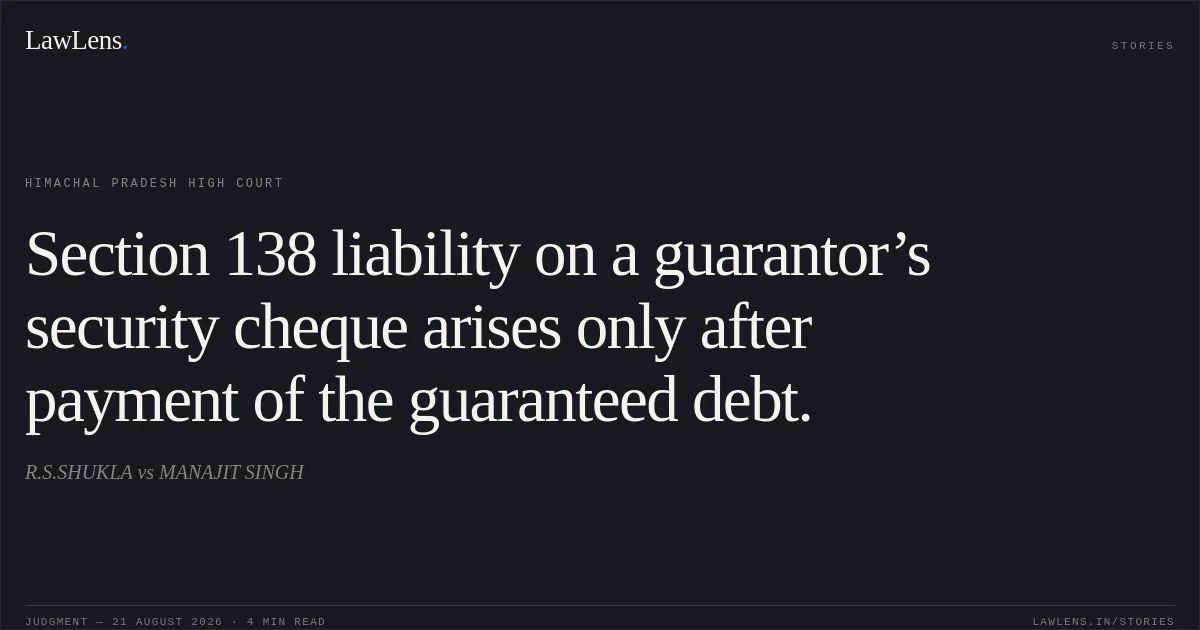
The High Court held that the complainant was entitled to present the cheque only after paying the guaranteed debt to the bank. Since no such payment was proved, the cheque did not represent an existing legally enforceable liability when presented, and the ingredients of Section 138 of the NI Act were not established.
The appeal against acquittal was dismissed, and the Trial Court’s judgment dated 07.09.2011 was affirmed. The respondents were directed under Section 437-A CrPC to furnish bail bonds of ₹25,000 each with one surety each, effective for six months and subject to appearance before the Supreme Court if required in any ensuing proceedings.
Source reference: paras. 29–30; p. 22Original Court PDF
R.S.SHUKLAvsMANAJIT SINGH
Click to open original judgment
Original judgment, available to read, download and summarize on LawLens.in