Facts
The Petitioner was a director of M/S PRJ Enterprises Ltd. (Respondent No. 2), which entered into a Memorandum of Understanding (MOU) with Respondent No. 1 for the supply of vehicles.
Source reference: para. 3-4Pursuant to disputes, the company issued cheques totaling Rs. 45,00,000/- to Respondent No. 1, which were dishonoured upon presentation on 15.06.2012 due to "Funds Insufficient".
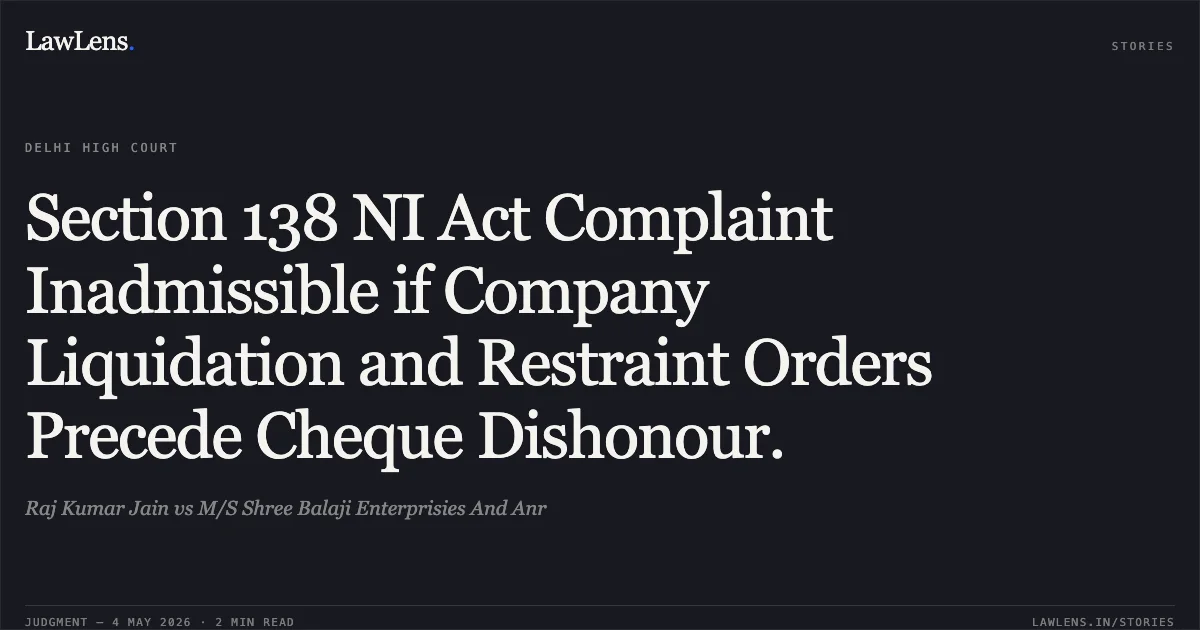
Source reference: para. 7-8Crucially, before the dishonour and subsequent demand notice (02.07.2012), the Delhi High Court had admitted a winding-up petition against the company on 23.05.2012, appointing a Provisional Liquidator and restraining the directors from operating company accounts or alienating assets.
Source reference: para. 10, 20The Petitioner sought quashing of the Section 138 Negotiable Instruments (N.I.) Act complaint, arguing he had no control over the company's affairs when the cause of action arose.
Source reference: para. 1, 14Issues
1. Whether a complaint under Section 138 of the N.I. Act is maintainable against a Director when the company has been placed under a Provisional Liquidator prior to the dishonour of the cheque and issuance of the statutory notice.
Source reference: para. 16, 202. Whether an account can be said to be "maintained" by a person under Section 138 if they are legally restrained from operating it by a court order.
Source reference: para. 28-31Law Applied
The court primarily applied Section 138 of the Negotiable Instruments Act, 1881, emphasizing the requirement that a cheque be drawn on an "account maintained by him".
Source reference: para. 28It further relied on Sections 450, 456, and 457 of the Companies Act, 1956, which dictate that upon the appointment of a liquidator, the Board of Directors becomes functus officio and the liquidator assumes custody of all assets and records.
Source reference: para. 21-22Precedents including M.L. Gupta v. Ceat Financial Services Ltd. and M/S Pec Ltd. v. M/S Sabari Exim Pvt Ltd established that directors cannot be held vicariously liable under Section 141 if the company is legally precluded from making payments due to liquidation proceedings.
Source reference: para. 23-25, 37Reasoning
The court reasoned that the appointment of a Provisional Liquidator on 23.05.2012 effectively suspended the Petitioner's authority to manage the company's bank accounts.
Source reference: para. 22, 27Since the cheques were dishonoured on 15.06.2012 and the demand notice was issued on 02.07.2012—both dates falling after the liquidator took charge—the Petitioner was legally and practically unable to ensure the encashment of the cheques or honour the demand notice.
Source reference: para. 20, 27, 31The court interpreted the phrase "account maintained by him" in Section 138 to mean an account over which the drawer exercises continuous, active authority.
Source reference: para. 29Because the court-ordered restraint made it impossible for the Petitioner to give binding instructions to the bank, the essential ingredients of the offence were not satisfied.
Source reference: para. 30-31This transition of power to the Official Liquidator rendered the Petitioner functus officio as of the date the cause of action crystallized.
Source reference: para. 22, 31Holding
The court answered the issues in the negative, holding that the complaint was legally non-maintainable because the essential ingredient of "maintaining" the account was absent at the time of the offence.
The Court allowed the petition and quashed Complaint Case No. 2712/2012 and all emanating proceedings against the Petitioner.
Source reference: para. 32Acts & Sections Cited
4 provisions across 2 statutes referred to in this judgment. Each provision opens on LawLens.
Code of Criminal Procedure, 19731
Negotiable Instruments Act, 18813
Original Court PDF
Raj Kumar JainvsM/S Shree Balaji Enterprisies And Anr
Click to open original judgment
Original judgment, available to read, download and summarize on LawLens.in