Facts
The suit properties originally belonged to Perumal Naidu and thereafter devolved upon his sons, Gopal Naidu and Pottu alias Duraisamy Naidu, who held them as members of a joint Hindu family. Gopal Naidu died issueless in 1929, leaving his widow Rangammal, and Pottu alias Duraisamy Naidu died in 1935, leaving his widow Dhanalakshmi Ammal. The High Court held that both widows possessed limited estates in the properties.
Source reference: para. 20The widows executed several alienations in favour of the defendants. In an earlier suit, O.S. No.320 of 1946, the plaintiff and two others were declared to be reversioners of Pottu alias Duraisamy Naidu, and the earlier alienations were held invalid. However, recovery of possession was refused because the widows’ limited estates were still subsisting.
Source reference: paras. 21–24After the Hindu Succession Act, 1956 came into force, Dhanalakshmi Ammal and Rangammal executed further sale deeds in February 1975. Dhanalakshmi Ammal died on 20 March 1975. The plaintiff thereafter instituted the present suit for recovery of possession and mesne profits, contending that the 1975 alienations were invalid and that he had succeeded as the surviving reversioner.
Source reference: paras. 5.1–5.2, 7The Trial Court decreed the suit, holding that the widows’ limited estates had not enlarged into absolute estates because they were not in actual possession of the properties. The First Appellate Court affirmed that decision. The defendants preferred the present second appeal under Section 100 of the Code of Civil Procedure.
Source reference: paras. 12–13Issues
Whether the judgments of the courts below were vitiated by holding that Section 43 of the Transfer of Property Act, 1882 was inapplicable.
Source reference: para. 14Whether a suit for recovery of possession was maintainable without a prayer for declaration of title when the defendants had specifically denied the plaintiff’s title.
Source reference: para. 15(a); para. 32Whether, after the commencement of the Hindu Succession Act, 1956, the plaintiff could maintain a claim as a reversioner, having regard to the statutory changes governing succession.
Source reference: para. 15(b); para. 33Whether the plaintiff became the legal heir of Rangammal under Section 15 of the Hindu Succession Act, 1956.
Source reference: para. 15(c); para. 34Law Applied
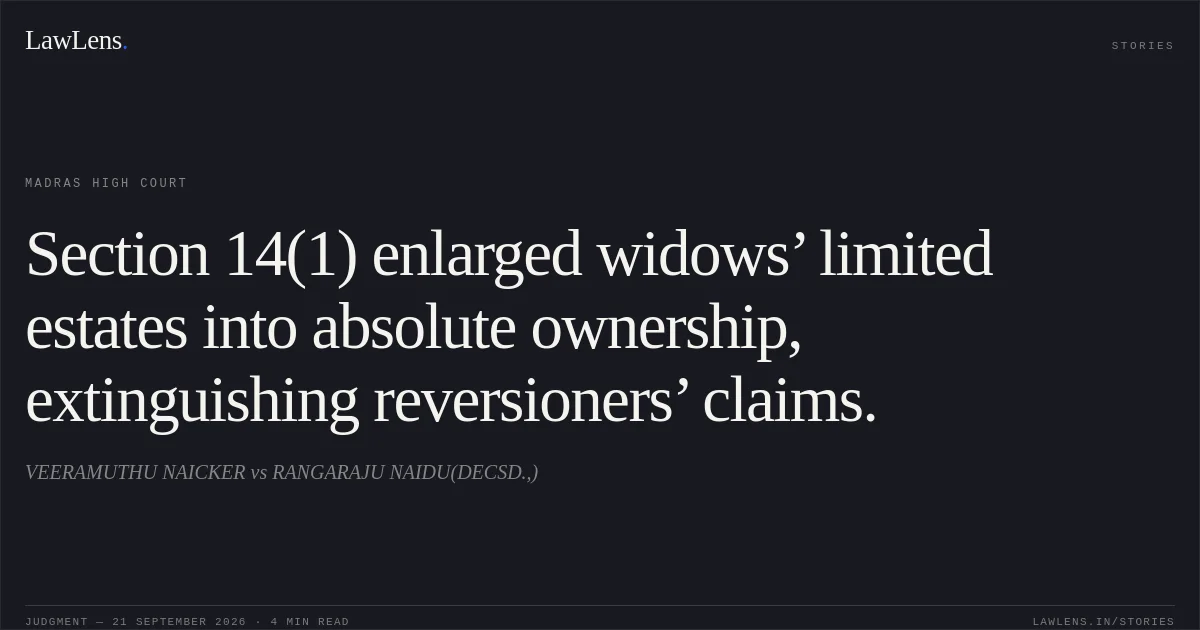
The Court applied Section 14(1) of the Hindu Succession Act, 1956, under which a Hindu female’s limited estate in property possessed by her becomes an absolute estate. “Possession” was construed broadly to include actual, constructive, or legal possession, including a subsisting legal right to obtain possession.
Source reference: para. 25The Court relied on V. Sampathkumari v. M. Lakshmi Ammal, which recognised that actual physical possession is unnecessary where the female Hindu retains possession in law.
Source reference: para. 25Relying on Daya Singh v. Dhan Kaur, (1974) 1 SCC 700, and Kumarasamy Gounder v. D.R. Nanjappa Gounder, AIR 1978 Mad 285, the Court held that succession to the estate of a limited owner opens only upon her death and is governed by the law then in force; a reversioner’s interest during the widow’s lifetime is merely spes successionis, not a vested right.
Source reference: paras. 27–28The Court also relied on B. Hanuman Prasad v. Indrawati, AIR 1958 All 304, for the principle that the concept of reversioners was displaced by the Hindu Succession Act and that a claimant could no longer enforce rights merely in the capacity of a customary reversioner.
Source reference: para. 29Section 43 of the Transfer of Property Act applies as an estoppel against an unauthorised transferor and not against a person claiming independently as a reversioner.
Source reference: para. 31Reasoning
The Court found that the earlier decree declaring the alienations invalid did not extinguish the widows’ legal rights in the properties. Although the earlier alienees remained in physical possession, the widows retained a legally enforceable right to recover possession; therefore, they were “possessed” of the properties within the meaning of Section 14(1) of the Hindu Succession Act.
Source reference: para. 26Their limited estates consequently enlarged into absolute ownership upon the commencement of the Act. The 1975 sale deeds were therefore executed by absolute owners and were valid and binding on the plaintiff.
Source reference: para. 26The plaintiff’s earlier declaration as a reversioner did not confer a vested or indefeasible title. His interest was only a contingent chance of succession, which could arise only if the widow’s limited estate subsisted until her death. Since the widows’ estates had already become absolute under Section 14(1), the plaintiff could not rely upon the earlier reversioner declaration to challenge the 1975 alienations.
Source reference: para. 27As the plaintiff had no subsisting title as a reversioner, a bare suit for recovery of possession, particularly without a declaration of title, was not maintainable.
Source reference: para. 32Section 43 of the Transfer of Property Act was also inapplicable because the 1975 transfers were not unauthorised transfers by limited owners; they were made after enlargement of the widows’ estates into absolute ownership.
Source reference: para. 31Holding
The High Court answered the substantial questions in favour of the appellants. It held that the widows’ limited estates had enlarged into absolute estates under Section 14(1) of the Hindu Succession Act, 1956; the 1975 sale deeds were valid; the plaintiff could not maintain the suit as a reversioner; and the suit for recovery of possession without declaration of title was not maintainable.
The Second Appeal was allowed, the judgments and decrees of the Trial Court and First Appellate Court were set aside, and O.S. No.202 of 1981 was dismissed. The plaintiff’s legal representatives were directed to refund any mesne profits received from the defendants. No order as to costs was made.
Source reference: para. 35Acts & Sections Cited
6 provisions across 3 statutes referred to in this judgment. Each provision opens on LawLens.
Code of Civil Procedure, 19081
Hindu Succession Act, 19564
Transfer of Property Act, 18821
Original Court PDF
VEERAMUTHU NAICKERvsRANGARAJU NAIDU(DECSD.,)
Click to open original judgment
Original judgment, available to read, download and summarize on LawLens.in