Facts
The petitioner/informant alleged that he and his brothers occupied and constructed houses near their ancestral property under a family arrangement.
Source reference: para. 2He claimed that Respondent No. 1 obstructed the drain and access to his house by covering the drain, installing iron stairs, tethering cattle near the staircase, damaging the staircase, and dumping cow dung, thereby creating nuisance and an apprehension of breach of peace.
Source reference: para. 2On the police report, the Sub-Divisional Magistrate initiated proceedings under Section 145 CrPC.
Source reference: para. 3After considering the Tehsildar’s report and the parties’ evidence, the Trial Court found no apprehension of breach of peace and held that the petitioner had not established possession within two months before the complaint; it dismissed the proceedings.
Source reference: para. 5The Revisional Court upheld the dismissal, observing that the dispute was civil in nature and that the statutory requirements of Section 145 CrPC were not satisfied.
Source reference: para. 6The petitioner thereafter invoked the High Court’s inherent jurisdiction under Section 528 BNSS, corresponding to Section 482 CrPC.
Source reference: para. 13Issues
Whether the High Court should exercise its inherent jurisdiction under Section 528 BNSS, corresponding to Section 482 CrPC, after dismissal of the petitioner’s revision by the Sessions Court?
Source reference: paras. 13–18Whether the proceedings under Section 145 CrPC were maintainable when the petitioner failed to establish that he had been in possession of the disputed property, or had been forcibly and wrongfully dispossessed, within the period prescribed by Section 145(4) CrPC?
Source reference: paras. 19–22Whether the findings of the Trial Court and Revisional Court disclosed any serious miscarriage of justice, abuse of process, or breach of a mandatory legal provision warranting interference?
Source reference: paras. 18, 23Law Applied
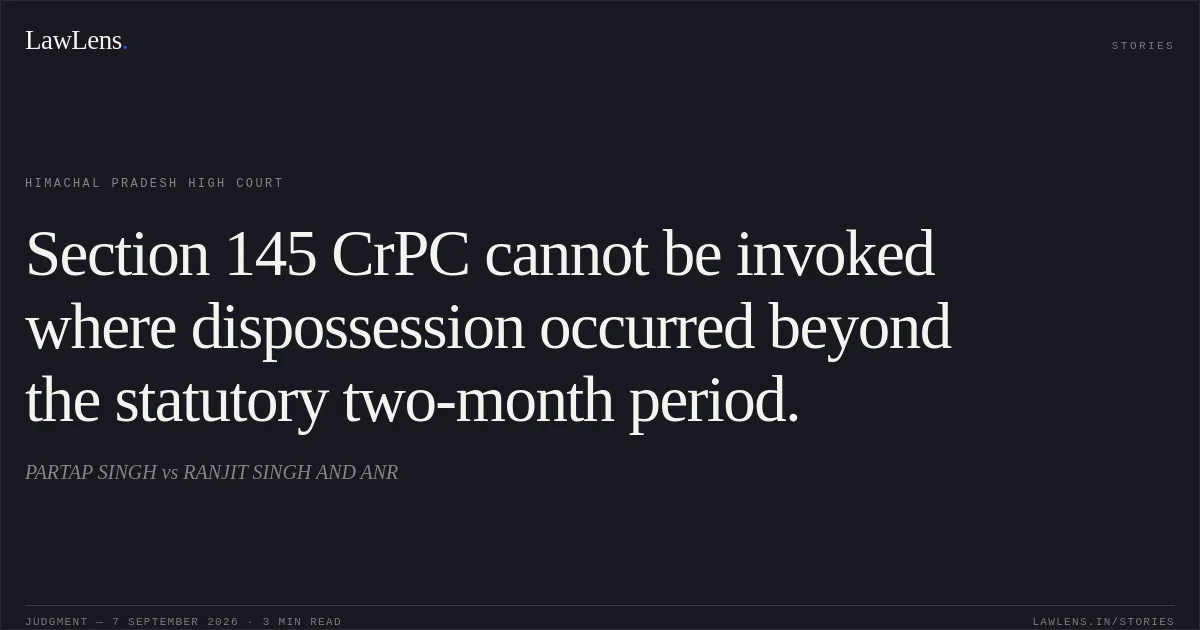
Section 145(4) CrPC requires the Magistrate to determine possession as on the date of the preliminary order, and its proviso permits a person forcibly and wrongfully dispossessed within two months before the police report or other information—or thereafter before the preliminary order—to be treated as being in possession.
Source reference: para. 19In R.C. Patuck v. Fatima A. Kindasa, (1997) 5 SCC 334, the Supreme Court held that where there is no material showing possession or dispossession within the statutory period, the Magistrate lacks jurisdiction to grant relief under Section 145 CrPC.
Source reference: para. 20Section 528 BNSS, corresponding to Section 482 CrPC, preserves the High Court’s inherent power to prevent abuse of process and secure the ends of justice; however, after a party has already invoked revisional jurisdiction, that power must be exercised sparingly and only in cases involving grave miscarriage of justice, abuse of process, failure to comply with mandatory procedure, or an apparent legal error.
Source reference: paras. 13–17This principle was drawn from Krishnan v. Krishnaveni, (1997) 4 SCC 241, Rajinder Prasad v. Bashir, (2001) 8 SCC 522, Kailash Verma v. Punjab State Civil Supplies Corporation, (2005) 2 SCC 571, and Shakuntala Devi v. Chamru Mahto, (2009) 3 SCC 310.
Source reference: paras. 13–17Reasoning
The High Court held that its jurisdiction under Section 528 BNSS was limited because the petitioner had already pursued a revision before the Sessions Court; interference was therefore justified only upon proof of a serious miscarriage of justice or legal error.
Source reference: paras. 13–18The petitioner’s own pleadings stated that the obstruction, dumping of cow dung, and other alleged acts had existed since 2018, and that he had been unable to cultivate his fields or visit his residence from that year.
Source reference: para. 21Since the police complaint was filed on 14.05.2019, the alleged dispossession was clearly outside the two-month period contemplated by the proviso to Section 145(4) CrPC.
Source reference: para. 22The petitioner therefore could not invoke the deeming provision treating a dispossessed person as being in possession.
Source reference: para. 22The dispute also concerned rights and access to property for which civil remedies were available, and the concurrent factual findings disclosed no jurisdictional error, abuse of process, or miscarriage of justice warranting interference.
Source reference: paras. 5–6, 22–23Holding
The High Court answered the issues against the petitioner.
It held that the statutory requirements for proceedings under Section 145 CrPC were not satisfied because the petitioner failed to establish possession, or forcible and wrongful dispossession, within the prescribed two-month period.
Source reference: para. 22No exceptional ground existed for exercising the inherent jurisdiction under Section 528 BNSS.
Source reference: para. 23Accordingly, the petition was dismissed, and the orders of the Trial Court and Revisional Court were allowed to stand.
Source reference: para. 25Acts & Sections Cited
16 provisions across 5 statutes referred to in this judgment. Each provision opens on LawLens.
Code of Criminal Procedure, 1973
Bharatiya Nagarik Suraksha Sanhita, 20231
Indian Penal Code, 18604
Limitation Act, 19631
Specific Relief Act, 19631
Original Court PDF
PARTAP SINGHvsRANJIT SINGH AND ANR
Click to open original judgment
Original judgment, available to read, download and summarize on LawLens.in