Facts
The respondent Assessing Officer (AO) originally issued a notice dated 10.06.2021 under Section 148 of the Income Tax Act, 1961 ("the Act") for Assessment Year 2013-2014, utilizing the extension provided by the Taxation and Other Laws (Relaxation of Certain Provisions) Ordinance, 2020 (TOLA).
Source reference: para. 3Following the Supreme Court’s decision in Union of India v. Ashish Agarwal, this notice was treated as a show-cause notice under the newly inserted Section 148A(b).
Source reference: para. 4The Revenue provided the requisite information to the petitioner on 26.05.2022, with the deadline for a reply being 10.06.2022.
Source reference: para. 7The AO subsequently passed an order under Section 148A(d) on 20.07.2022 and issued a new notice under Section 148 on 21.07.2022.
Source reference: paras. 2, 7The petitioner challenged these proceedings, alleging they were time-barred under the "surviving time" principle established by the Supreme Court.
Source reference: para. 2Issues
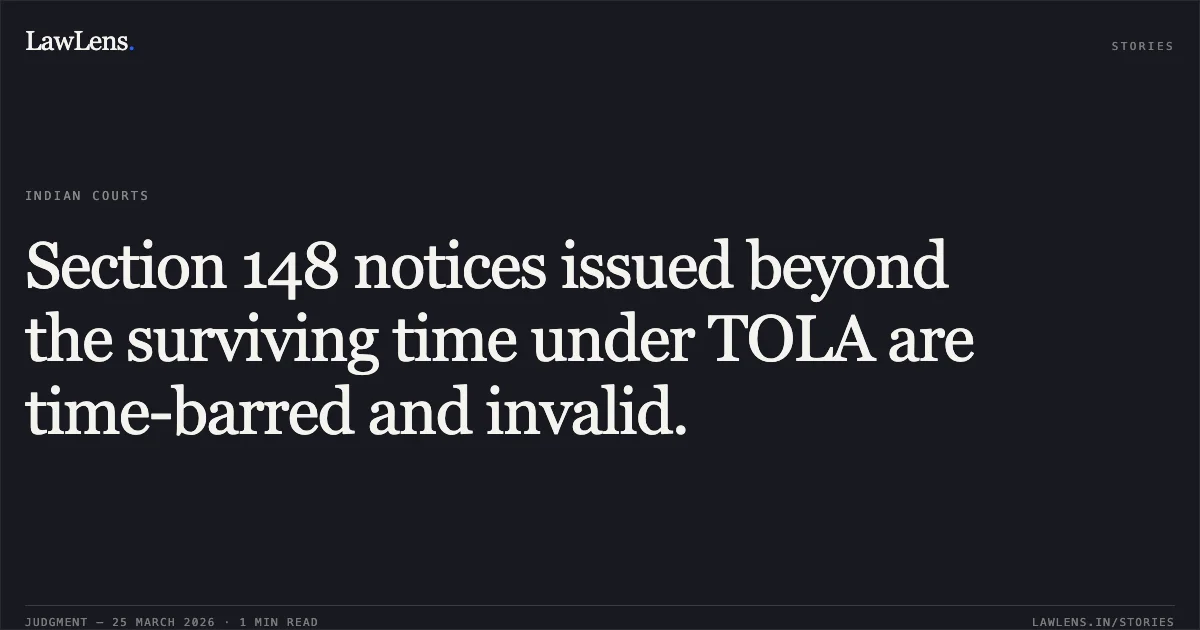
1. Whether the reassessment notice issued under Section 148 of the Act is valid or time-barred under the "surviving time" framework established in Union of India v. Rajeev Bansal.
Source reference: paras. 5, 7Law Applied
The court applied Sections 148 and 148A of the Income Tax Act, 1961, alongside the provisions of TOLA 2020.
Source reference: paras. 2-3It relied on the Supreme Court’s ruling in Union of India v. Ashish Agarwal, which deemed old-regime notices as notices under Section 148A(b) of the new regime.
Source reference: para. 4The court applied the "surviving time" principle from Union of India v. Rajeev Bansal, which dictates that the Revenue must issue reassessment notices within the time remaining from the original limitation period (as extended by TOLA) after excluding the period during which proceedings were deemed stayed by judicial intervention.
Source reference: paras. 5, 9The court also followed its own precedent in Dhanraj Govindram Kella v. Income Tax Officer.
Source reference: para. 6Reasoning
The court calculated the "surviving time" available to the Revenue to issue a valid Section 148 notice.
Source reference: para. 7The original notice was issued on 10.06.2021, and the TOLA extension for that period ended on 30.06.2021, leaving a "surviving time" of 21 days.
Source reference: para. 7Under the Rajeev Bansal framework, the limitation period was stayed from the date of the deemed notice until 15 days after the Revenue supplied the relevant information to the assessee.
Source reference: para. 9In this case, information was supplied on 26.05.2022, and the 15-day response period expired on 10.06.2022.
Source reference: para. 7Consequently, the Revenue had 21 additional days from 10.06.2022—until 01.07.2022—to issue the Section 148 notice.
Source reference: para. 7Since the AO passed the Section 148A(d) order on 20.07.2022 and issued the Section 148 notice on 21.07.2022, both actions occurred after the expiry of the surviving limitation period.
Source reference: paras. 7, 9Holding
The High Court held that the impugned notice and order were invalid as they were issued beyond the surviving limitation period prescribed by the Act and clarified in Rajeev Bansal.
The court allowed the petition, quashing the order under Section 148A(d) dated 20.07.2022, the notice under Section 148 dated 21.07.2022, and all consequential reassessment proceedings.
Source reference: para. 10Rule was made absolute.
Source reference: para. 10Acts & Sections Cited
4 provisions across 2 statutes referred to in this judgment. Linked provisions open on LawLens.
Income Tax Act, 19613
Taxation and Other Laws (Relaxation of Certain Provisions) Ordinance, 20201
Original Court PDF
RAMESHCHANDRA RATILAL BORDIWALA, LHS OF LATE RATILAL DAHYABHAI CHAUHANvsTHE INCOME TAX OFFICER, WARD 1(2)(1), SURAT
Click to open original judgment
Original judgment, available to read, download and summarize on LawLens.in