Facts
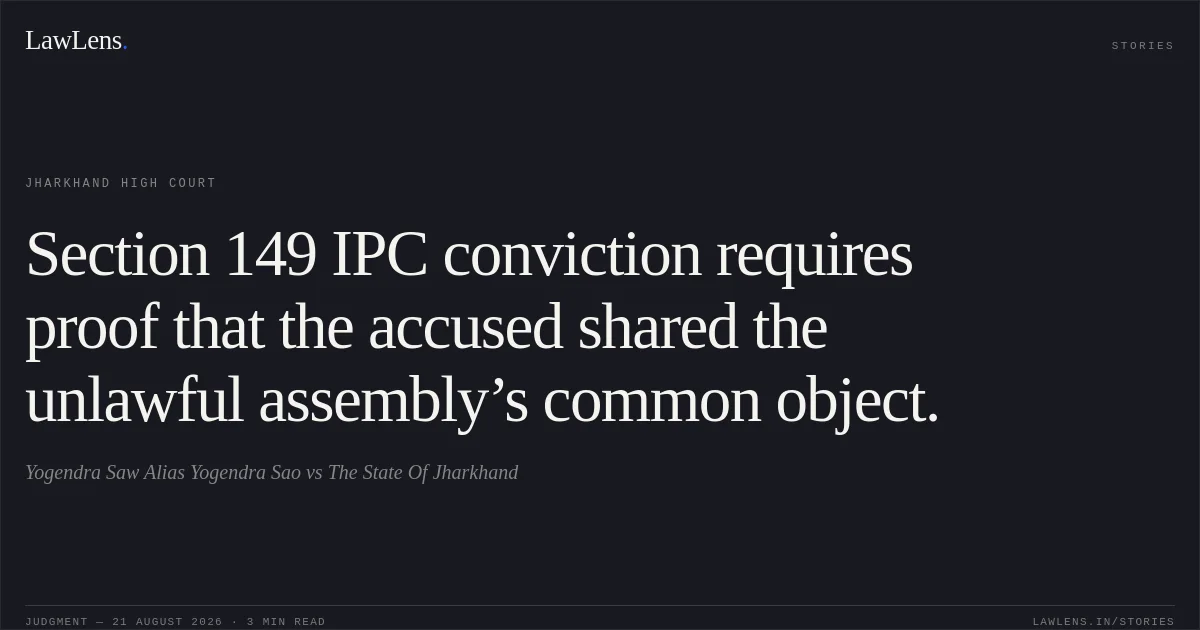
The petitioner, Yogendra Saw @ Yogendra Sao, was prosecuted in Keredari P.S. Case No. 55 of 2010 arising from an alleged disturbance during the proposed inauguration of an NTPC office/residential project at Keredari on 17 August 2010. The prosecution alleged that the petitioner, described as a local MLA, led a crowd that abused and assaulted NTPC personnel, damaged decorative arrangements, and obstructed the inauguration; the FIR was registered under Sections 147, 149, 323, 341, 353, 427, 504 and 506 IPC against the petitioner and other persons
Source reference: paras. 3–4After investigation, charge-sheets were filed against the petitioner and other accused persons, and the cases were amalgamated for trial. The trial court convicted the petitioner under Sections 323/149, 341/149, 504/149 and 353/149 IPC and sentenced him to concurrent terms of imprisonment, including one year under Sections 353/149 and 504/149 IPC. The appellate court affirmed the conviction on 4 April 2016 in Criminal Appeal No. 97 of 2015.
Source reference: paras. 2, 5–6Issues
Whether the concurrent findings of conviction against the petitioner under Sections 323/149, 341/149, 504/149 and 353/149 IPC suffered from an error of law warranting interference in criminal revision?
Source reference: para. 15Whether the prosecution had proved that the petitioner committed any overt act or shared the common object necessary to attract vicarious liability under Section 149 IPC?
Source reference: paras. 12, 18Law Applied
The Court applied Sections 323, 341, 353 and 504 IPC, concerning voluntarily causing hurt, wrongful restraint, assault or criminal force to deter a public servant from discharge of duty, and intentional insult likely to provoke breach of peace, respectively. Section 149 IPC imposes constructive criminal liability upon every member of an unlawful assembly for an offence committed in prosecution of its common object, but such liability requires proof of the unlawful assembly and the accused’s membership, together with the requisite common object or knowledge.
Source reference: paras. 14–18The Court also applied the revisional principle that interference is warranted where the concurrent findings of the courts below are perverse, legally erroneous, or unsupported by the evidence. No judicial precedent was cited in the judgment.
Source reference: paras. 14–18Reasoning
The Court found that the evidence established, at most, the petitioner’s presence at the scene and his identification as the MLA leading or accompanying a gathering. PW-1 stated that the petitioner had not assaulted anyone, while PW-2 alleged that the crowd was led by him but did not attribute a specific assault or other overt act to him. The informant, PW-4, did not identify the accused persons in his examination-in-chief, although he stated in cross-examination that he had been pushed by the petitioner and that the scuffle occurred under his leadership.
Source reference: paras. 16, 18Other witnesses either failed to identify the petitioner or gave evidence inconsistent with the alleged assault, abuse, and obstruction; PW-6 was declared hostile, and PW-7 denied that any such occurrence took place. In these circumstances, the Court held that the prosecution had not established the petitioner’s specific participation or a common object sufficient to sustain liability under Section 149 IPC. It further noted that the person specifically alleged in the FIR to have assaulted the informant, Leeladhar Sao, had been acquitted on the same evidence, whereas the petitioner had been convicted despite the absence of a proved overt act. The concurrent findings were therefore held to be perverse and contrary to the weight of the evidence.
Source reference: paras. 16, 18Holding
The High Court allowed the criminal revision and set aside the judgments of conviction and sentence passed by the trial court and affirmed by the appellate court. The petitioner was acquitted of the charges under Sections 323/149, 341/149, 504/149 and 353/149 IPC.
As he was on bail, he was discharged from the liabilities of his bail bonds, and the sureties were also discharged. Pending interlocutory applications, if any, were disposed of, and the trial court records were directed to be returned to the concerned court.
Source reference: paras. 20–22Acts & Sections Cited
9 provisions across 2 statutes referred to in this judgment. Each provision opens on LawLens.
Indian Penal Code, 18608
Code of Criminal Procedure, 19731
Original Court PDF
Yogendra Saw Alias Yogendra SaovsThe State Of Jharkhand
Click to open original judgment
Original judgment, available to read, download and summarize on LawLens.in