Facts
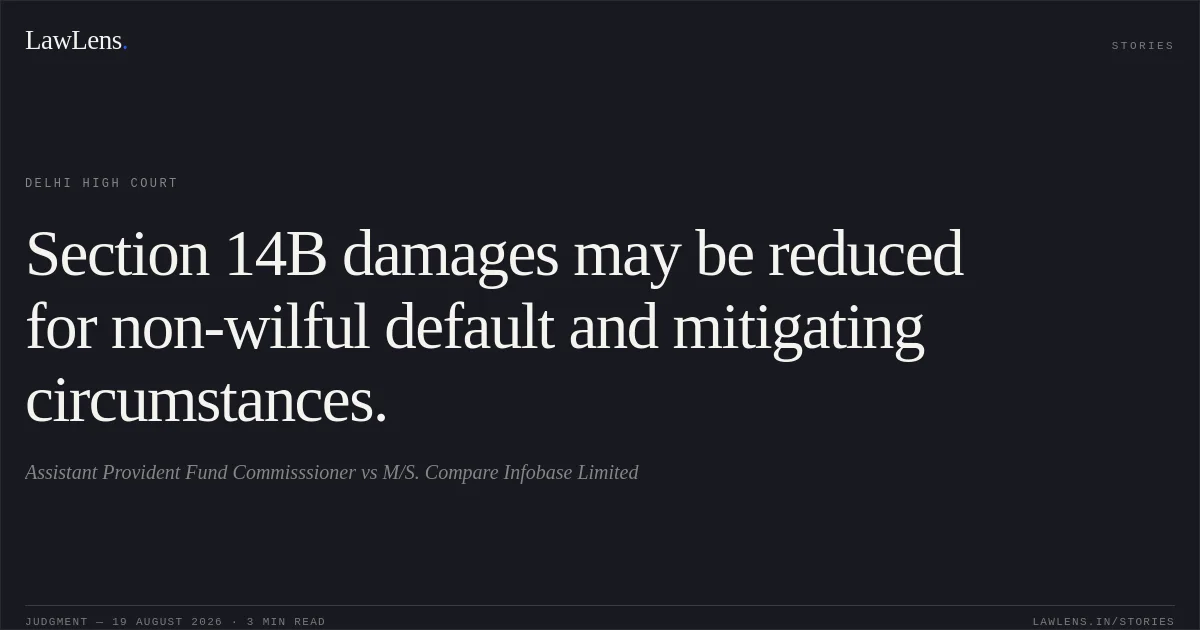
The Assistant Provident Fund Commissioner imposed damages of ₹23,05,515 under Section 14B of the Employees’ Provident Funds and Miscellaneous Provisions Act, 1952 (“EPF Act”), along with interest of ₹11,02,035 under Section 7Q, for delayed remittance of provident fund contributions between March 2008 and February 2014.
Source reference: para. 3The respondent challenged the order before the Employees’ Provident Fund Appellate Tribunal. The Tribunal reduced the damages to ₹5,00,000 while maintaining the liability to pay interest.
Source reference: para. 4The Assistant Provident Fund Commissioner challenged the Tribunal’s order under Article 226 of the Constitution, contending that the damages had been reduced on erroneous considerations and below the amount quantified by the statutory authority.
Source reference: para. 5Despite the passage of several years, notice could not effectively be served on the respondent.
Source reference: para. 2Issues
Whether the High Court, while exercising writ jurisdiction under Article 226, should interfere with the Appellate Tribunal’s reduction of damages under Section 14B of the EPF Act?
Source reference: paras. 6–7, 12–13Whether damages under Section 14B could be reduced on the basis of mitigating circumstances and absence of wilful default, notwithstanding that mens rea is not an essential ingredient for imposing liability under that provision?
Source reference: paras. 8–11Whether the Appellate Tribunal had acted unlawfully or arbitrarily in reducing the damages from ₹23,05,515 to ₹5,00,000?
Source reference: paras. 7, 11–13Law Applied
Section 14B of the EPF Act authorises recovery of damages, not exceeding the amount of arrears, for an employer’s default, while Section 7Q imposes liability for interest on delayed payment.
Source reference: para. 10Although mens rea is not necessary to attract liability under Section 14B, the quantum of damages must depend on the facts and circumstances of each case; the provision has both compensatory and punitive purposes and requires a reasoned, speaking order, as held in Organo Chemical Industries v. Union of India, (1979) 4 SCC 573.
Source reference: para. 10The absence of wilful default and the existence of mitigating circumstances may justify reduction of damages, consistent with Shanti Garments (Private) Ltd. v. Regional Provident Fund Commissioner, 2002 SCC OnLine Mad 704.
Source reference: paras. 10–11Horticulture Experiment Station v. Provident Fund Organization, (2022) 4 SCC 516, establishes that mens rea is not an essential element for imposing liability under Section 14B.
Source reference: para. 9Under Article 226, the High Court reviews the decision-making process rather than reappreciating evidence or substituting its own factual conclusions, as stated in Syed Yakoob v. K.S. Radhakrishnan, 1963 SCC OnLine SC 24.
Source reference: paras. 6, 12Reasoning
The Court held that the Tribunal had passed a reasoned order after considering the respondent’s nature of business, bona fides, the worldwide recession in the IT sector in 2008, the respondent’s financial crisis and irregular cash flow, and the fact that the delay was not wilful.
Source reference: para. 8The respondent had also paid the interest of ₹11,02,035, which supported its bona fides.
Source reference: para. 8While mens rea was unnecessary for establishing liability under Section 14B, that principle did not prevent the authority or Tribunal from considering the absence of wilful default when determining the quantum of damages.
Source reference: paras. 9–11The original authority had failed to address the respondent’s mitigating pleas or explain how the damages had been quantified, whereas the Tribunal had properly considered those factors.
Source reference: para. 11Since no perversity, arbitrariness, or defect in the decision-making process was demonstrated, the Court declined to reassess the factual findings or interfere under Article 226.
Source reference: paras. 6, 12–13Holding
The Court held that the Appellate Tribunal was justified in reducing the Section 14B damages to ₹5,00,000 after considering the respondent’s bona fides, financial difficulties, absence of wilful default, and payment of statutory interest.
No perversity or arbitrariness warranting writ interference was established.
Source reference: paras. 11–13The writ petition was accordingly dismissed, and the pending application was also disposed of.
Source reference: para. 14Acts & Sections Cited
2 provisions across 1 statute referred to in this judgment. Linked provisions open on LawLens.
Employees’ Provident Funds And Miscellaneous Provisions Act, 19522
Original Court PDF
Assistant Provident Fund CommisssionervsM/S. Compare Infobase Limited
Click to open original judgment
Original judgment, available to read, download and summarize on LawLens.in