Facts
Contract labourers complained to the Assistant Labour Officer (ALO), alleging that they had not received revised minimum wages, retrenchment compensation, notice pay, and other settlement dues after their retrenchment.
Source reference: paras. 3–6Following an inquiry and exchanges with the contractor and the petitioner, whom the ALO treated as the principal employer’s representative, the ALO filed an application under Section 15(2) of the Payment of Wages Act, 1936 before the Sub-Divisional Judicial Magistrate, Jajpur.
Source reference: paras. 3–6The application was registered as a criminal complaint case, and the Magistrate took cognizance against the petitioner and contractor on 19 September 2019.
Source reference: paras. 3–6The petitioner challenged the cognizance order under Section 482 CrPC, arguing that Section 15(2) provides a claims procedure, not a criminal offence.
Source reference: paras. 6–9Issues
Whether Section 15(2) of the Payment of Wages Act creates a criminal offence for which the Magistrate could take cognizance.
Source reference: para. 9Whether the ALO’s application should have been handled as a statutory claims proceeding rather than registered and pursued as a criminal complaint case.
Source reference: paras. 8–10Law Applied
Section 15(1) of the Payment of Wages Act provides for appointment of an authority to hear and decide claims arising from wage deductions or delayed payment; Section 15(2) permits an application to that authority for appropriate relief.
Source reference: pp. 6–12Section 15(3) empowers the authority to direct payment or refund and, where applicable, compensation.
Source reference: pp. 6–12Section 18 gives the authority specified civil-court powers, while Rule 11 of the Payment of Wages (Procedure) Rules, 1937 directs the authority to follow relevant CPC procedure, subject to the Act and Rules.
Source reference: pp. 6–12Rules 3, 4 and 8 prescribe the form, authorisation and notice procedure for such claims.
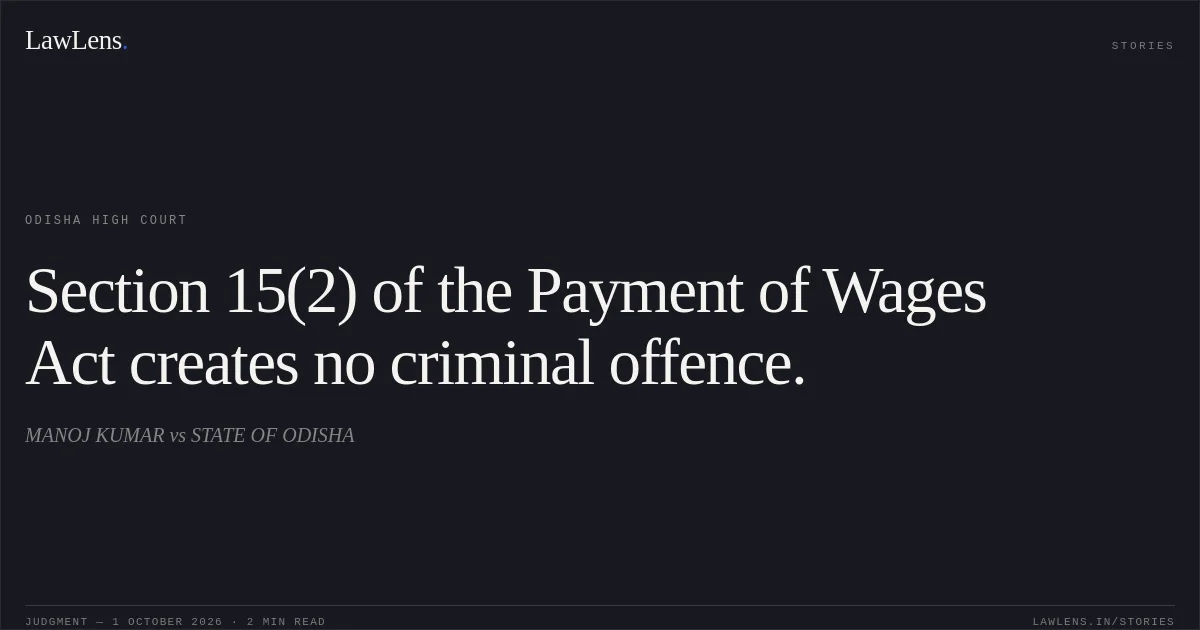
Source reference: pp. 6–12The Court held that Section 15(2) provides a procedure for adjudicating wage claims and does not itself create a criminal offence.
Source reference: para. 9Reasoning
The Court considered the statutory scheme and found that proceedings under Section 15 are quasi-judicial claims proceedings, conducted by an appointed authority using the powers and procedure contemplated by Section 18 and the Rules.
Source reference: para. 8Because Section 15(2) concerns applications for directions concerning wage deductions or delay, and does not create an offence, the Magistrate could not properly take cognizance of an alleged offence under that provision.
Source reference: para. 9The application should instead have been registered as a Miscellaneous Jurisdiction Case and pursued under the statutory procedure.
Source reference: para. 10Holding
The Court held that the cognizance order was legally unsustainable.
It set aside the order dated 19 September 2019 in 2(c) C.C. Case No. 7 of 2019 and granted the opposite parties liberty to initiate the appropriate proceeding in accordance with law.
Source reference: paras. 10–12The Court expressed no opinion on the merits of the workers’ claims or the parties’ substantive contentions.
Source reference: paras. 10–12Acts & Sections Cited
6 provisions across 3 statutes referred to in this judgment. Each provision opens on LawLens.
Code of Criminal Procedure, 19732
Indian Penal Code, 18603
Code of Civil Procedure, 19081
Original Court PDF
MANOJ KUMARvsSTATE OF ODISHA
Click to open original judgment
Original judgment, available to read, download and summarize on LawLens.in