Facts
The petitioner, one of the legal representatives of the deceased original tenant, occupied Shop No. 5175, forming part of property Nos. 5174–5177, Basant Road, Paharganj, New Delhi.
Source reference: no citationRespondent No. 1 filed an eviction petition under Section 14(1)(e) read with Section 25-B of the Delhi Rent Control Act, 1958 (“DRC Act”). After being served with summons, the petitioner filed an application for leave to defend on 30 March 2026, followed by the respondent’s reply and the petitioner’s rejoinder.
Source reference: p.2While the leave-to-defend application was pending for arguments, the petitioner moved an application under Section 151 CPC seeking to place additional identity documents, death certificates, passports, electoral rolls and photographs of the premises and an alleged alternative accommodation on record.
Source reference: pp.2–3The Additional Rent Controller dismissed the application on 6 July 2026, holding that the documents were available or known to the petitioner earlier and could not be introduced after expiry of the statutory period for filing the leave-to-defend application.
Source reference: pp.3–4The petitioner challenged that order under Article 227 of the Constitution.
Source reference: p.4Issues
Whether the petitioner could invoke Section 151 CPC to introduce additional documents after filing the application for leave to defend under Section 25-B of the DRC Act, when the matter had been fixed for arguments?
Source reference: p.6, para. 15Whether the proposed documents disclosed or supported any triable issue warranting interference with the ARC’s refusal to take them on record?
Source reference: pp.6–9, paras. 16–25Whether the ARC’s order suffered from jurisdictional error, perversity or material irregularity warranting interference under Article 227 of the Constitution?
Source reference: p.10, para. 28Law Applied
The Court applied Section 25-B(4) of the DRC Act, under which a tenant must file an affidavit seeking leave to defend within the prescribed 15-day period and disclose therein the grounds constituting the defence; failure to do so may result in the landlord’s pleadings being deemed admitted.
Source reference: pp.3, 6, para. 16Section 151 CPC confers discretionary inherent powers, but those powers cannot be used to circumvent the special and expeditious procedure under Section 25-B of the DRC Act.
Source reference: p.6, para. 16Relying on Prithipal Singh v. Satpal Singh, (2010) 2 SCC 15, the Court reiterated the strict significance of the statutory period for filing leave to defend.
Source reference: p.3; p.6, para. 16It also relied on Madhu Gupta v. Gardenia Estates (P) Ltd., 184 (2011) DLT 103, which held that permitting amendment or supplementation of a leave-to-defend application would undermine the sanctity of the 15-day period.
Source reference: p.3Under Suresh Kumar Kohli v. Rakesh Jain, (2018) 6 SCC 708, legal heirs succeed to the tenancy as joint tenants, and an eviction petition against the heir in occupation is sufficient; impleadment of every legal heir is not necessary.
Source reference: pp.7–8, paras. 19–20Interference under Article 227 is warranted only where jurisdictional error, perversity or material irregularity is demonstrated.
Source reference: p.10, para. 28Reasoning
The Court held that the petitioner’s explanation for the delayed production of documents was vague: he did not state when each document came into his possession, from whom it was obtained, or why it could not have been filed with the leave-to-defend application or rejoinder.
Source reference: p.7, para. 18The identity documents and death certificate were intended to support an objection that all legal heirs of the deceased tenant ought to have been impleaded; however, that objection did not raise a triable issue because an eviction petition against the heir in occupation is sufficient under Suresh Kumar Kohli.
Source reference: pp.7–8, paras. 19–20The photographs of the mezzanine floor merely sought to substantiate a plea already taken in the leave-to-defend application regarding the structure and incorrectness of the respondent’s site plan.
Source reference: p.8, para. 21Similarly, the photographs of Shop No. 5176 and electoral rolls were intended to support the existing defence concerning alternative accommodation and the respondent’s alleged bona fide requirement, rather than establish any subsequent event.
Source reference: p.9, para. 22The pendency of arguments and the absence of prejudice to the respondent did not confer an automatic right to supplement the statutory leave-to-defend pleadings, since Section 25-B does not contemplate successive opportunities to improve the defence.
Source reference: pp.9–10, paras. 23–27Accordingly, the ARC’s discretionary refusal was neither perverse nor legally infirm.
Source reference: p.10, para. 28Holding
The Court answered the issues against the petitioner.
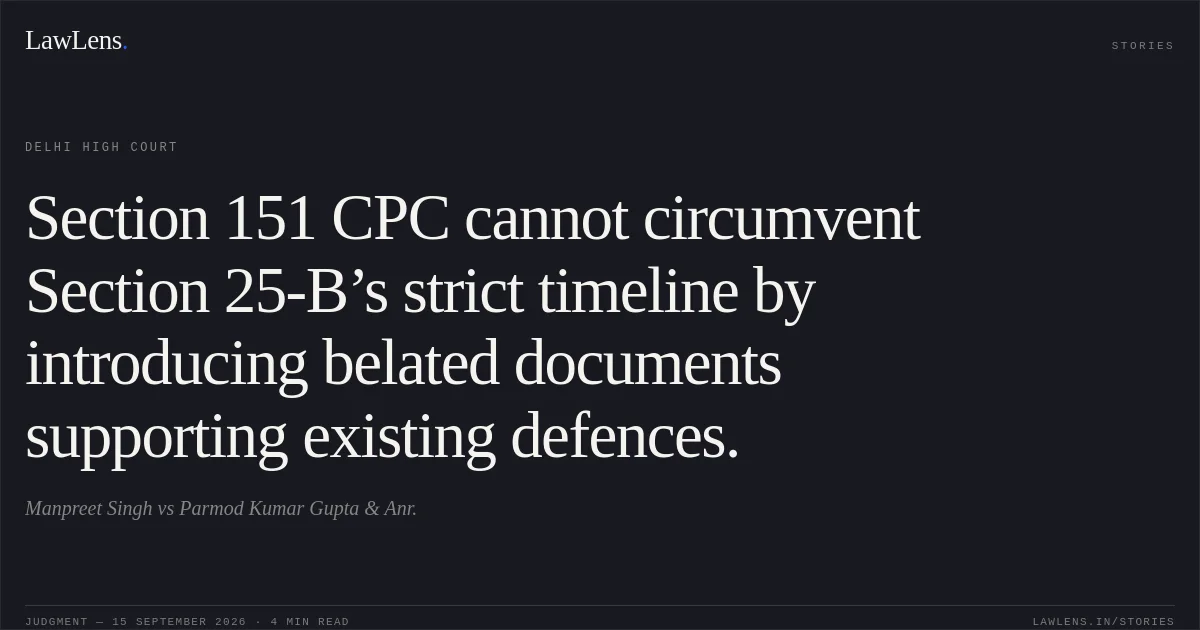
It held that Section 151 CPC could not be used to introduce documents belatedly after completion of the relevant pleadings under Section 25-B of the DRC Act, particularly where the documents were either previously available or merely supported pleas already raised.
Source reference: pp.10–11, paras. 29–32No jurisdictional error, perversity or material irregularity was found in the ARC’s order dated 6 July 2026.
Source reference: pp.10–11, paras. 29–32The petition under Article 227 was dismissed, pending applications were disposed of, and the Court clarified that its observations would not prejudice the merits of the eviction proceedings.
Source reference: pp.10–11, paras. 29–32Acts & Sections Cited
2 provisions across 2 statutes referred to in this judgment. Each provision opens on LawLens.
Code of Civil Procedure, 19081
delhi rent control act, 19581
Original Court PDF
Manpreet SinghvsParmod Kumar Gupta & Anr.
Click to open original judgment
Original judgment, available to read, download and summarize on LawLens.in


