Facts
The appellant challenged the judgment dated 19.09.2025 passed by the Special Sessions Judge (POCSO Act), Champawat, which convicted him under Section 354 of the IPC and Sections 7/8 of the POCSO Act.
Source reference: p. 1-2The prosecution alleged that on 01.02.2024, the appellant intercepted a 17-year-old victim, offered her ₹500 to accompany him into the bushes, and caught her hand when she refused.
Source reference: p. 2An FIR was lodged on 02.02.2024 following the victim’s narration of the incident to her family.
Source reference: p. 2During the trial, the victim deposed that the appellant abused her and threw a ₹500 note into the bushes but did not explicitly testify to the use of criminal force or sexual assault.
Source reference: p. 3, 6The trial court convicted the appellant to four years’ imprisonment based on the victim’s testimony and her prior statement under Section 164 CrPC.
Source reference: p. 2, 8Issues
1. Whether the prosecution established the foundational ingredients of Section 354 IPC and Sections 7/8 of the POCSO Act through reliable substantive evidence.
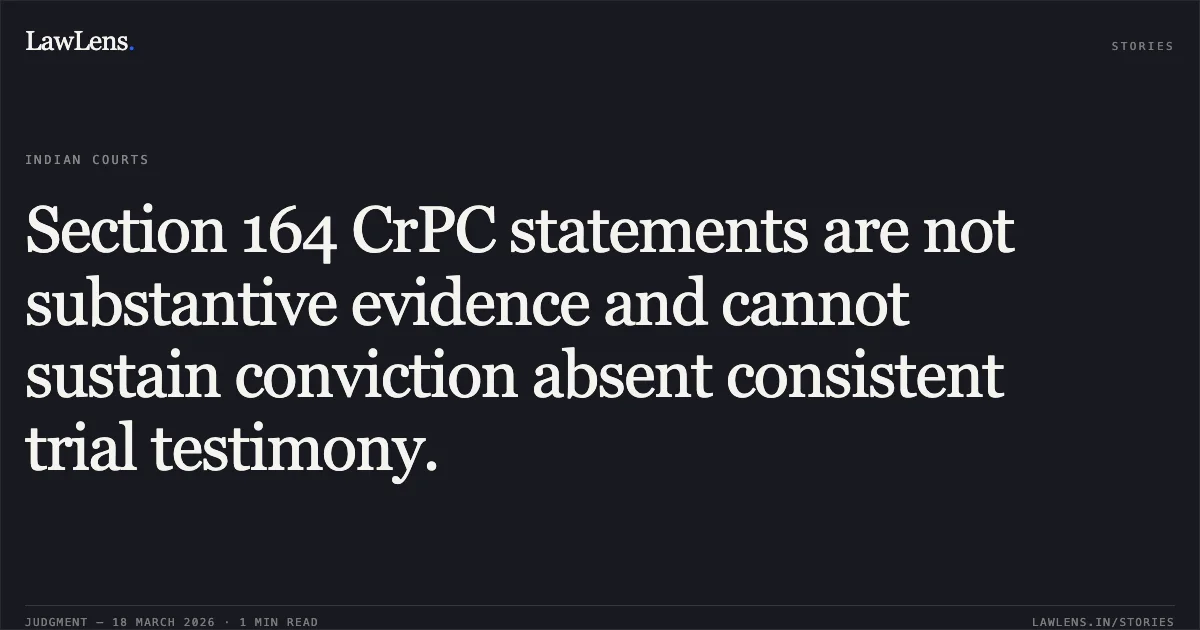
Source reference: p. 3-42. Whether a conviction can be sustained based on a statement recorded under Section 164 CrPC when the victim’s substantive testimony in court materially departs from the initial allegations.
Source reference: p. 4, 7Law Applied
Section 354 of the IPC regarding the use of criminal force to outrage modesty and Sections 7 and 8 of the Protection of Children from Sexual Offences (POCSO) Act, 2012, defining and punishing sexual assault.
Source reference: p. 2A statement recorded under Section 164 CrPC is not substantive evidence and can only be utilized for corroboration or contradiction of the witness.
Source reference: p. 4, 7The burden of proof remains on the State to prove guilt beyond reasonable doubt, and any reasonable doubt arising from inconsistencies must benefit the accused.
Source reference: p. 7Reasoning
The High Court determined that the trial court’s conviction was unsustainable because the victim’s substantive testimony in court failed to support the gravamen of the charges.
Source reference: p. 6While the FIR and Section 164 CrPC statement alleged physical molestation, the victim’s deposition before the court focused only on verbal abuse and the act of throwing currency.
Source reference: p. 6The court reasoned that since the testimony in court is the only substantive evidence, a material departure from earlier statements necessitates strong corroboration, which was absent in this case.
Source reference: p. 7It further noted that the recovery of a ₹500 note did not proves the use of criminal force or the intent required for sexual assault.
Source reference: p. 6-7The court concluded that the trial court placed undue weight on the Section 164 CrPC statement and failed to appreciate that the lack of independent eye-witnesses and the inconsistencies in the victim's court testimony created a reasonable doubt.
Source reference: p. 7-8Holding
The High Court answered the issues in the negative, holding that the State failed to prove the appellant's guilt beyond reasonable doubt.
The court held that where the substantive testimony does not unequivocally support the essential ingredients of the offence, the benefit of doubt must be extended to the accused. Consequently, the appeal was allowed, the impugned judgment of conviction and sentence dated 19.09.2025 was set aside, and the appellant was acquitted of all charges.
Source reference: p. 8Acts & Sections Cited
5 provisions across 3 statutes referred to in this judgment. Each provision opens on LawLens.
Indian Penal Code, 18601
Code of Criminal Procedure, 19732
Original Court PDF
MAHESH SINGHvsSTATE OF UTTARAKHAND
Click to open original judgment
Original judgment, available to read, download and summarize on LawLens.in